Walk Derbyshire – Ashover & Littlemoor via Ashover Rock
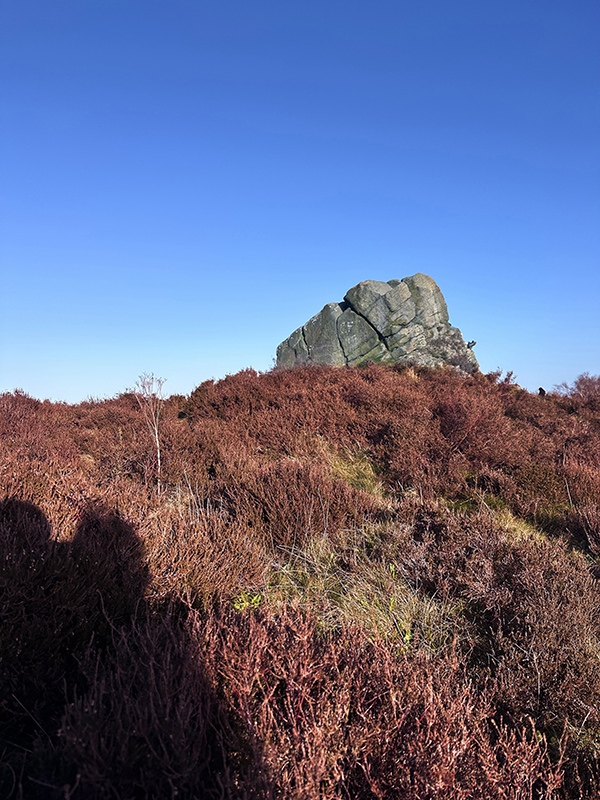
Such a pretty little village with stone cottages, lovely country pubs and stunning walks which feature water and hills with awesome views. Ashover is definitely a walkers paradise and offers nice places for a drink or meal after. This month’s walk features a beautiful view through the heather which should hopefully be out in full beauty about now, a small amount of walking on the road, a walk past Ashover Family Farm which was full of tulips when we did the walk but this changes throughout the year so it’ll be sunflowers in the summer and pumpkins in the autumn. When you get to the top of the hill, where the rock is, here is a lovely opportunity for a picnic and seems a reasonably popular place to watch the sunset. There is one quite steep incline up the road so take your time but it isn’t too far and definitely worth making the extra effort to reach. THE WALK :: THE WALK :: THE WALK You can park on Hockley Lane near the Old Poet’s pub. The village is awkward to park in as it is small. If you struggle to park here then you can use the Village Hall and just walk down to the start of the walk.///obviously.conclude.looms We start the walk just down the little lane to the left of the Old Poet’s pub. If it has been raining this can be a tricky little start to the walk as there are a few rocks and dips so be careful. If it is dry – still be careful but this is only for about 5 minutes. Follow the bridle path all the way down the lane, over the little bridge with the stream and up the steep incline to the top of the hill. No need to rush, take your time and enjoy the view behind you.///beards.bolts.reporting At the top of the hill head straight ahead and follow the track to the road at the bottom. From here we cross straight over to where you will see a footpath. This takes you into the woods for a little while. Hopefully rhododendrons will be out – if they are enjoy! Carry on until you exit the woods and you will be in the old quarry now. From here you need to head to the path which will take you downwards. You will notice a large disused chimney so you will know if you are going in the right direction.///blogs.wheels.handbags Again, if it has been really raining, this section of the walk will be very muddy and quite slippery underfoot so be careful. You will come out to a farm house on the right hand side. Carry on straight left down the road. You will usually see the beautiful belted Galloway here in the fields. We now walk onto Gin Lane and from here we are just a stones throw away from Milltown. If you are in desperate need of a drink at this point then from here head right to the pub which is open 12-3pm most days. We now walk past the side of the river. Have a little paddle if it’s hot. When you come to the end of the path, there is a bridge over the river and we end up on the road for a short distance. Turn left and head along the road until you see a little path slightly to the left which starts to head up in-between peoples gardens.///simmer.useful.divider When we reach the top of this path we head across Hockley Lane – be careful as it is a fast road but not particularly busy! Just past the couple of houses on your left you will see a footpath sign on the opposite side of the road up a couple of steps. Head up here and you will go past the quarry on your left hand side. From here follow the lane all the way for a few minutes. You will come out onto a road. Keep to the side as this again is a fast road but we literally need to walk 100 yards or so and you will see Eastwood Lane to your right. This is where Ashover Family Farm have the huge field to the left so hopefully you will see something beautiful growing here. We past a field with a herd of gorgeous sheep on the right which were really friendly. We start to climb up now, so again, take your time. We head all the way up to the top of the lane. This now takes you through the village of Littlemoor. What a sweet village. You can from here see views of Ogston Reservoir in the distance. Carry on along the lane and you will see the road eventually goes off to the right. Here we head straight ahead which is now Milken Lane. ///waxing.proceeds.scorpions From here you will find a footpath to the right which is going into the trees and moorland. This is now Fabrick Wood where another beautiful viewing point awaits. Head to the top for yet again another beautiful picnic spot. Enjoy! Just past the rock you will be able to see the village of Ashover down to your left. You will see a path heading down, this is the one we are taking. You will end up on a lane again and will then turn right and head down through a tunnel ///renews.credible.cleanest and into a field. Cross the field to the right hand side. You will come out at the Black Swan in Ashover. Grab yourself a swift pint and some pork scratchings! Then head down through the village to where you parked your car. There is a really cute little village shop here selling ice cream, lovely home made cakes and other items. I still believe it is cash only so please support local businesses and take some cash with you. INFORMATION Parking: Roadside along from the Poets Corner
Celebrity Interview – Mark & Lard
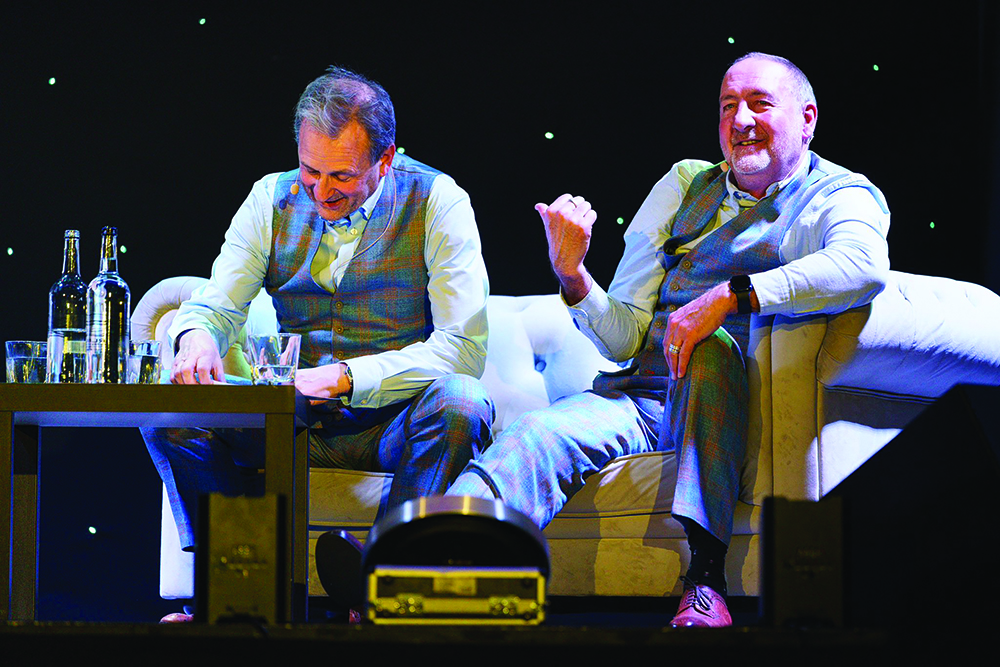
by Steve Orme Mark Radcliffe and Marc Riley presented various weekday shows on BBC Radio 1 from 1991 to 2004. Now they are on the road with their show Carry On – An Evening With Mark and Lard which is basically a series of clips from their afternoon programme. They will stop off at both Buxton and Nottingham over the next few months. Mark and Lard, both northerners, first teamed up in 1991. Radcliffe was a radio producer who began presenting specialist shows. Riley, formerly a guitarist with post-punk band The Fall, was a record plugger and tried to get Radcliffe to play his records. Radcliffe eventually took on Riley as his sidekick. Marc reckons getting kicked out of The Fall was the best thing that’s happened to him in his working life. “Being in The Fall was quite hard work. It was an honour and a privilege and I absolutely loved the band. But if I hadn’t got kicked out, then none of the rest of the things that have happened to me over the last 30 years would have happened. “The Fall was a massive thing for me. I’m still very proud of it but if I’d been in there for 20 years I think I would have been an emotional and nervous wreck instead of being on the radio to ten million people.” When Mark and Marc presented Hit The North they were allowed to play their own choice of records. They were snapped up by Radio One and given “the graveyard shift”, as it’s known in the industry – broadcasting from 10pm until midnight. Again they picked all the music which featured the likes of Oasis, Blur and Nick Cave. That led to their being given the breakfast show on Radio 1 after the departure of Chris Evans. They lasted only eight months – the shortest of any presenter in that time slot. “It was a massive culture shock,” says Marc, “because not only was the audience massive and not really used to us, we weren’t used to working at that time of day. It was awful for everybody. “We also had to play nothing but anodyne music that we didn’t like at all. It was a well-paid job, the profile was very high but we failed. “Then we went to the afternoon show which was hugely successful which is how we’re in the position now to be able to tour the country and get big audiences who basically want to see the afternoon show. The tour has to fit around the anarchic duo’s other work. Mark Radcliffe presents the Folk Show on Radio 2 on Wednesdays and a two-hour show with Stuart Maconie on 6 Music on Saturdays and Sundays. Marc Riley hosts an evening show on 6 Music from Monday until Wednesday which features sessions by artists that he chooses. Their live show has proved popular, with several dates selling out. “We start the show off by recounting the fact that we’re treading the same boards as Laurel and Hardy and Charlie Chaplin,” says Marc. “It’s mind-blowing really, an absolute privilege to be able to play those places.” Mark Radcliffe tries to put his finger on how the live gig works: “It’s not a resumption of the show, it’s the resumption of a friendship between Marc and I which isn’t to say we fell out. “We went on our separate paths for a long time but what we’re doing live is more akin to conversations we would have off air and in the pub.” Marc Riley adds his thoughts: “You don’t need two people to present a radio programme – it’s just largely music. But the relationship we had on air was largely about making each other laugh. “That’s what the audience are coming back to see and hear. A lot of them know the clips that we play in, they’re aware of the characters and the punchlines but they still laugh like an open drain at the end of it. We’re having a good laugh. Not every show is the same.” As well as presenting, Mark and Lard created a spoof rock band called the Shirehorses who released two CDs. Mark turned down Marc’s suggestion that they should resurrect the band – but when Marc pointed out it was the 20th anniversary of Mark and Lard’s last show, they agreed to do a couple of gigs. It soon became clear there was a big demand for their live show. So why has it taken them 20 years to stage this tour? Mark Radcliffe points out they were doing other things. When they started Mark was single while Marc Riley was married but didn’t have children. “We were very different people then in a different world,” says Mark. “We went to the pub and talked about things and made each other laugh. By the time the show finished I was married, we both had children and we didn’t live as close to each other. “I got to the point where I didn’t want to do it any more. You change as a person. A new Mark and Lard show could only be disappointing for fans of the old one. A lot of it was stupid and puerile. “We started together 30 years ago. I just don’t think it’s credible for two blokes in their sixties to be those people. “It’s a very different thing going on stage and talking about it in retrospect. Looking back and celebrating it, we do call the show an exercise in celebration, nostalgia and pension pot enhancement. That’s honest but accurate.” Mark Radcliffe will turn 67 at the end of this month and Marc Riley is 63. Neither is worried about the BBC being ageist and getting rid of them. “I don’t think you could accuse Radio 2 of being ageist,” says Mark. “Tony Blackburn’s on and he’s in his 80s. “I’ve been working in radio since 1979 so I can hardly complain about anything. “Mark and Lard
Derby’s Iconic Market Hall is Back
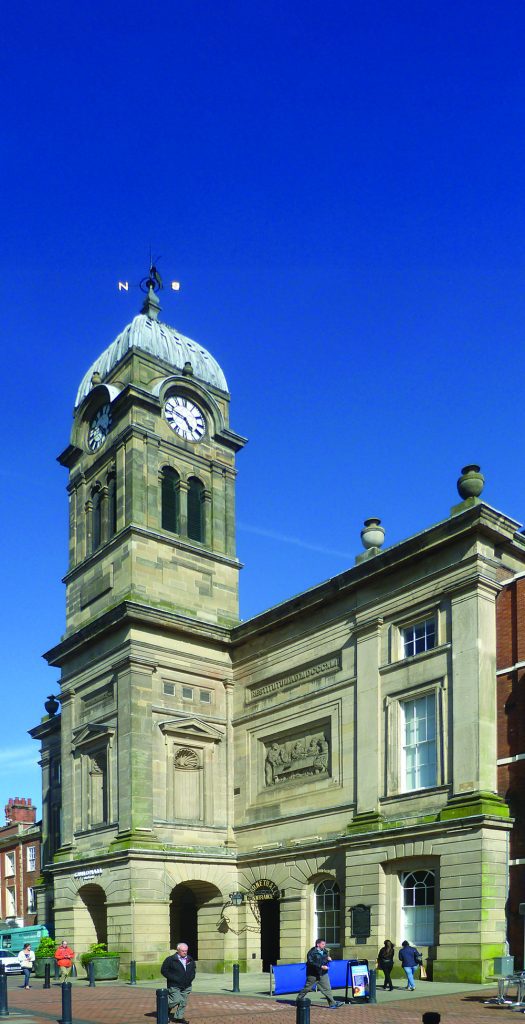
by Maxwell Craven “The design that emerged and which Thorburn built from 1863, centered upon an impressive covered hall with an iron roof made by local founder, J. & G. Heywood & Co. at their Phoenix Foundry, which covered an area of 220 x 110ft.” From Medieval times, Derby was a flourishing market town. Indeed, the Saxon mint established in the 10th century and which produced silver pennies until 1154, had more moneyers and a greater output of change than that of Nottingham, suggesting in the terms of trade, Derby then outstripped its easterly neighbour. Derby’s markets were scattered: livestock was sold at the widest part of Friar Gate between Bridge Street and Brick Street, grains were sold in the wide part of Corn Market (the clue is in the name) and most other things were sold in the Market Place, where there were areas set aside for bakeries, butcher’s stalls and other items, mainly under the control of the Abbot of Darley. By the early 19th century these arrangements were considered insufficient, and when a new Guildhall was commissioned by the Derby Improvement Commissioners from London architect Matthew Habershon (1789-1852) in 1828, a covered area of stalls was provided behind the building. This elegant Greek revival building was stone faced at the Market Place side, but largely brick to the south. Unfortunately, Habershon’s Guildhall burnt down rather spectacularly on the evening of Trafalgar Day 1841, taking most of the Borough’s precious records stored within, with it. Henry Duesbury, grandson of the founder of the China factory, was commissioned to build a replacement, which incorporated much of the ground floor of its predecessor, and much of the entire east elevation which was glimpsed from the Market Hall or Lock-up Yard. The original market area behind managed, miraculously, to survive unscathed. However, by the 1860s, even this area was considered to be inadequate and a decision was taken to clear it and build anew. The Borough engineer at the time was a Stranraer-born Scot, Thomas C Thorburn, who developed a detailed specification, before subcontracting the design to Manchester architect James Stevens (1826-1902). The design that emerged and which Thorburn built from 1863, centered upon an impressive covered hall with an iron roof made by local founder, J. & G. Heywood & Co. at their Phoenix Foundry, which covered an area of 220 x 110ft. (67 x 33.5m). The roof span soared to 86ft 6ins (26.4m), with an apex at 64ft (19.5m). Much of the engineering concept of the roof and the galleries which ringed the space was, for the time, innovative, and it was all opened to much acclaim in Spring 1866. The exterior is of brick and rusticated ashlar with a fairly restrained (for the era) Classical pedimented facade to the south, facing Albert Street and Osnabrűck Square. It is now listed grade II. Market Hall, Thornburn’s Sketch 1862, showing a much more elaborate building However, all was not well. The original opening was planned for 1865, but Thorburn suddenly resigned and very promptly departed for a new post elsewhere. His local successor, George Thompson (1833-1882), was disconcerted to find there was an inherent weakness in the iron structure, to remedy which he was obliged to come up with solutions. Thus, a scheme of remedial works and necessary alterations was undertaken in some haste to prevent the entire structure possibly descending on everyone’s heads at the planned grand opening. The structural defects thus revealed were, of course, blamed on Stevens, and on the departed Thorburn for sub-contracting the job in the first place; the real reason was that in those days the consequences of radical design could not be tested by computer modelling, and occasionally trial gave way to error. The Council spent much time and money pursuing both Stevens and Thorburn for redress, for no blame could be apportioned to the iron founders – especially as James Heywood, proprietor of the Phoenix Foundry, was an alderman of the Borough! The southern façade of the building was marred in the early years of the 20th century by a rather crude cluster of buildings constituting the fish and poultry markets, built on the site of William Strutt’s fireproof calico mill ironically burnt down in 1853. This fish market was an extension of that provided by Stevens and Thorburn in 1863 as part of the original build. A large turret clock was supplied by leading Derby clockmaker Edward Johnson, for the south gallery, but this was inexplicably removed in 1988 but, fortunately, was rescued and donated to Crich Tramway Museum when the building was completely refurbished and extended eastwards, with a new very elegant brick facade. The interior was originally fitted with stalls, the design of which was altered in the 1930s, when Herbert Aslin, the Borough Architect, designed new ones in the manner of the period, and these lasted until the 1988 rebuilding, when they were replaced by rather less pleasing ones. The hall was re-opened by the Mayor, Cllr. Les Shepley in the same year, an event commemorated in a ground glass inscription etched into the new glass doors giving onto Osnabrűck Square. The Market Hall closed to enable the current refurbishment to begin getting on for a decade ago now, but the Council failed to make any viable arrangements for the poor old stallholders – some of whom had been in business there for more than two generations – and this had led to misgivings that the Council would not be able to replicate the relaxed and positive ambience of the place as it had been previously. There have been delays and disconnected progress, but thankfully the Iconic Market Hall is finished. Now begins a new era for this grand building and for the city of Derby. Of course, the proof of the pudding will be in the eating! Maxwell Craven 00
The Art of Conservation
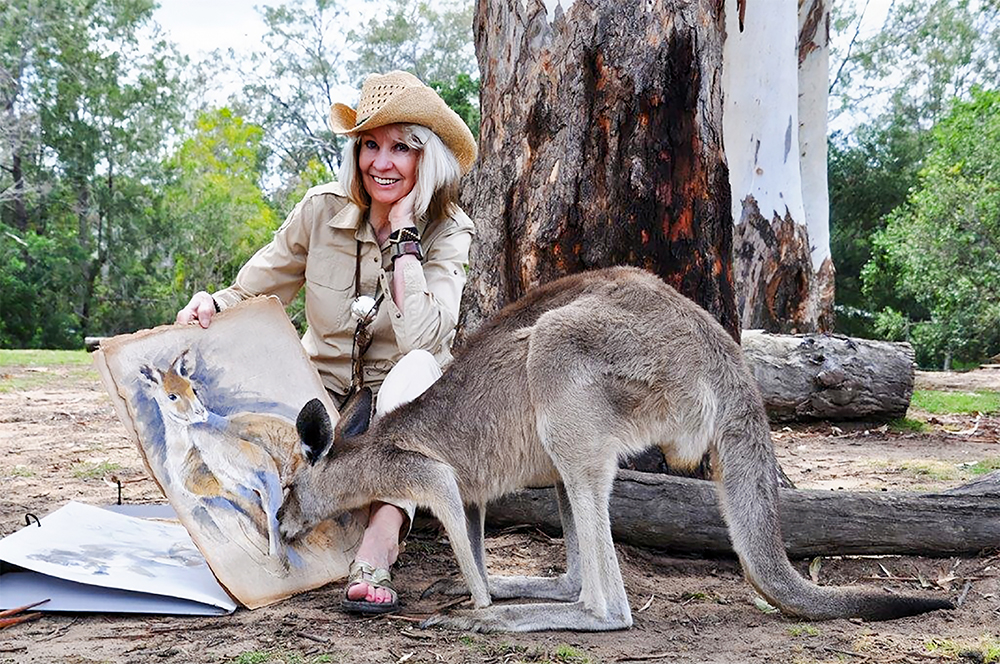
Around 70km north of Hanoi, Vietnam a beautiful Asiatic moonbear stretches to his full height and climbs up onto a high platform to examine a fresh bunch of wild grasses, leaves and branches. But for the first seven years of his life, this bear had spent his days in a dark cramped cargo container on an illegal bile farm in the south of the country undergoing the unending torture of regular bile extraction through an open wound in his abdomen. His rescue and relocation to the beautiful safe surroundings of the Animals Asia sanctuary was made possible through a Foundation established by one of Derbyshire’s best loved wildlife artists. In countries across Asia, thousands of bears live a life of torture on bear farms, so that their bile can be extracted and used in traditional medicine to cure ailments. Bears are confined in cages which vary from agonisingly tiny “crush” cages to larger pens, all of which cause terrible physical and mental suffering. When Pollyanna Pickering established her charitable Foundation in 2000, it was with the original fairly modest intention of raising funds to purchase equipment for small wildlife rescue centres and sanctuaries rehabilitating British wildlife. She never imagined that a decade later her funding would allow a moonbear to be released from a life of torture – or that to this day her Foundation would be helping to fund conservation projects from Bhutan to Belize. This summer the 25th anniversary of the Foundation is being celebrated in an exhibition to be staged in her private gallery at Brookvale House Oaker Matlock Derbyshire DE4 2JJ (AA Signposted) from 21st – 29th June (Admission Free). Visitors will be able to view over fifty original paintings – many of which will be on display to the public for the very first time – in a relaxed and comfortable atmosphere. The gallery will also be welcoming a very special guest – ‘Longarm’ – a life sized sculpture of a brave and inspirational orang utan created by the award winning wildlife sculptor Casey Nadine Banwell. Pollyanna’s work as a wildlife artist always brought her into close contact with the animals she loves. Many years ago she began to visit wildlife sanctuaries in the UK to sketch and paint the creatures in their care – and became increasingly interested in the work they were carrying out. She became a licensed registered keeper to care for and rehabilitate injured and orphaned raptors, but soon discovered people would bring any wildlife in need of help to her door! This hands on work was sometimes challenging, but also very rewarding – and Pollyanna felt it was her way of giving something back to the birds and animals who made it possible for her to earn her living as a wildlife artist. All the birds and animals she cared for were rehabilitated into the wild, unless too badly disabled to survive independently in which case they were given a home with her for the rest of their natural lives. Pollyanna funded the hospital – including the treatment, medical supplies, feeding and rehabilitation work entirely through a percentage of sales of her artwork. Eventually after fifteen years of hands on care, she had to make the difficult decision to scale down the sanctuary. Her increasing success in the art world was taking her away from home for ever-longer periods of time, and she was unable to secure permanent expert help to care for the patients. However she was determined to find a way of carrying on her conservation and rescue work with wildlife, and the Pollyanna Pickering Foundation was established. With Pollyanna’s daughter Anna-Louise as president, The Foundation continues in its original aim to help British wildlife in need. However Pollyanna always believed that in order for her to fully capture the realism of her subjects it was vital to study and sketch them in their natural habitats, and so she has travelled into some of the most remote and inhospitable parts of the world, to study and paint endangered species in their increasingly fragile habitats. She witnessed first hand the huge impact we have had on the natural world, primarily through destruction of habitat and poaching of endangered species. The Foundation’s scope widened to raise funds for the protection and rescue of wildlife worldwide, and has helped to protect Rhinos in Africa, Wolves in Ethiopia, orphaned polar bears in the arctic, and build a tiger orphanage in Nepal. Major campaigns have helped to fund construction of enclosures at Born Free’s big cat sanctuaries in South Africa and Ethiopia and purchased equipment for Project Tiger’s anti-poaching rangers working in India. Through exclusive adoption programmes, the Foundation supports a wild cheetah relocation programme in South Africa, the care of Giant Pandas in China, and the rehabilitation of orphaned wild dogs in Namibia. Most importantly the Foundation never forgets the individual animal – Pollyanna’s work has helped fund the rescue of lions from a Romanian Zoo and their subsequent transfer to the Born Free sanctuary in South Africa – and of course the Foundation has committed to funding the care of Polly Bear in the Animals Asia sanctuary for the rest of his natural life. “It is an honour to continue Pollyanna’s legacy through the Foundation” Anna-Louise told us “Through the funds we raise at the exhibition, alongside our annual prize draws and the talks I give to societies all around the UK we are able to continue our work world-wide – in the past few years we have been helping to protect Jaguars in Brazil, Snow Leopards in the Himalayas and Lions in Kenya.” Two new limited edition prints will be launched at the anniversary exhibition. Also on display throughout will be Pollyanna’s extensive range of books, greetings cards, fine art and limited edition prints, and a wide variety of gift ware featuring her work, including brand new card crafting kits as launched live on television! A sneak preview of next year’s charity cards will also be
Lost Houses of Derbyshire – Old Radburne Hall
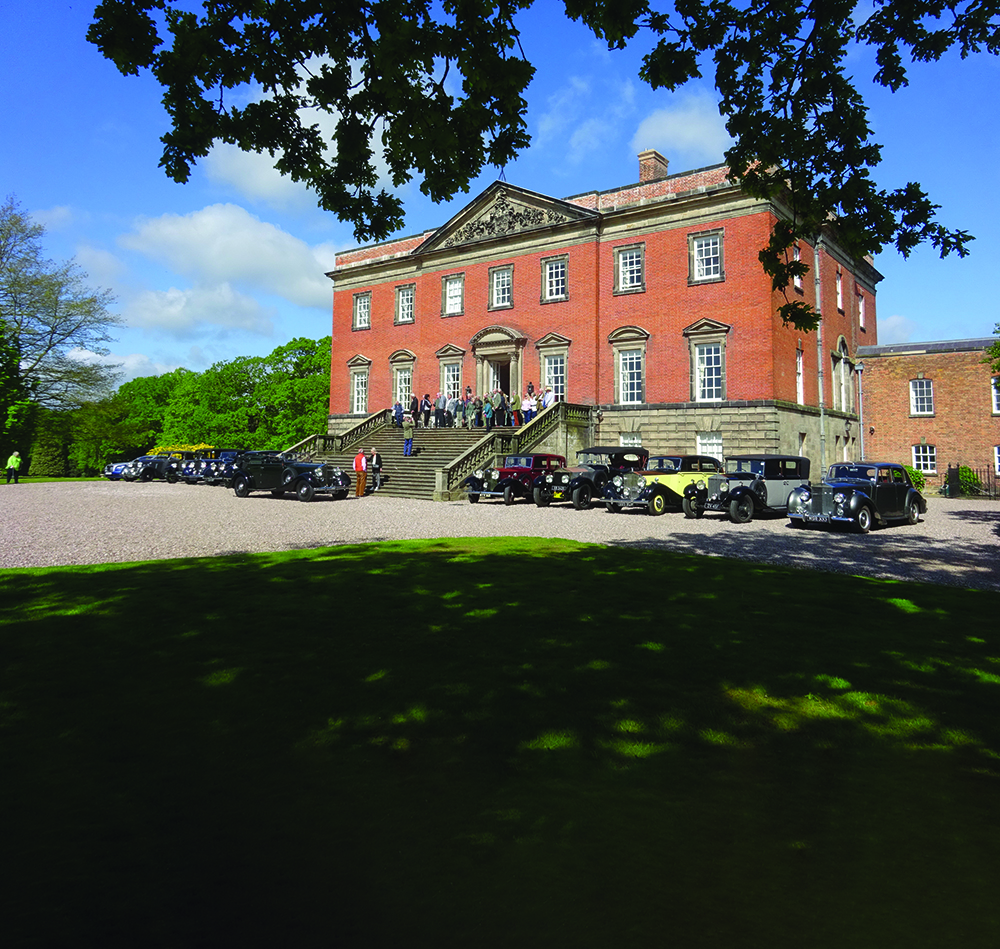
By Maxwell Craven One of the most delightful, sequestered and ancient parish churches in the county is that of St. Andrew, Radbourne, set beside the Radbourne Brook (effectively a tautology: the clue is in the name, the ‘red bourne’, or stream) in a hamlet which hardly seems to exist, despite being barely four miles from Derby. It is well hidden from the unfrequented road, although well signposted. As you descend the path to the church you can see across a broad pasture to the brook and the ridge beyond, atop which stands the fine Georgian mansion that is today’s Radburne Hall (the spelling differs from that of the settlement, by hallowed tradition), although it is slightly beyond one’s eye-line. The pasture itself is full of strange hollows, and was originally the site of the first known houses on the site. Radbourne is one of those rare landed estates: one that has never been sold since its first recorded owner obtained it. It has, however, passed via an heiress four times since its first record, the first three in the Middle Ages, the fourth currently, but the blood of the first recorded tenant, Wakelin de Radbourne – who is on record for 1100, but was almost certainly the 1086 (Domesday Book) tenant – still flows in the veins of the incumbent family. Who exactly Wakelin was is not clear, although it has been suggested that he was reasonably close kin to his overlord, the tenant in chief, Henry de Ferrers, lord of an hundred Derbyshire manors, other members of whose family certainly used the name. The monumnet to Sir John, now at Mazerolles The grandson of Walkelin left no son but a daughter and heiress, who married John de Chandos who was of a minor gentry family from SW Herefordshire, Chandos being a locality in Much Marcle parish in that county. John’s great-great-grandson was Sir John Chandos, KG, the great hero of the Hundred Years’ War, Constable of Aquitaine and Seneschal of Poitou, created by Edward III Viscount St Saveur-le-Viscomte in the Contentin in 1360. Sir John, born around 1320, was a close friend of the heir to the throne, Edward, the Black Prince and, in 1348 joined his patron in being nominated one of the first ever Knights of the Garter. Described by the medieval historian Froissart as ‘wise and full of devices’, as a military strategist, Chandos is believed to have been the mastermind behind three of the most important English victories of the Hundred Years War. He was chief of staff to the Black Prince at the Battle of Crécy in 1346, was a leading commander a decade later at the Battle of Poitiers and also in the Battle of Auray, in the War of the Breton Succession in 1364, following which his commander, John Duke of Montfort, was able to succeeded as John IV, Duke of Brittany. In addition to his other honours, Chandos was created the lieutenant of France and vice-chamberlain of England. In 1369, the French launched a successful counter-attack, regaining much territory and forcing Edward to recall the retired Chandos, who attempted to deal with the French attempts to regain a foothold in Poitou, of which he was made governor. In a skirmish following an unsuccessful attempt to re-take St. Savin, Chandos met the French on the bridge at Lussac. In the ensuring melée, Chandos’ long coat led to him slipping on the frost. James de Saint-Martin, a French squire, struck Chandos with his lance, piercing his face below the eye although Chandos’ uncle, Edward Twyford of Kirk Langley, standing over his wounded nephew, repulsed the attack. The wounded Chandos was carried on a large shield to Monthemer, the nearest English fortress, but died, unmarried, in the night, either on the 31st December or the early hours of New Year’s Day 1370. Sir John Chandos as Knight of the Garter, 1348 from the Bruges Garter Book Such was Sir John’s reputation that Charles V (‘the Wise’) of France is reported to have said that ‘had Chandos lived, he would have found a way of making a lasting peace’ although French chronicler Jean Froissart was more circumspect, saying ‘I have heard him at the time regretted by renowned knights in France; for they said it was a great pity he was slain, and that, if he could have been taken prisoner, he was so wise and full of devices, he would have found some means of establishing a peace between France and England.’ He added of Chandos that ‘Never since a hundred years did there exist among the English one more courteous, nor more full of every virtue and good quality.’ He certainly comes across much in the heroic mould of those other two hammers of the French, the Dukes of Marlborough and Wellington, although his reputation lost nothing in having been killed in battle. The estate passed to Sir John Lawton, married to one of Chandos’s sisters, although the loss of the original patent creating Sir John a Viscount means that no one is sure whether it was remaindered to his sisters and their issue, failing any heirs of his body, or not. As a French title, albeit granted by the King of England (but as King of France), this may well be true, meaning that Lady Chichester might well be Viscountess de St. Sauveur. Certainly, his heiress brought all his property to her husband to Sir Peter de la Pole from Cheshire. The Poles, too burgeoned mightily once ensconced in the county, for younger branches settled at Kirk Langley, Barlborough and in a moated house north of Hartington, now marked by a farmhouse called Pool Hall; one of this latter branch, John Pole, became the outlaw after whom Castleton’s Poole’s Cavern was (phonetically) named. Nevertheless the Radbourne Poles have been there ever since, although they assumed the additional surname of Chandos in the Regency period as homage to the enduring renown of Sir John. At Radbourne Sir John is reputed to have had a ‘mighty large howse of
English Wine Project – Award winning wines from Derbyshire
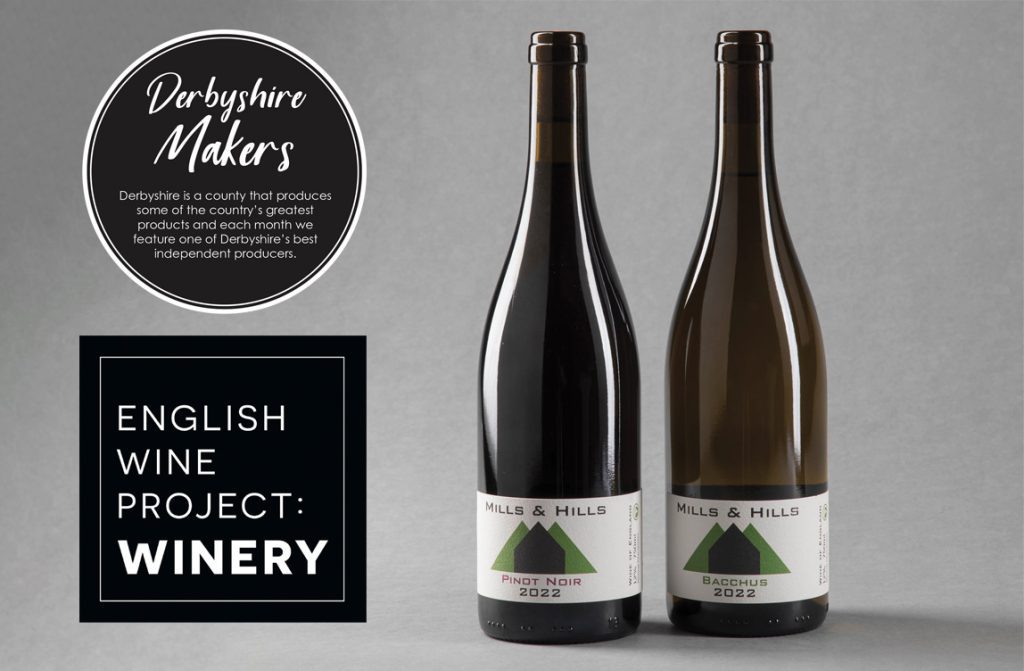
Derbyshire is a county that produces some of the country’s greatest products and each month we feature one of Derbyshire’s best independent producers. It’s just getting interesting again for Darley Abbey based wine maker, Kieron Atkinson. After a couple of weeks of ‘quieter’ times post-Christmas, Kieron’s gearing up for the announcement of the latest international wine award. This time it’s him up against some global winemaking ‘heavyweights’ from the southern hemisphere, competing for the coveted Wine Maker of the Year award, chosen by Naked Wines. If Kieron wins, he will be the first ever English wine producer to earn the accolade. After over a decade of winning multiple awards for his wines, you might think they become less special over time…? “Absolutely not!” Kieron clarifies; “every award I am nominated for is special to me and each time I win an accolade for the wine I produce, I feel really proud of what I’ve been able to achieve from here in Derbyshire; not the usual place you would expect to see an award winning winery!” Kieron left the army in 2010 after serving tours in Iraq and Afghanistan, deciding to start a totally different career in wine production and vineyard management. After graduating from Plumpton College to gain a second degree, he hasn’t stopped. The English Wine Project was established to allow Kieron to produce the best possible English wine, made from grapes grown here in Derbyshire at the historic and wonderfully atmospheric Renishaw Hall Estate in North Derbyshire. Kieron conducts vineyard tours in the spring to autumn months which visitors love as well as running courses in grape growing, pruning and the annual harvest. “We have lots of fun harvesting. It really is what the wine growing year is all about,” Kieron explains. “Seeing people getting stuck in to harvest, hauling juicy grapes into crates and enjoying the fruits of their labour all together is great to experience.” There are also tours of the urban English Wine Project Winery throughout the year, based in the attractive mills at Darley Abbey on the edge of Derby. On a winery tour, visitors see the process of wine making up close; enjoying tasting multiple wines, and ciders (also an award-winning venture of Kieron’s) which can be paired with foods and – sometimes – live music. The rustic yet urban setting of the winery, on the banks of the River Derwent as it flows towards Derby city centre, is really unique. “We really enjoy people dropping in to see us for a glass or bottle of wine by the river and the tours are great fun. People find out so much about the science behind wine, but also they come away having tasted delicious wines made right here by grapes that haven’t travelled far. We make a truly English product about which we should be really proud!” states Kieron. The range of English Wine Project wines include: Renishaw Hall Vintage Cuvée white and pink – Trophy medal winning – traditional method sparkling wine. Renishaw Hall Walled Garden White, Rosé and Red – A real hero wine range for us that sells out almost as soon as it’s in a bottle. Mills & Hills Bacchus and Pinot Noir – Mills & Hills is my own best of English label. For these wines I am working with the best growers in the UK, from the increasingly famed Crouch Valley in Essex through to Worcestershire. Kieron started producing cider in 2020 and now has four ciders in the range under the labels; Even Cider, King and Queen of the Orchard and soon to be joined by Buck Cider. These ciders are proving to be successful with pubs, deli’s and farm shops across the region. “At the winery we offer a totally distinctive experience for birthday parties, group tours, work events or simply get-togethers with friends, where you want to enjoy your own private space doing something special and memorable. People always have loads of fun and enjoy quality drinks at the same time as learning something new about wines, ciders and their production. We’re always happy to deliver orders to customers’ doors,”describes Kieron. So, as Kieron waits to hear on this latest global wine award, he’s busy down at the winery, preparing the 2023 wine for their next step ready to be released – and relished – in early summer 2024 To order award winning English Wine Project wines and ciders produced entirely by Kieron, visitwww.englishwineproject.co.uk 00
Walk Derbyshire – Shardlow’s Inland Port and Eighteenth Century Walk

When the eighteenth century Duke of Bridgewater’s fiancé gave him what we might today call the push, he decided that not only was he secretly pleased to be rid of her, but to be honest, he was also bored by London, which took up too much of her time through the London Society she frequented. Moving north, back to his estate outside Manchester, the Duke of Bridgewater didn’t take long to come up with the idea of what to do with his spare time. He also decide how to use his growing wealth from the coal being mined beneath his estate. This growing fortune we must realise had come about at the start of what became known as ‘The Industrial Revolution’. What had once been carried out mainly by hand, was now increasingly mechanised, run by entrepreneurs such as Richard Arkwright on steam-driven spinning and weaving machines, machines demanding mechanical power. That power was provided by steam engines, engines driven by coal. The Duke of Bridgewater supplied a large share of the coal, but it had to be carried to the mills on the backs of mules, an extremely slow process. So slow was the movement of coal over the comparatively short distance that mill-engines were frequently running out of fuel in their attempt to keep up with the insatiable demand for produce. The duke had the coal and the finance to develop his side of the business of producing cotton fabrics. There were thousands of tons of the stuff lying a mere hundred feet or so beneath the ground; access to it was comparatively easy, but it was one which eventually led to a new industry, together with an expansion of the duke’s coal sales. The answer to the problem of how to reach Manchester in the shortest possible time was easy. Simply dig a canal direct to the coal face and fill a barge, then float it all the way to the centre of Manchester. Hazards such as the eventual building of the Manchester Ship Canal were simply circumnavigated by innovations such as swing bridges and tunnels. Having successfully developed a canal directly from the productive end of his coal mines and the rapidly expanding cotton mills in and around Manchester, a place soon to become known as ‘Cottonopolis’, the duke used the services of a completely untrained engineer and surveyor known as James Brindley. Barely literate and with no formal education, Brindley was able to calculate, purely by eye, the best route for a canal across otherwise open country. Canals had first been built by the Romans, as a means of transporting heavy goods over long distances. Their arrow-straight roads were simply there to move foot soldiers as rapidly as possible across open countryside. Everything else was carried by barge away from sea-ports that sprang up around the country. It took until the seventeen hundreds for the likes of the Duke of Bridgewater and his engineers such as James Brindley to become enthused with developing canals. For a brief time until superseded by the railways, a sort of canal mania swept through the British countryside It had long been a pipe dream of the likes of Brindley to link North Sea ports with Liverpool, where a port devoted to the import of raw cotton and other Caribbean based raw materials like tobacco and sugar were being off-loaded. With raw materials coming in from the west and a ready market in Europe to the east, all that was needed was to move these finished goods eastwards and timber for builder’s needs from the Scandinavian forests in return. At first this was dealt with by road transport, but ideally it would be more efficient to move them by barges floating on convenient canals. We cannot be sure who spotted this answer to the conundrum, but it lay in the fact that land between the Humber Estuary and Liverpool is served by numerous rivers, but mainly the Mersey and its tributaries in the north of a large area of flat land, and also the eastward-draining Trent in the middle. With the finances of Francis Egerton, Duke of Bridgewater and the untrained skills of James Brindley, a system of inter-linking canals through surrounding counties were dug in order to create the Trent and Mersey Canal, England’s major barge-only canal. Of the three local rivers, Erewash, Derwent and Trent, only the Trent which starts life above Leek in Staffordshire has sufficient water flowing westwards between its banks, but within its eastern confines there as a steady growing flow towards the North Sea. The now named Trent and Mersey Canal makes a turn towards the River Mersey and the Port of Liverpool where nowadays goods are mainly confined to container carrying vessels offloaded directly on to lorries for delivery throughout the north of Britain. Of the two Derbyshire rivers joining the middle Trent, only the Erewash has ever profitably carried goods; this was along the short-lived Erewash Canal running between Derby and Nottingham. The Derwent was never suitable for navigation, except for using its water for the Cromford Canal. What the Derwent can do, is provide water for the Trent, which it does near Shardlow and in doing so, forms a complex of basins and boatyards complete with warehouses and workshops. The Trent & Mersey Canal was opened in 1777, initially designed to carry locally dug clay to the Potteries, but later used as a safe route for the fragile products on return journeys. Surrounding all this, is a level 3 mile path, which is the subject of this month’s walk starting from Shardlow Port. This rarity on English canals was the commercial hub of the region, where goods both finished or were an essential part of ongoing production. At one time it would have been busy with carters offloading raw materials ranging from China clay, to silk and raw cotton, carefully packed finished crockery from Stoke, knitted stockings and lace from Nottingham, or preparing cotton yarn for the weavers. USEFUL
Steve Orme Interviews – Peter Ireson – Venue Director at Theatre Royal & Royal Concert Hall

“The East Midlands has been a hotbed of entertainment for decades – and Nottingham can rightly claim to be the region’s capital when it comes to attracting big names.” Although acts and tastes come and go, one asset that has remained constant is Nottingham’s Theatre Royal and Royal Concert Hall. Well over half a million people visit the venue each year to see more than 600 performances including rock musicals, ballet and everything in between. Being responsible for putting on those shows might be a daunting prospect for some people. But Peter Ireson who has been venue director since 2019 and has worked in all areas of the performing arts reckons it’s his dream job. “Obviously I have my nervous times as the boss. It’s a great privilege but it’s also a big responsibility. Over Covid I worried about the venue and I worried about the staff – but it’s what I chose for my career and I’ve loved every minute of it.” Covid managed to do something that not even two world wars had achieved: the closure of the complex. Since reopening in June 2021 after being out of action for 15 months, the venue has regained its reputation as a place to go for a great night’s entertainment. The Theatre Royal, with its classic façade and Corinthian columns, cost £15,000 when it opened in 1865. Most of the country’s major touring productions now stop off at the 1,107-seat theatre which hosted the premiere of Agatha Christie’s masterpiece The Mousetrap in 1952. It’s been described as “one of the most beautiful Victorian theatres in Britain”. In 1982 the £12 million Royal Concert Hall was completed, with Elton John the first act to perform in the 2,257-seater auditorium whose acoustics are said to be among the best in Europe. Peter acknowledges that he and his team have a responsibility to the arts community: “We very much see ourselves as custodians of those buildings. They were there before I was of working age and they’ll be there long after. “My job is to keep the venue going and keep it successful. It’s about keeping the business sustainable and handing it on to the next generation of theatre workers and producers. “We’re trying to develop and grow the venue to get more people involved and see how live entertainment can connect, inspire and challenge people. “That’s what drives me on as well as the financial and artistic success of the venue. It’s for the people of Nottingham and surrounding areas. It’s a great resource.” Peter has 30 years’ experience in venue management and arts administration. He got the bug with his first job in the mid-1980s, at London’s Mermaid Theatre where he was selling ice creams. “It was infectious. I just love it and I still get that buzz,” says Peter. He actually worked at the Theatre Royal and Royal Concert Hall in the 1990s as a front-of-house manager before leaving to run his first venue: Bedworth Civic Hall. That led to multiple roles at Derby city council where he spent 16 years. There he was responsible for large outdoor events and oversaw tourism as well as being director of Derby LIVE. One of his achievements was reopening the old Derby Playhouse as Derby Theatre in 2009 after the venue had gone into administration. That enabled him to lift the Theatrical Management Association’s manager of the year award. “The theatre industry was so relieved that such a popular, long-standing venue had actually been saved because there was a real concern that it could be lost to the city,” Peter explains. He recalls that he loved his time when he first worked at the Theatre Royal and Royal Concert Hall: “It was always in the back of my mind that my dream job would be to go back there as the boss. I was absolutely thrilled when I managed to secure that role.” The venue is owned by Nottingham city council and has to balance its books by taking in touring productions – it doesn’t produce any of its own shows. So does Peter agonise about having rows of empty seats for a particular event? “Most theatre managers wake up in the night worrying about those things. We’ve got staple shows which always do very well, like The Rocky Horror Show which will come around every couple of years. “Research has shown that people are cultural omnivores. They have much more diverse and broader tastes than we sometimes imagine. Like any business, we’ve got the shows which you might call bankers which will always do really well. But tastes do change over time, so you’ve got to be looking for the new shows. “Some do really well and some don’t do so well. We rely on promoters and producers who are looking for the next big thing, who are looking to develop shows.” Peter outlines the success of the Theatre Royal: “Everybody who is anybody in British theatre in the past 150 years has played that venue. It’s been on the touring circuit of British theatre for so long. “It’s an absolutely gorgeous building to work in. Whenever I invite new people to the city and I show them around, they’re absolutely blown away by it. The way it’s set out no one’s that far away from the stage. It feels really intimate and it’s a great experience for both performers and audiences.” While going to work may be an ordeal for some people, it’s a joy for 61-year-old Peter: “You walk into the venue and some days there’s a large rock show getting in, there are roadies everywhere and flight cases being pushed around. There can be a big musical and you can hear the cast being called to the stage. Sometimes it’s just a magical place to be in, with so many creative people and then see the audiences turning up and their anticipation. At the end people walk away having had a great experience and being thrilled and uplifted.”
Lost Houses of Derbyshire – Haden’s House Cathedral Quarter, Derby

If you were to walk towards the city centre in Derby along Queen Street, you would eventually reach St. Michael’s, an unassuming Victorian church designed by Henry Isaac Stevens of Derby and built in 1857-59 of ridged ashlar blacks to replace its Medieval predecessor, the chancel of which collapsed, rather dramatically, on a summer Sunday, 17th August 1856, mercifully, just after the congregation had left. The church is now solicitors’ offices, having been converted from ecclesiastical use by Derek Latham as his own offices in 1979. Then there is a gap there before one reaches St. Michael’s House, a red brick building which used to be HQ of the Cathedral until about 20 years ago. This gap bears the name St. Michael’s Church Yard, which it once was but, before 1959, the view through the gap would have been terminated by a fine white painted Georgian house, Nos. 3-4 St. Michael’s Church Yard, which once looked across the church yard to Queen Street and had a garden which ran down to the Derwent. The plain façade of this house – two and a half storeys and five bays wide with an extra lower ground floor on the east side facing the river – had, as so often in Derby, a house of considerably greater antiquity, being said by one Derby author to date from ‘at least the seventeenth century’. A person familiar with the house in its declining years also made mention of unusually thick walls, roughly squared stone plinth work appearing in what was largely a brick house, blocked mullioned windows visible from within (but not evident on the exterior) and a staircase which, if correctly described, must have dated from the later seventeenth century, of oak with turned balusters ‘slightly bulbous in shape running continuously up the gradient of the stair’. There was also a bolection moulded chimney piece, two others ‘of Jacobean appearance’ and a ceiling centered by ‘an oval of realistic fruit.’ The pleasure grounds ran down to the mill-race and, prior to the building of the Derby Silk Mill 1717-1721, no doubt reached the river bank and had a summerhouse there, as did so many other Derby gentry town houses. It is by no means clear who built this house, although there is some circumstantial evidence to suppose that by the time it had receive its Restoration period makeover, it was the town house of the Poles of Radburne Hall. In the 1741 election German Pole stood as the Tory candidate in the first general election of that year, being defeated by skulduggery on the part of the Whig-dominated corporation. They, knowing that the majority of Pole’s supporters would be coming in from the country and that Pole had put money behind the bar of a number of inns for their refreshment, closed the polls at lunch-time, handily disenfranchising any who had not finished their refreshments. Pole, despite having lost, gained much credit from restraining his supporters from rioting. The Poles seem to have relinquished the house after the death of German Pole (who had built the new (present) Radburne Hall, and it was sold to John Balguy of Alfreton (pronounced ‘Bawgie’), a member of an ancient family from Hope which had gone into coal ownership in a big way, making enough money to live in Swanwick Hall by 1770. People of his ilk needed a residence in Derby, not only to stay in whilst attending the assemblies and the race-meetings (which invariably coincided) but also to be on the spot to oversee their business interests. The Balguys made some improvement to the house, adding the plain Georgian brick façade, and parapet (barely hiding an older, uneven roofline) and installing panelling in the dining room. Balguy bought Duffield Park in 1791, shortly after he had been appointed recorder of Derby, but, in the early 1800s, the house was let to Thomas Haden (1760-1804), later an Alderman and Mayor of Derby in 1811 and 1819. He was partner to Joseph Wright’s brother, Richard, a doctor who had inherited Dr. Erasmus Darwin’s medical practice and lived and worked in St. Alkmund’s Church Yard. Haden needed to be close to Wright’s practice, so rented the Balguy’s house in St. Michael’s church yard. The Hadens, at the centre of Derby’s social life being friends with most of those Enlightenment period figures of the time, especially the king-pin, William Strutt who, from 1807 lived very close by at St. Helen’s House, added a ballroom embellished with neo-Classical plasterwork, lit by a large canted bay overlooking the garden. Thomas Haden had several sons, of whom the third, Henry, a surgeon, was the only fatal casualty of the Derby Reform riot of 10-12th November 1831, when he was mugged in Queen Street, left for dead and subsequently succumbed to his injuries (he wasn’t even a Tory, but was in the wrong place at the wrong time, poor chap). In 1818 his sister Ann had married a young American-born army officer, Kirk Boott (1790-1837) who went on to become one of the founding fathers of the cotton-spinning city of Lowell, Massachusetts; the father, also Kirk, a friend of Joseph Wright’s other brother, John, a banker, had migrated to Boston in the 1770s. One of Haden’s grandsons was the surgeon Sir Francis Seymour Haden, FRCS (1818-1910) who, although knighted for the advances he brought to obstetrical surgery and for his role as a co-founder of the Royal Hospital for the Incurables (now the Royal Hospital for Neuro-Disability), is nowadays more famous as an extremely talented artist who excelled as an etcher. As an artist, Haden was well known as having enjoyed a close relationship to the US born impressionist James Abbot MacNeil Whistler (a descendant of Ann Haden and the Boots) marrying Whistler’s half-sister Dasha Delanoy. Needless to say, like most people who befriended Whistler, they eventually fell out rather drastically. In his younger days, he had joined his grandfather’s medical practice, in direct succession to Dr. Darwin himself. Nor did the Hadens
Grindlow & Shatton

By Maxwell & Carole Craven Having enjoyed a delightful wander around these two small hamlets, once part of the enormous parish of Hope, Carole said, ‘I can see why Pevsner forgot about them.’ The two settlements, lying on either side of the same hill (Shatton & Abney Moor) are related to each other only in their administrative subordination to Hope, a connection finally severed over a century ago. Another contrast is that Shatton, dismissed by most of the nineteenth century directories as ‘a hamlet containing about three farms’ had grown over the last 70 years, whereas Grindlow has shrunk markedly. Yet we could not help but see why they got ignored. We visited Grindlow first, coming up from A623 via the delightful (but well recorded by Pevsner at least) village of Foolow from which it lies less than two miles to the NW. At first glance there appear only a scatter of stone built vernacular buildings, but straight in front of us beyond a triangle of grass separated by only partly metalled tracks, we spotted a low, sizeable mound. This surely, was the original Grin Low, and normally the sort of thing Sir Nikolaus Pevsner would have picked up on. As the Old English word Hlaw means a small hill or tumulus, this might once have been a Bronze Age burial mound; the first element means what you’d expect: ‘green’ – the intrusive ‘d’ is a mutation of more recent times. Yet it is not recorded as such by the County Council; furthermore, the local antiquary and mound-delver, Thomas Bateman in the mid-Victorian era failed even getting his ubiquitous spade into it and even missed another Bronze Age round barrow a quarter of a mile to the east opened by a rival in 1862. There was an attractive group of farm buildings to the right, Hall Farm (no record of a hall, it might be added to explain the name) and another attractive agricultural ensemble beyond the Green Low (as we might term it) in Chapel House Farm. Between, flanking the mound, a fine very old carboniferous limestone wall bearing traces of blocked windows set with an old wall post box. All this means little, unless one knows the history. The place missed Domesday Book, but by 1195 it was in the hands of Matthew de Stoke whose capital mansion was somewhere near where the present Stoke Hall stands on the Hathersage road. He gave it to the Prior of Lilleshall, in Shropshire, and the monks built a grange, a farm manned by a granger (usually a monk) who received the tenants’ rents and ran a farm. The settlement was a valuable one, as it was rich in lead, and the grange must have been able to render fairly rich returns to Shropshire on the basis of these. The monks also established a chapel at the grange, which lasted until 1549, when the final elements of the Dissolution of the Monasteries was played out. The land, nearly 300 acres, was thereafter granted to the husband of Bess of Hardwick, Sir William Cavendish, and from him descended to the Earls of Newcastle, from whom it descended to Hon William Cockayne, by whose heirs it was sold in 1809 to William Cox of Derby. The only reason Cox wanted it was for the lead, for he was a prominent lead merchant, and builder of Derby’s famous shot tower. In 1789 the village had about 170 inhabitants, but Cox’s investment turned out to be a shaky one, for the lead mines on the estate were rapidly becoming exhausted or too wet to work: in 1846 there were only 110 inhabitants and by 1895 this figure had dropped to 35; the bubble had burst. We doubted whether the population today was any larger. None of the buildings and farms is styled the Grange or Grange Farm, so we concluded that the long, low Hall Farm was probably the site of the monastic grange; it has mullioned windows, prominent kneelers on the gable ends and an attached (former) cow house. In the other direction, towards Abney, beyond the posting box, was Chapel House which seems to have 17th century origins, but which has been modernised quite heavily and is difficult to read from the road. Does its nomenclature, we wondered reflect knowledge of the site of the dissolved chapel? Chapel House Farm, opposite, is much like hall farm and a third farmstead to the north is in much the same mould too, but stuccoed. All the buildings are in carboniferous limestone, very light grey – hence ‘White Peak’ – and very hard to work. Where there are architectural features, like moulded mullions, doorcases and quoins they are invariably done in millstone grit, imported from the far side of the Derwent. The one place we did not venture to in the township was Silly Dale, which name seemed, nevertheless, irresistible. In 1343 it was rendered Selidale, from Old English saelig (= happy, prosperous – not ‘silly’!) + dael (= dale). Perhaps we should modernise it, less misleadingly, as Happidale! Whilst Grindlow lacks architectural set pieces, no one could deny its charm on a sunny day, like the one on which we saw it, enhanced by the superb views west and south west towards the Cheshire and Staffordshire Peak. Hence, we re-mounted the chariot, and drove lazily through further winding lanes (meeting virtually nothing coming the other way, mercifully), through well-Pevsnered Great Hucklow, past that 21st century rarity, a fluorspar mine, and rejoined the B6049 to travel through Bradwell and Brough, beyond which we turned right onto the A6187 and drove a couple more miles east to a right turn into Shatton Lane. Looking at the OS map, one could probably have done the journey in half the time over the hill, if armed with a Chelsea tractor! Shatton has always been part of Brough, and had no independent manorial existence, unlike Grindlow yet was, surprisingly, part of the manor of Castleton, rather than Hope, although