A Visit to Brimham Rocks, North Yorkshire
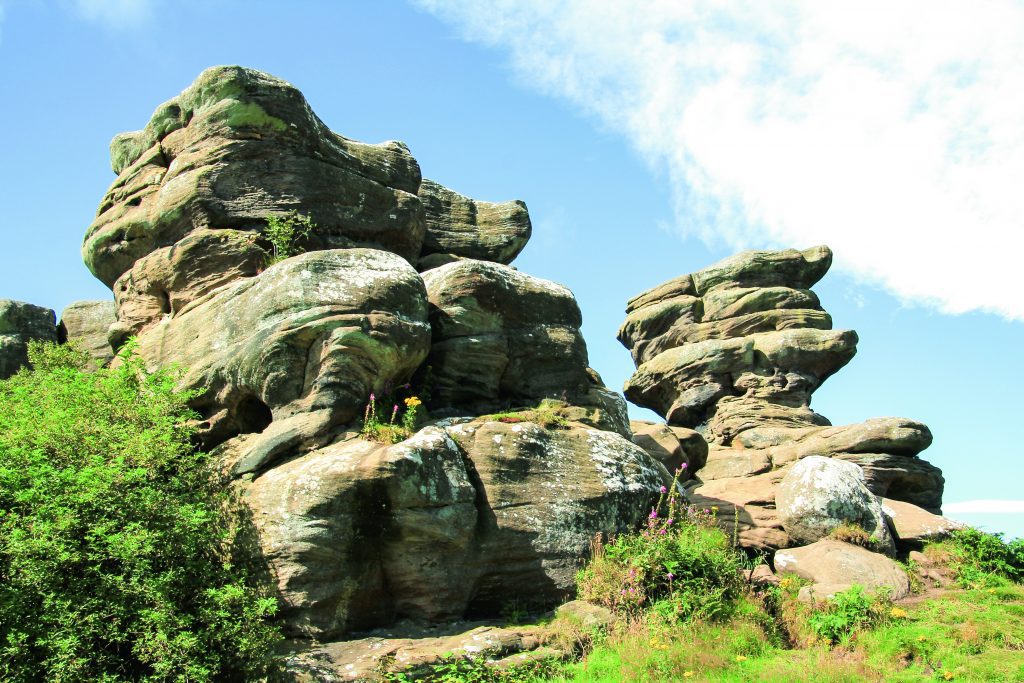
In this feature, Brian Spencer takes a nostalgic visit to one of the strangest geological features in Britain. Currently out of bounds during lockdown, it is somewhere Brian plans to revisit once freedom of movement is available. Brimham Rocks, sometimes called Brimham Crags are a group of strangely eroded millstone grit rocky towers high above the western edge of a183.9 hectare (454 acre) moorland escarpment overlooking Nidderdale, 8 miles (13km) north west of Harrogate. Such is the importance of the site that it is classed as an Area of Outstanding Natural Beauty. Along with the rocks, the surrounding moorland is home to semi- rare wild creatures and acid loving plants, all living in and around birch woodland on a large unspoilt area of both wet and dry heath. The major attraction to the site is its strange water and weather-eroded rocks, which were formed over many millions of years from sediments laid down in a huge river delta. Subsequent earth movements and ice and river erosion left an escarpment high above what became the River Nidd. The escarpment splintered into rocky towers over the millennia which, in turn separated into inter-connected boulders and rock faces. During the mid-seventeen hundreds an interest developed in what was called New-Druidism. Manmade rock circles and other unusual rock features in the landscape were considered to be the work of druids. Brimham Rocks became the venue for many of the philosophical thinkers of the day, who wrote quasi-serious essays following their visits to Nidderdale. In line with the then current ideas, they gave fanciful names to many of the rocks; they came up with names such as the Druid’s Idol, Druid’s Altar and Druid’s Writing Desk which have lasted into modern times. Brimham Rocks are formed from a semi-coarse sandstone laid down in the later part of the Carboniferous period in what became the Pennines (rocks on Kinder Scout were similarly laid down around this time). Due to the sands being deposited in moving streams which changed direction from time to time, it resulted in cross-bedding. This is very evident in most of the Brimham outcrops. Weathering in the Ice Age and windblown sand even now has led to the weaker and harder strata weathering at different rates; this resulted in the towers’ weird and fanciful shapes. We prefer to travel up to Brimham Rocks by way of Skipton and Pateley Bridge a few miles to the north along Nidderdale. Being on an old coaching road, the village is well appointed for cosy pubs and interesting shops – it even boasts having the oldest sweet shop in the country. True or not, being sold toffees from a glass jar takes us oldies back a few decades. Pateley Bridge was even once connected to the railway network. For a long time it was the terminus of a branch line from Harrogate, left over from a railway laid to supply building materials to three reservoirs being built towards the head of Nidderdale. From Pateley Bridge we took the steep road climbing the east side of the dale as far as a cross roads at Low Laithe. From there a left turn joins an even steeper road thoughtfully signposted to Brimham Rocks, our destination. Turning into the car park we got our first glimpse of the wonders to come. Rather like something out of a John Wayne cowboy movie, piled boulders and rock towers beckoned from the surrounding dwarf silver birch and a friendly National Trust attendant pointed out the start of a little path that winds through the trees up to the first of the named rocks. While many of Brimham’s druidical rocks were named by antiquarians in the eighteenth century, others have more fanciful names given to them by caretaker guides based at Rock House in the centre of the moor in order to attract paying visitors. Our first contact with named rocks came quite soon after walking along the narrow path diverging from the central track leading to Rock House. Part of a long sinuous escarpment of broken rocks it is the Surprise View over-looking the length of Nidderdale far below. This was just a taste of things to come and we followed them to a rock tower with a perched dog-like stone called inevitably, the Watchdog. Not all the rocks have ‘official’ names and we soon began to enjoy ourselves by inventing names that fulfilled our imaginations. The one I spotted was a perfect rendering of a cartoonist’s version of the late Prime Minister Margaret Thatcher MP. Named rocks begin with the Watchdog, but the most modern and arguably the best is the Smartie Tube; here we swung round through isolated outcrops, all the time wondering what it would be like to explore the moor in thick mist or a snow storm. Thoughts of a Sherlock Holmes adventure came to mind or some-thing out of a Hammer Horror film would revel in the unusual setting. The path, fortunately in glorious sunshine, led us back towards the central track, stopping first at an area called the Cannon Rocks; why this is so I am not sure, but the next outcrop across the track, is called the Blacksmith’s Anvil and is easy to find because of that. All the paths seem to join at the bottom of a hollow where the Eagle and Castle Rocks hold sway. That was until a bunch of hooligans bounced the rocker out of balance. To their right the Flower Pot and Oyster Shell seem to be the result of a gardener with a vivid imagination. The space beyond opens out to offer somewhere to rest and enjoy a little refreshment. Rock House, now a Grade II Listed Building once a hideaway for sportsmen harassing the moorland grouse and occasional wild deer is now the Visitor Centre from where in better times guided tours of the rocks are on offer. Immediately to the left of the Visitor Centre, the Dancing Bear stands proud on his rocky plinth.