Lost Houses of Derbyshire – Old Radburne Hall
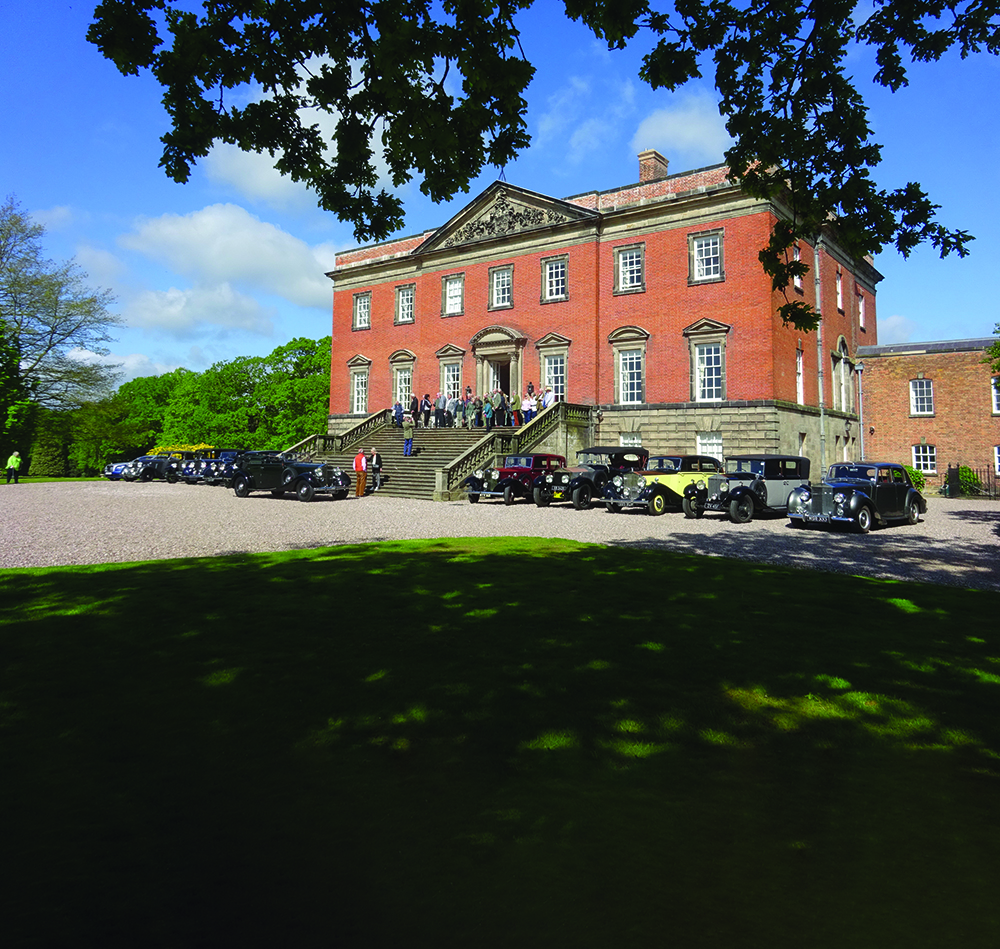
By Maxwell Craven One of the most delightful, sequestered and ancient parish churches in the county is that of St. Andrew, Radbourne, set beside the Radbourne Brook (effectively a tautology: the clue is in the name, the ‘red bourne’, or stream) in a hamlet which hardly seems to exist, despite being barely four miles from Derby. It is well hidden from the unfrequented road, although well signposted. As you descend the path to the church you can see across a broad pasture to the brook and the ridge beyond, atop which stands the fine Georgian mansion that is today’s Radburne Hall (the spelling differs from that of the settlement, by hallowed tradition), although it is slightly beyond one’s eye-line. The pasture itself is full of strange hollows, and was originally the site of the first known houses on the site. Radbourne is one of those rare landed estates: one that has never been sold since its first recorded owner obtained it. It has, however, passed via an heiress four times since its first record, the first three in the Middle Ages, the fourth currently, but the blood of the first recorded tenant, Wakelin de Radbourne – who is on record for 1100, but was almost certainly the 1086 (Domesday Book) tenant – still flows in the veins of the incumbent family. Who exactly Wakelin was is not clear, although it has been suggested that he was reasonably close kin to his overlord, the tenant in chief, Henry de Ferrers, lord of an hundred Derbyshire manors, other members of whose family certainly used the name. The monumnet to Sir John, now at Mazerolles The grandson of Walkelin left no son but a daughter and heiress, who married John de Chandos who was of a minor gentry family from SW Herefordshire, Chandos being a locality in Much Marcle parish in that county. John’s great-great-grandson was Sir John Chandos, KG, the great hero of the Hundred Years’ War, Constable of Aquitaine and Seneschal of Poitou, created by Edward III Viscount St Saveur-le-Viscomte in the Contentin in 1360. Sir John, born around 1320, was a close friend of the heir to the throne, Edward, the Black Prince and, in 1348 joined his patron in being nominated one of the first ever Knights of the Garter. Described by the medieval historian Froissart as ‘wise and full of devices’, as a military strategist, Chandos is believed to have been the mastermind behind three of the most important English victories of the Hundred Years War. He was chief of staff to the Black Prince at the Battle of Crécy in 1346, was a leading commander a decade later at the Battle of Poitiers and also in the Battle of Auray, in the War of the Breton Succession in 1364, following which his commander, John Duke of Montfort, was able to succeeded as John IV, Duke of Brittany. In addition to his other honours, Chandos was created the lieutenant of France and vice-chamberlain of England. In 1369, the French launched a successful counter-attack, regaining much territory and forcing Edward to recall the retired Chandos, who attempted to deal with the French attempts to regain a foothold in Poitou, of which he was made governor. In a skirmish following an unsuccessful attempt to re-take St. Savin, Chandos met the French on the bridge at Lussac. In the ensuring melée, Chandos’ long coat led to him slipping on the frost. James de Saint-Martin, a French squire, struck Chandos with his lance, piercing his face below the eye although Chandos’ uncle, Edward Twyford of Kirk Langley, standing over his wounded nephew, repulsed the attack. The wounded Chandos was carried on a large shield to Monthemer, the nearest English fortress, but died, unmarried, in the night, either on the 31st December or the early hours of New Year’s Day 1370. Sir John Chandos as Knight of the Garter, 1348 from the Bruges Garter Book Such was Sir John’s reputation that Charles V (‘the Wise’) of France is reported to have said that ‘had Chandos lived, he would have found a way of making a lasting peace’ although French chronicler Jean Froissart was more circumspect, saying ‘I have heard him at the time regretted by renowned knights in France; for they said it was a great pity he was slain, and that, if he could have been taken prisoner, he was so wise and full of devices, he would have found some means of establishing a peace between France and England.’ He added of Chandos that ‘Never since a hundred years did there exist among the English one more courteous, nor more full of every virtue and good quality.’ He certainly comes across much in the heroic mould of those other two hammers of the French, the Dukes of Marlborough and Wellington, although his reputation lost nothing in having been killed in battle. The estate passed to Sir John Lawton, married to one of Chandos’s sisters, although the loss of the original patent creating Sir John a Viscount means that no one is sure whether it was remaindered to his sisters and their issue, failing any heirs of his body, or not. As a French title, albeit granted by the King of England (but as King of France), this may well be true, meaning that Lady Chichester might well be Viscountess de St. Sauveur. Certainly, his heiress brought all his property to her husband to Sir Peter de la Pole from Cheshire. The Poles, too burgeoned mightily once ensconced in the county, for younger branches settled at Kirk Langley, Barlborough and in a moated house north of Hartington, now marked by a farmhouse called Pool Hall; one of this latter branch, John Pole, became the outlaw after whom Castleton’s Poole’s Cavern was (phonetically) named. Nevertheless the Radbourne Poles have been there ever since, although they assumed the additional surname of Chandos in the Regency period as homage to the enduring renown of Sir John. At Radbourne Sir John is reputed to have had a ‘mighty large howse of
The Lost Houses of Derbyshire – Burdett’s House, Full Street, Derby
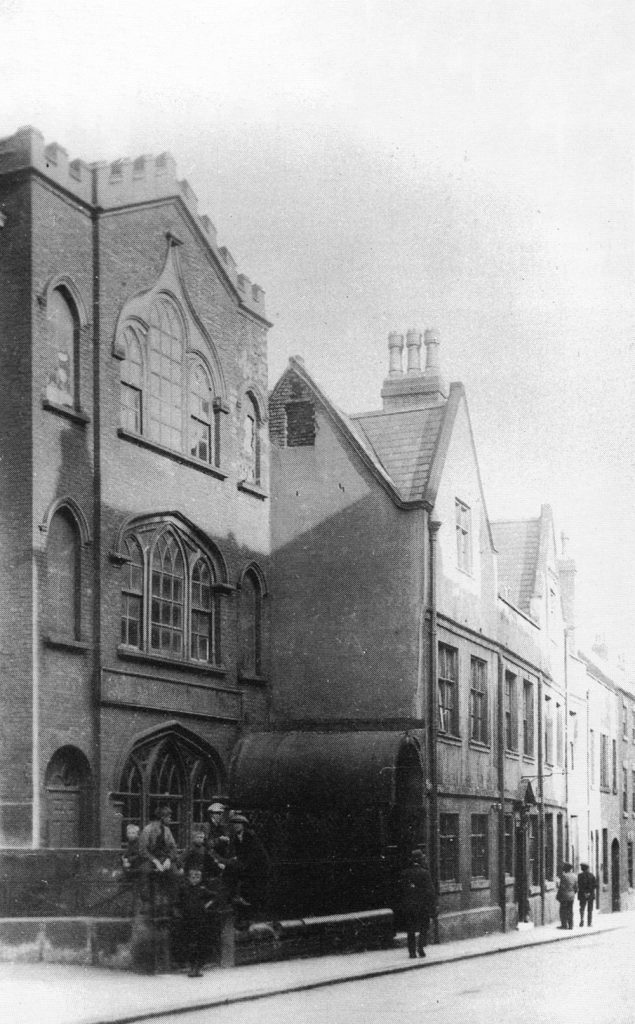
Peter Perez Burdett is an important, enigmatic and tantalizing figure. He is best remembered as a cartographer, having surveyed and drawn only the second one inch to one mile UK county map of Derbyshire and he repeated the exercise with Cheshire. He was also a talented artist, he claimed to have invented the mezzotint, and was an amateur astronomer, a talent that drew him into the circle of Washington Shirley 45th Earl Ferrers FRS. He appears to have been born in 1734 or 1735 — making him a contemporary of Joseph Wright — the son of William Burdett and his wife Elizabeth, younger daughter and sole heiress of the Revd. Peter Perez, vicar of Eastwood, Essex, who died in 1750. It is also unknown what his background was, for he moved in the highest circles throughout his life with the greatest ease. It seems clear that a double portrait of Peter Burdett and his wife Hannah by Wright was carefully posed at Knowle Hill, the (then) dismantled secondary seat of the Burdetts of Foremark, the background being the still stunning vista towards the north east — the topography is unmistakable. Yet, whilst staying with Earl Ferrers at Staunton Harold c. 1760-1764 and later, living in Derby he was never exposed as a fraud by the Burdetts or anyone else. Burdett may have been in the army, for he must have learnt his surveying skills somewhere, but the 1750s finds him in Manchester – doing precisely what has never been clear – where he married and had a family. Yet by the time he appeared in Derby, we hear no more of them and he re-marries the widow of a Leicester businessman and much later still, the daughter of a Bohemian count! He was certainly a very accomplished man; he even played the ’cello to a good enough standard to perform with the Derby Society of Musicians: a good quality education is implicit. Certainly, he and Ferrers were close enough to observe the Transit of Venus in 1761 and to write up their findings for the Transactions of the Royal Society and for the latter to lend him considerable sums of money. In 1763 Burdett had a bond from Lord Ferrers which allowed him to pay Joseph Wright – clearly by then a friend – £160 plus interest from the 200 guinea (£210) fee that Wright charged Lord Ferrers for painting A Philosopher Lecturing upon an Orrery in 1763. This sum, however, was thought by the late art historian Judy Egerton to have been in part a disguised loan to Burdett. Hence, Wright only received the first £50 of his fee and we find him chasing Burdett for the balance for years thereafter and right up until the ever-impecunious Burdett, hard pressed by creditors, left Derby in a hurry in 1768. He was still chasing some of the money when Peter Burdett left Liverpool for the Continent in 1774, when Wright was still £80 short! The original idea of the bond was for Lord Ferrers to pay Burdett the whole sum to pass on to Wright, deducting from it as a loan half to Burdett. The intention was to tide Burdett over whilst he built himself a house in Derby (and thus get Ferrers’ lodger out of Staunton Harold, then being extensively rebuilt to his own design). Once settled, the idea was for Burdett to pay the balance back to Wright when he had got established and recovered his financial position by publishing his map of Derbyshire, which happened in 1767. So where did the money go? What we strongly suspect is that it was spent on his new house in Derby’s Full Street, separated by one substantial building from Bess of Hardwick’s almshouses. Burdett’s house was later 11, Full Street, and was unique in Derby in being of brick with stone dressings and designed in Strawberry Hill Gothic – invariably termed ‘Gothick’ by architectural historians – the form of Gothic revival pioneered (indeed, trumpeted) by man of mode, the Hon. Horatio (‘Horace’) Walpole, later 4th Earl of Orford, 1717-1797) and much taken up amongst the cognoscenti in the middle years of the 18th century. As Burdett seems to have only paid £100 or a little more for his house, it also seem likely that it was an existing building which he merely re-fronted and internally up-dated before moving in early in 1764 (in which year he was first described as ‘of Derby, Gent.’) The house narrow end to the street, was of a full three storeys, with a wide central section breaking slightly forward under a crenellated parapet the middle section being a broken pediment, into which protruded the crocketed top floor window, a Gothicised Venetian window set in an ogee panel. The first floor central window was tripartite set in a Tudor-style four-centered arch as was that on the ground floor, which was flanked by a door on each side. The fact that the top floor was the tallest, suggests that the original building may well have been 16th century or early Jacobean in origin. The late Edward Saunders, Joseph Pickford’s biographer, has plausibly attributed this re-fronting to the Derby architect who is known to have been a close friend of both Wright and Burdett. Pickford is not notable for having worked in Gothick, but his Gothick Temple at Kedleston is closely related to 11, Full Street, as was Knowle Hill (since reduced) and the Chalybeate Well head at Quarndon, also attributed to Pickford by Edward. Pickford also competently restored parish churches at Coventry and Nottingham St. Mary. Regrettably, we have no record of the interior, although, like his neighbours, Burdett’s garden ran down to the bank of the Derwent and included a patch of ground on the bank opposite, too. Burdett was a Strict Observance Freemason – a continental and rather strange version of Freemasonry – and appears to have been fairly high up in its ranks, too, for he was visited at the house by a
The Lost Houses of Derbyshire – Grangefields, Trusley
Grangefields lies in the northern part of the parish of Trusley and has a long history going back to the compilation of the Domesday Book in 1086, and maybe before, for it lies only a quarter of a mile south of Long Lane, the alignment of the Roman Road from Derventio (Little Chester) to Salinae (Middlewich, Cheshire) via the fort at Chesterton, Staffs. A Roman villa has never been identified in Derbyshire, but if one ever was, a gentle south facing, well-drained slope is the most likely place and the area of Long Lane is a promising one. Whether Grangefields was on or near one has yet to be ascertained, but it would not surprise me if one day such a villa did turn up nearby. Thus, in 1086, both the manorial estates at Trusley had been bestowed on a great lord, Henry de Ferrers, who made a man called Hugh his hereditary tenant of both there. Later charters establish that Hugh’s full name was Hugh le Arbalaster. The name derives from arcuballista a Latin term for a crossbow, which rather suggests that Hugh might have acquired this name from his day-job, so to speak, as a leader of a group of crossbow-men. It would be fun to think that he was wielding one at the battle of Hastings and that Trusley was his reward! Hugh had a son called Serlo, who adopted the surname of Beaufei (spelt in a number of confusing ways), indicating that, whatever Hugh had been up to at Hastings, he probably hailed from the small Norman settlement of Beaufai, Département de l’Orne, not far from the Mesnil, in Normandy. Serlo’s great grandson, Robert de Beaufei, started granting pieces of land to various monastic houses, a habit which his like-named son continued. Between them, the two Roberts made grants to the Abbeys of Croxden, and Burton in Staffordshire, the Priory of St. Mary de Pratis in Derby and the Knights of St. John of Jerusalem at Yeaveley. These were nearly all made from the northern part of Trusley, from just one of the two manorial estates, that away from the village, manor and church, and all between the 1260s and 1290. Indeed, this part of Trusley seems to have originally had its own name, Thurmundesley, as a pair of early charters make clear. This derives from the old Norse personal name ‘Thormund’ + leah = ‘ley’, a meadow or clearing. It would probably have mutated to ‘Thurmandsley’, ‘Thurmsley’ or even ‘Thursley’ today. This may be a clue, indeed as to which of the two men holding Trusley in 1066 had this part of the settlement, for as Ulfketel is also a Norse name, it would be tempting to think of him as Thormund’s descendant or heir, and that Thormund himself must have arrived long before, cleared the land and settled. It was the Cistercian monks of Croxden Abbey, however, who were granted the site of Grangefields, part of a 40-acre gift made by the younger Robert de Beaufei in 1180 and topped up with further land later. Here they established or took over a farm. Sometimes, monks were sent to work such farms, which were called ‘granges’, but more usually lay families were given the tenancies. In time, therefore, the place became known, not as Thurmundesley, but Grangefields, just as a nearby holding granted to the Nuns of Kings Mead Priory in Derby, gradually came to be called ‘the meadow of the nuns of Trusely’, eventually Nunsfield. Certainly, the name Grangefields was recorded (as Graungefeld) in the documents relating the dissolution of Croxden Abbey in 1538. The land and farm at Grangefield was assessed in value by King Henry VIII’s bean-counters at £4 – 6s – 3d (£4.33) – worth £1,817.10 in today’s values, or three cows, or 143 days’ wages in 1538. Thus, Grangefields was acquired speculatively by Dr. Thomas Leigh and William Cavendish (later to become the second husband of Bess of Hardwick) on 17th September 1538 to be assessed, the price fixed and offered for sale. The tenant at the time was William Glossop, of a Wirksworth family and when the estate was sold on in 1545 to Robert Fitch, he appears to have been left in place. Indeed, the sparse surviving records suggest that the Glossops continued as tenants before buying the freehold some time between 1571 and 1598. He did not keep it long though, for he sold it on again first to Edward Kynnersley of Brailsford and then to Francis Curzon a younger son of Francis, of Kedleston. However, at some stage, Francis Curzon seems to have decided to sell it on yet again and it would appear that Robert Glossop, or his father, had become wealthy enough to buy the farm, for Robert was in possession in 1600 when, on 26th October, he mortgaged it to raise money. Unfortunately, whatever Robert needed the money for, the mortgage appears to have been foreclosed with the result that it passed by 1608 to John Gregson ‘yeoman’ of Sutton-on-the-Hill who immediately sold it on to Robert Hope. Unfortunately, not much is known of the family, but Robert was born to Charles Hope at Etwall, not only did Robert Hope buy the estate, but he also appears to have built a fine new house, or more probably, rebuilt the late medieval house which he acquired, adding a crosswing and generally modifying the building, producing an irregular but delightful timber façade. It was described by William Woolley in 1713 as ‘,,, a pretty private seat formerly a grange belonging to Croxden Abbey’, whilst Stephen Bagshaw added, ‘it is a long, half-timbered building having many gables.’ The only comparable house locally are perhaps the earlier West Broughton Old Hall or the slightly later and more symmetrical Wakelyn Old Hall at Hilton. The house fortunately lasted into the age of photography (by a whisker) being the subject of the Calotype photograph which may have been taken by photographic pioneer W. H. Fox-Talbot, who was married
The Lost Houses of Derbyshire – West Hallam Hall

No native West Hallam resident, of course, would acknowledge being resident of Ilkeston – they are fiercely independent folk – but the loss of the hall caused this unexpected expansion, and the man responsible was bullish Nottingham developer and bigwig, Alderman Sir Albert Ball (1863-1946), as with one of two other lost Derbyshire houses (not to mention Nottinghamshire ones!) The manorial estate at West Hallam came very early into the hands of the Cromwell family, later famous for giving us Lord Treasurer of England, Ralph, Lord Cromwell KG, who built Wingfield Manor in the 1440s. When he died in 1455 his daughter and heiress was long married to Sir Richard Stanhope KB of Rampton, Nottinghamshire, but her daughter Maude, who inherited the West Hallam element of Lord Cromwell’s estates from her mother, sold it in 1467 to Thomas Smith, otherwise known as Powtrell. The Powtrells were an ancient Nottinghamshire family, seated since the late 12th century at Thrumpton; a junior branch was at Atlow in Derbyshire in the 13th and 14th centuries, another at Prestwold, Leicestershire a little later. Richard Powtrell had been Receiver General of Edward III, but died without issue in 1399; his heiress Isabella, his brother’s daughter, had by 1420 been long married to Thomas Smith of Breaston, and their son, Thomas, is the man who inherited West Hallam in the right of his wife, and assumed the surname and arms of Powtrell in lieu of Smith. The Cromwells may have had a house there in the very early period – there is a moated site called The Mot, fed by the Stanley Brook, in nearby Fox Holes plantation where Ralph de Cromwell II is said to have established a residence – but seem not to have lived there after their rise to fame and power in the 14th century hence, when Thomas Smith (or Powtrell) decided to build a new house, it would have been an entirely new affair, arranged around a courtyard. In 1670 it was taxed on 20 hearths, which is quite a healthy number for a medieval house, so the house was probably a fairly grand affair of coal measures sandstone. Like a number of the grander houses in the county, West Hallam Hall also had a domestic chapel, served by a priest, probably the incumbent of the parish church, which stood immediately to the east of the house. This arrangement was only thrown into sharp contrast after 1536 when Henry VIII broke with Rome and declared himself Supreme Governor of the church in England. John Powtrell (died 1544) could not stomach this upheaval and remained staunchly Roman Catholic, becoming classified as a recusant and being fined for non-attendance at church on a regular basis, thus diminishing (as the Crown intended) the family’s financial resources – in the hope that to save their patrimony – Catholic gentlemen would conform. His son Sir Thomas continued this stance after Queen Mary’s death, although the younger son Nicholas, a lawyer, was content to conform and became ancestor of the Powtrells of Egmanton, Nottinghamshire and Chilwell. This persecution intensified after the arrest of Mary, Queen of Scots, Lord Shrewsbury being the chief instigator of various campaigns of suppression in Derbyshire, culminating in the execution of the Padley Martyrs and Richard Simpson at Derby in 1588. Despite this, the Powtrells seem to have managed to keep their heads down until 1680 when the Catholic priest George Busby was arrested at West Hallam Hall, where his predecessor had had a loyal following of 40 local people. He was tried before a grand jury empanelled with the cream of the local (Protestant) landed gentry, and executed in 1681 – this in the wake of the hysteria surrounding the conspiracy called the Popish Plot which came to a head at that very time. By this time, too, the Powtrells had lost the estate, for in 1666 when Henry Powtrell died, the house and lands passed to Sir Henry Hunloke of Wingerworth, brother of Mrs Powtrell (and of the wife of Henry’s brother, John), by deed of gift which allowed the Powtrell family to continue to live in the house, which they did until the death of John’s younger nephew, William, in 1687. This arrangement was almost certainly because the recusancy penalties had finally taken their toll on the family fortunes. The Hunlokes, also recusants, but, with much coal under their estate just south of Chesterfield, were bullet-proofed against the depredations of recusancy fines, used West Hallam Hall as a place for younger sons and widows to live, but by the mid-18th century it was lying empty, and they demolished it a few years after 1770 – except for the chapel which served a flourishing if select Catholic community in the area. Once the hall had been demolished, a two and a half storey brick farmhouse was built to replace it, yet with the chapel still attached. What did for it, the last surviving fragment of the old hall, was the Duke of Wellington’s Catholic Emancipation Act, passed in 1829. From thence the local Catholics could worship openly again for the first time in 300 years, and could travel to Chapels in Derby, Ilkeston and Nottingham to worship on Sundays and feast days. Hence, in around 1833, the old building was finally taken down. Its stained glass, some of which is claimed to have been rescued by the Powrtrells from the dismantling of the Abbey of Dale nearby, was installed in the parish church next door. The very ancient cruciform sandstone font had, much earlier, found its way to Holy Trinity, Mapperley, but in 1815 it was identified and recovered by Revd. Thomas Bloodworth, who gave it to Sir Robert Wilmot, Bt., of Chaddesden Hall who, in turn, presented it to Revd. William Hope, a Derby bigwig, who bequeathed it to the Museum at Derby. It was subsequently presented to St. Barnabas, Radbourne Street, Derby on its consecration in 1885 where it remains. Meanwhile,
Lost Houses of Derbyshire – Haden’s House Cathedral Quarter, Derby

If you were to walk towards the city centre in Derby along Queen Street, you would eventually reach St. Michael’s, an unassuming Victorian church designed by Henry Isaac Stevens of Derby and built in 1857-59 of ridged ashlar blacks to replace its Medieval predecessor, the chancel of which collapsed, rather dramatically, on a summer Sunday, 17th August 1856, mercifully, just after the congregation had left. The church is now solicitors’ offices, having been converted from ecclesiastical use by Derek Latham as his own offices in 1979. Then there is a gap there before one reaches St. Michael’s House, a red brick building which used to be HQ of the Cathedral until about 20 years ago. This gap bears the name St. Michael’s Church Yard, which it once was but, before 1959, the view through the gap would have been terminated by a fine white painted Georgian house, Nos. 3-4 St. Michael’s Church Yard, which once looked across the church yard to Queen Street and had a garden which ran down to the Derwent. The plain façade of this house – two and a half storeys and five bays wide with an extra lower ground floor on the east side facing the river – had, as so often in Derby, a house of considerably greater antiquity, being said by one Derby author to date from ‘at least the seventeenth century’. A person familiar with the house in its declining years also made mention of unusually thick walls, roughly squared stone plinth work appearing in what was largely a brick house, blocked mullioned windows visible from within (but not evident on the exterior) and a staircase which, if correctly described, must have dated from the later seventeenth century, of oak with turned balusters ‘slightly bulbous in shape running continuously up the gradient of the stair’. There was also a bolection moulded chimney piece, two others ‘of Jacobean appearance’ and a ceiling centered by ‘an oval of realistic fruit.’ The pleasure grounds ran down to the mill-race and, prior to the building of the Derby Silk Mill 1717-1721, no doubt reached the river bank and had a summerhouse there, as did so many other Derby gentry town houses. It is by no means clear who built this house, although there is some circumstantial evidence to suppose that by the time it had receive its Restoration period makeover, it was the town house of the Poles of Radburne Hall. In the 1741 election German Pole stood as the Tory candidate in the first general election of that year, being defeated by skulduggery on the part of the Whig-dominated corporation. They, knowing that the majority of Pole’s supporters would be coming in from the country and that Pole had put money behind the bar of a number of inns for their refreshment, closed the polls at lunch-time, handily disenfranchising any who had not finished their refreshments. Pole, despite having lost, gained much credit from restraining his supporters from rioting. The Poles seem to have relinquished the house after the death of German Pole (who had built the new (present) Radburne Hall, and it was sold to John Balguy of Alfreton (pronounced ‘Bawgie’), a member of an ancient family from Hope which had gone into coal ownership in a big way, making enough money to live in Swanwick Hall by 1770. People of his ilk needed a residence in Derby, not only to stay in whilst attending the assemblies and the race-meetings (which invariably coincided) but also to be on the spot to oversee their business interests. The Balguys made some improvement to the house, adding the plain Georgian brick façade, and parapet (barely hiding an older, uneven roofline) and installing panelling in the dining room. Balguy bought Duffield Park in 1791, shortly after he had been appointed recorder of Derby, but, in the early 1800s, the house was let to Thomas Haden (1760-1804), later an Alderman and Mayor of Derby in 1811 and 1819. He was partner to Joseph Wright’s brother, Richard, a doctor who had inherited Dr. Erasmus Darwin’s medical practice and lived and worked in St. Alkmund’s Church Yard. Haden needed to be close to Wright’s practice, so rented the Balguy’s house in St. Michael’s church yard. The Hadens, at the centre of Derby’s social life being friends with most of those Enlightenment period figures of the time, especially the king-pin, William Strutt who, from 1807 lived very close by at St. Helen’s House, added a ballroom embellished with neo-Classical plasterwork, lit by a large canted bay overlooking the garden. Thomas Haden had several sons, of whom the third, Henry, a surgeon, was the only fatal casualty of the Derby Reform riot of 10-12th November 1831, when he was mugged in Queen Street, left for dead and subsequently succumbed to his injuries (he wasn’t even a Tory, but was in the wrong place at the wrong time, poor chap). In 1818 his sister Ann had married a young American-born army officer, Kirk Boott (1790-1837) who went on to become one of the founding fathers of the cotton-spinning city of Lowell, Massachusetts; the father, also Kirk, a friend of Joseph Wright’s other brother, John, a banker, had migrated to Boston in the 1770s. One of Haden’s grandsons was the surgeon Sir Francis Seymour Haden, FRCS (1818-1910) who, although knighted for the advances he brought to obstetrical surgery and for his role as a co-founder of the Royal Hospital for the Incurables (now the Royal Hospital for Neuro-Disability), is nowadays more famous as an extremely talented artist who excelled as an etcher. As an artist, Haden was well known as having enjoyed a close relationship to the US born impressionist James Abbot MacNeil Whistler (a descendant of Ann Haden and the Boots) marrying Whistler’s half-sister Dasha Delanoy. Needless to say, like most people who befriended Whistler, they eventually fell out rather drastically. In his younger days, he had joined his grandfather’s medical practice, in direct succession to Dr. Darwin himself. Nor did the Hadens
Lost Houses of Derbyshire The Hough, Hulland

by Maxwell Craven The standing remains of the moated secondary seat of the de Bradbourne family no longer exist for me to share with you, but, like Brizlincote Old Hall, the site is marked by a well-preserved moat, and moated sites are relatively rare in Derbyshire, although many more are recorded in the sources than survive. The site lies east of Brunswood Lane and south of the A517 at Hulland; the well-preserved moat measures 150 by 125 feet (45.7 x 38 m) and includes traces of the abutments of a bridge, although much less well preserved and far less discernable than that at Bearwardcote (see Country Images for August 2014). The name Hough has two old English derivations: either from hoh = ‘spur of a hill’ or from haga = ‘enclosure’. As The Hough is not in the spur of a hill, but in the valley by the immature Brailsford Brook, the latter derivation is probably the correct one, especially as the entire area north of the Ashbourne Road is full of ancient hunting parks. Hulland was owned by the aristocratic Danish settler Toki in 1066, along with much else in the area, but it was granted, as a manor which included Ednaston, before 1086 to Geoffrey Alselin. It descended in his family with Ockbrook, to the Bardolphs (as in Stoke Bardolph in Nottinghamshire) who seem to have had a seat there but who sold The Hough estate before 1250 to Sir Robert de Ashbourn of Ashbourne. He founded a chantry in a domestic chapel previously added to the building (which at that date would undoubtedly have been of timber). His heirs eventually sold the estate to Sir Roger de Bradbourne of Bradbourne, some time before 1296 This family descended from Gerard de Bradbourne, a follower of the de Ferrers Earls of Derby, who had been granted the tenancy of Bradbourne before about 1150 and his descendant, the Sir Roger who acquired the estate, soon afterwards built a house here. His first effort was fashionably moated and may well have been of timber, as was the norm in those days, but at some unknown date – probably around 1451, it was replaced by one of brick and stone, the builder being John Bradbourne, the first of the family to be specifically referred to as ‘of The Hough’. Previously, the junior branch of the family had been settled there, descendants of Sir Roger’s third son, another Roger, whose line ended with an eldest son, Henry. He came to a sticky end, having been executed at Pontefract in March 1322 for joining the rebellion of Thomas, Earl of Lancaster (who was also Earl of Derby), ignominiously defeated at the Battle of Boroughbridge. This was part of the long-running civil war waged between Edward II and various, really quite disparate elements, opposed to the King’s choice infelicitous of advisers. In this case it was the appointment, following the defeat at Bannockburn, of the Despenser family, which enraged the powerful Mortimer clan and, in due course, put out of joint the nose of Earl Thomas, too, for he had been in control of policy since the clear-out of advisers following the defeat by the Scots in 1314. John Borrowe’s late 17th century Hulland Old Hall, north front with the earlier (or re-constructed) portion to the left In the event, the much under-rated Edward II pursued a policy of dividing his opponents; he first disposed (temporarily as it turned out) of the Mortimers in a crushing defeat early in 1322, before turning his attention to Thomas of Lancaster. Unfortunately for the heir of the Bradbournes, Henry ended up on the wrong side! The Bradbourne dynasty, despite this setback, went on from strength to strength. Having rebuilt the house in stone, in 1463, John Bradbourne founded another chantry in the domestic chapel attached to the manor house (in manerio meo de Holendo – ‘in my manor of Hulland’), dedicated to Our Lady, which managed to survive the Reformation, when it became a chapel-of-ease of the parish of Ashbourne but, by the early 18th century it was ‘little used’ and indeed was completely gone by 1750 or thereabouts. The estate, with Lea Hall (see last month’s Country Images) and other nearby property, was inherited by William Bradbourne, on the death of his father Sir Humphrey in 1581. In 1594, however, beset by debts and childless, William sold it all to his brother-in-law, Humphrey Ferrers, who lived on the Bradbournes’ wider estate on a property at Boylestone, inherited from the Waldeschef family, whilst his father was alive and himself occupying the family seat at Tamworth Castle. This is despite William having a brother, Anthony, who was a prosperous London merchant with three sons; what happened to them and whether they had any descendants is not clear. Indeed, despite several other junior branches of the family, the Bradbourne name seems to die out at this juncture altogether. Humphrey Ferrers later inherited Tamworth Castle from his father and was knighted, but his son John (died 1633) lived at Lea Hall and consequently from this time the old house at The Hough appears to have been left empty; indeed it could well be that the Civil War accounted for its eventual destruction. Certainly, the Ferrers family were left in much reduced circumstances after the Restoration – the price of loyalty to the Crown – and in 1690 they sold the estate to the up-and-coming John Borowe of Castlefields, Derby a Nottingham-born former soap boiler. Both William Woolley and Dr. Pegge make clear that by then (the end of the 17th century) the house at The Hough had become a quarry for the convenience of any scavenging old villager wanting to effect an inexpensive home makeover, although Woolley adds that Hulland Old Hall, nearby, was ‘built out of the ruines’ of the Bradbournes’ old house by John Borowe. Examination of the earliest portion of the Old Hall house, which John Borowe had built in the village rather than out at
The Lost Houses of Derbyshire – Blackwall Hall

When one speaks of houses that are lost, one speaks of houses built, lived in and eventually discarded as redundant, too expensive, too damaged or too inconvenient to continue living in. With regard to the potentially spectacular house that Bess of Hardwick no less, built or intended to build at Blackwall-in-Peak, none of the above need apply, for it is by no means certain that Bess actually completed her new house there or, indeed, even began it. Blackwall-in-Peak is more generally spelt Blackwell these days, which is a reversion to the Blachewelle of Domesday Book (thus, ’dark well’), although by the early 14th century it was invariably spelt Blackwall, which usage continued until relatively recently. Blackwall was one of those manors in Derbyshire held in chief by William Peveril, and his tenants there seem to have taken their name from the place sometime in the late 12th century or a little later. By that time, however, Peveril had granted his estate there to Lenton Priory. Mind you, Lenton is a good way from Blackwall, which lies just north of the A6 west of Taddington, which meant that the prior and canons of Lenton were obliged to appoint a man on the spot to collect the rents and tithes in the township, and the evidence is that this was done by the leading free tenants, the Backwalls. Indeed, by the early Tudor period, Richard Blackwall of Blackwall had been appointed to the office of collector of rents and tithes on behalf of the Priory at an emolument of 40/- (£2) ‘and a gown’. Once dissolved, however, the manorial estate was in the hands of the Crown until 1552 when it was granted to Sir William Cavendish, then freshly arrived in Derbyshire as the second husband of Bess of Hardwick. Within a few years, the rent collecting proclivities of the Backwalls having been made redundant, the family migrated south to Kirk Ireton, where they built a new, still extant, manor house and from whom it took its name. Bess, meanwhile, two further hubands down the line, had turned herself in to something of a mega-builder, inspired in all probability by Sir William’s efforts in rebuilding Chatsworth, especially his use of the high house style, whereby the grandest reception rooms were placed in the uppermost storey (as in the east facing long gallery at Chatsworth) so that Derbyshire’s incomparable views might be best appreciated, inspired by Prior Overton’s tower at Repton and the high tower at Wingfield Manor. After her estrangement from her fourth husband, Lord Shrewsbury, Bess began to rebuild her ancestral home at Hardwick along similar lines, but without the benefit of much architectural discipline. Once widowed, she brought in Lord Shrewsbury’s architect, Robert Smythson, to build anew all over again a few hundred yard to the NE, to produce the spectacular Elizabethan ‘prodigy house’ of Hardwick Hall with its upper storey long gallery and state rooms, a flat roof peppered with banqueting houses in the towers on which to enjoy summer evenings, classical detailing, and an innovative through hall. Indeed halls, prior to this point, were invariably set longitudinally along the main façade of a great house with the main entrance at one end and a screen at the other through which access could be made to the services. At Hardwick, however, one goes up into a hall that runs away from you through a screen across with the width of the building. Nor did she stop there, for almost simultaneously, Bess began building another house of similar size at Oldcotes, Heath, for her son William Cavendish, which was very much in the Hardwick mould and which appeared in Country Images for November 2015. However, she wanted more. Between 1590 and 1600 (on the estimation of the late Mark Girouard) she commissioned Robert Smythson to design another house, plans for which remain in the Smythson collection of the RIBA now housed in the British Library. The plan for the principal floor (to be built, like Hardwick over a raised basement of lower ground floor) is headed, in Smythson’s witing, ‘A House for/Blackewall in the/Peacke.’ You might ask, why would Bess want another country house only 15 miles from Hardwick, and in an elevated (and frankly, very exposed) position, despite the views? The answer lies in the plan. Like Hardwick, it was rectangular in plan. With the hall running right through the principal storey. There were square towers inset from the corners of the building, but on the entrance side they were joined by the main wall, pushed forward flush with their outer sides, and not recessed as on the opposite side, a very similar effect as Hardwick, but much, much more compact. There were only two main rooms on either side of the hall, a parlour (with main stair alongside) and a great chamber. The hall was full-height, meaning that there was also space only for a pair of rooms on either side above, linked by a gallery over the hall screen (although no plan for the first floor survives, only one for the semi-basement). This lack of accommodation tells us clearly that this was not a permanent residence, but a lodge, for occasional use. In Elizabethan times there were two main types of grander lodge: either a retreat to which the family could repair once a year whilst the main house was cleaned from top to bottom, or as an occasional residence for either watching or indulging in the chase. A classic example of the former (of similar size and date) is Lord Burghley’s Wothorpe Lodge near Stamford, barely more than a mile from the main house and now a ruin. Yet the compact plan and notable tallness are very similar. As regards hunting lodges, a closely related building, although with a very much more compact in plan, is the hunting stand designed for Chatsworth by Smythson in about 1585; Wardour old castle a rebuilt Medeival keep, attributed by Girouard to Smythson c. 1570, is closer in scale,
The Lost Houses of Derbyshire – Netherthorpe Old Hall

Netherthorpe Old Hall was a stone built Elizabethan small manor house situated in Netherton, one of the group of modest hamlets which surround Staveley – Barrowhill, Mastin Moor, Norbriggs, Poolsbrook and Woodthorpe. Built of coarse ashlar of thin coal measures sandstone, there were hefty quoins and at one time dressings to the doorcases, windows and gables. The roof must once have been of stone slate too, but was latterly of Welsh slate, brought in by rail of the back of the rapid industrialisation of Staveley itself. When new, the house no doubt had a great hall set to one side of the central section, for the bold innovation of a through hall, being introduced by Robert Smythson at Wollaton, Worksop and Hardwick, were still in the future, and without doubt the house will have had all the accoutrements of that of a well-to-do minor gentleman: linenfold wainscotting, ribbed plaster Sheffield School ceilings, and a grand oak staircase. The hearth tax, however, tells us that it was taxed on a modest five hearths in 1670, probably because, with a great hall being the focus of domestic life, there were only four other heated rooms, one of which would have been the kitchen. In the only surviving view of the house, the chimney to the right probably served the great hall and that to the left the kitchen, with the other three sharing one or the other. Generally speaking, it probably looked like an expanded version of Staveley’s Furnace House, a building of similar vintage which ended up in the middle of the giant Staveley Works, surrounded by railway lines and which seems to have literally fallen to pieces around 1906. Yet over the centuries, Netherthorpe Old Hall managed to get modernised, losing its mullioned windows in favour of sashes and later casement openings. There had probably originally been stone copings to the gables with finials, and the great hall was later divided both horizontally and vertically from the seventeenth century to down-grade the accommodation quality in favour of extra space. The history of the place is a trifle complex, but readers of this element of Country Images will evince no surprise at that, one imagines. At Domesday, Staveley was held in chief by a Breton ‘baron’ called Hascoit or Acuit Musard, whose descendants held on there until 1294 when the dynasty ended somewhat chaotically. Ralph Musard who died in 1265 held two knight’s fees in Staveley, and his house was most likely on or near the site of the hall. His grandson John died without issue in 1294, leaving as heir an uncle, Nicholas, who was then rector of Staveley, who had children. At that time, parish priests were still allowed to marry, but that state was one that managed to pass Nicholas by, leaving his children illegitimate, although they were left in his will modest pieces of land locally and one sired the line of de Steynesbys from having acquired land at Stainsby. Therefore, when Nicholas died in 1301, his three sisters inherited the extensive estate in three portions. The eldest, Amicia married Anker de Frecheville, another man of Norman descent, whilst her sister Margaret married John de Hibernia (‘of Ireland’) and the youngest, Isabel, married William de Chellaston. The Frechevilles’ portion included the Musard seat. This three-way split soon reduced to two, though, for the Chellaston marriage left no issue and the Ireland portion, which included Netherthorpe, soon became forfeited to the Crown. In November 1308 as a sort of coronation present, Edward II granted this two thirds of Staveley to Robert de Clifford, 1st Lord Clifford, who was in attendance on the occasion. He immediately settled it, for life only, on the husband of his aunt, Idoine de Vipont, who was John, 1st Lord Cromwell, an old comrade-in-arms of Clifford’s from a campaign in France some years before. The quid pro quo was that Clifford in exchange took a portion of the manor of Appleby, Westmorland, giving him control over the whole Hundred of Appleby. Cromwell probably did not visit his two thirds of Staveley, and it is doubtful if there was at this time any house on it, as all the Musards’ successors had perfectly good houses elsewhere – the Cliffords at Skipton Castle and the Cromwells at Tattershall. On Cromwell’s death in 1335, however, the property reverted to the Cliffords, which family held on to it (presumably granting the manor house to a tenant or bailiff) until John, 9th Lord Clifford was killed in action during the Wars of the Roses fighting on the Lancastrian side in 1461. He was posthumously attainted and his lands once again reverted to the Crown and the estate was again tenanted under the Crown a situation which pertained until 1544. During this time, the Crown’s tenants at Netherthorpe in the later fifteenth century at least, appear to have been called Carter. Indeed, the Christian name of Anker Carter, who surrendered his lease in 1543, suggests that his father John, of Netherthorpe, must have been married to a daughter of one of the Frechevilles, for that family had enthusiastically adopted that distinctive name from their Musard ancestors. Thus in 1543, the new tenant was Robert Sitwell, from nearby Eckington. In 1544, Henry VIII granted the Crown’s two-thirds portion of Staveley to Francis Leake of Sutton Scarsdale, who within a year had sold his unexpected windfall to Sir Peter Frecheville of Staveley Hall, who was keen to re-unite the manorial estate. Needless to say, he also inherited Robert Sitwell, whose lease was almost certainly for ‘three lives’ a medieval system whereby a property could be held until the death of the third person to inherit it from the original grantee, when they could either pay to renew, extend, or merely surrender it. Sitwell was the descendant of a family much more famous now than then, although he was the founder of the family’s fortunes. The family’s origins are obscure. One Walter de Boys, or de Bosco (from French, bois = wood
The Lost Houses of Derbyshire – Nevill Old Hall, Ashford in the Water

By Maxwell Craven The history of Ashford-in-the-Water is both in places obscure and also generally complex; there are unhelpful gaps in our knowledge, too. It is also one of the few places in Derbyshire once lived in by a reigning sovereign prince, Melbourne Castle excepted. In reality, we are looking at two successive manor houses here, and the unlikely manifestation of the very grand Norman house of Nevill in this corner of England certainly demands explanation. Domesday Book accords Ashford considerable importance as, like Hope, it came with lots of berewicks (outliers) attached to it (no less than twelve in all), making it a prosperous entity. Whilst the church then fails to appear on the record (not always a guarantee that a church did not exist, just that it had no value to the crown), there was a mill and a lead mine – presumably a fore-runner of the Magpie Mine – and the whole lot was part of the King’s extensive holdings in Derbyshire. The crown retained control of the manorial estate until 1199, when it was granted by King John to no less a person than Gwenwynwyn, ruling prince of Powis, in Wales. From here in, however, it all gets a trifle complicated, for Gwenwynwyn was not, however, Prince of all Powis (central Wales), but of Powis Wenwynwyn, for the principality had been divided between him and his cousin Madoc (ruling Powis Fadog) by 1187. This had all come about because of Bleddyn ap Cynfyn, the first of his dynasty to rule Powis, which had once been reckoned as a kingdom and whose rulers claimed (on the testimony of the 8th century Pillar of Eliseg at Llangollen) descent from Vortigern via a daughter of the emperor Magnus Maximus. Bleddyn had fought alongside King Harold against William the Conqueror, with the result that the victorious conqueror, in revenge, let his land-hungry knights loose upon the Powis borders, breaking it up. Fortunately, Bleddyn’s sons spent the next three decades fighting back and, by 1096 had recovered most of it. Inevitably, however, internecine strife amongst the ruling princes of Wales eventually drove Gwenwynwyn to exile England in 1199, hence the grant of the manor of Ashford to him by King John. Whilst it seems quite possible that Gwenwynwyn did actually live in Ashford before his death in 1216, his son, Gruffydd (who came of age in 1232), certainly did. One or other of them built a moated manor house just north of the church. The moat was still visible in the mid-19th century but was barely by the early 20th century and only a crop mark in dry weather today. Moated manor houses began to become fashionable in the 12th century, elite nobles preferring them to the Normans’ motte-and-bailey castles and hence I rather think that Gruffydd was the builder here. Needless to say, in the early 19th century the site was called Ashford Castle. Gruffydd was only about five when his father died, but he continued in exile at Ashford until 1240, by which time he had married Hawise, the daughter of a marcher lord, John le Strange of Knockyn (Welsh Cnwcyn) in Shropshire, by whom he had an eldest son, Owain. He was granted the right of free warren at Ashford by the king in 1250. Having returned to Powis, he ruled successfully until 1274 when he fell out with Llewellyn ap Gruffydd, King of Gwynedd and was obliged to return to exile once again, but this time only for a few years, for his son Owain led the forces of Powis with Edward I against Llewellyn ap Gruffydd, ending Welsh independence. The following year Owain surrendered the principality of Powis to Edward I in 1283, received it back as an English barony, becoming Owain de la Pole – ‘Pool’ being the English name of the princely capital (now Welshpool). Ashford was surrendered to the Crown as part of the deal, for Gwenwynwyn had finally left there in 1282 and died in his native land about four years later. Ashford’s manorial estate was retained by the Crown and was leased to William de Birchall. In 1319, however, it was settled by Edward II on his younger brother Edmund, Earl of Kent when he came of age. It passed from his son, John, 3rd Earl, to Joan ‘the Fair Maid of Kent’ whom married Hon. Sir Thomas Holand, created Earl of Kent in 1360, at which date and for some time before, Ashford manor had been occupied by Otho de Holand a close kinsman. Later it was tenanted by a branch of the Dales of Chelmorton under the Earls of Kent until the death of Henry Holand, 4th Earl of Kent in 1408. The heiress was his fourth sister, Elizabeth, married to John Lord Nevill, son and heir of the 1st Earl of Westmorland, and it descended from them to Henry Nevill, 5th Earl, who died in 1563. At some time before this, however, the old 12th century house in the moat must have been abandoned as decayed, and probably because there was no room to expand it, as the moated area was by no means large. The family built a new mansion in the village called Nevill Hall (later Old Hall). The house they built, where Fennell street meets Church Street, is known only from a couple of old photographs and from a drawing by George Marsden, all done in the early 20th century. Built of stone, it was of three storeys in height, the surviving range gabled end-on to the road, with two and four-light mullioned windows, and a two-storey service range parallel to the street. It is reasonable to suppose that originally the house boasted two such wings, parallel, enclosing a courtyard (which would have included the small green which now graces the front of the site) with a main range between them containing the great hall. The probable size of the house rather suggests that at times it was inhabited by one or other of
Lost Houses of Derbyshire – Bretby Castle

By Maxwell Craven Like its Domesday Book twin, Newton Solney, Bretby is a total delight to visit, although much smaller and more sequestered, despite its closeness to the sprawling outer suburbs of Burton. Taking Bretby Lane out of Winshill one rises up onto the undulating higher ground south of the Trent and turns right into Mount Road, past the substantial walls of William Martin’s Bretby Farm and then left into the village. A few yards along on one’s left is a grassy triangle, at the apex of which stands the delightful St. Wystan’s Church, designed as a replacement for an ancient predecessor by T H. Wyatt for the Earl of Carnarvon of Bretby Hall and completed in 1877. This preceding church, always a chapel-of-ease to the Priory Church at Repton, had started off as the domestic chapel of the original great house at Bretby, now usually referred to as Bretby Castle. The origin of this house however, is far from straightforward. The land had come into the hands of William I from those of Earl Algar of Mercia as a result of the Conquest, but Domesday fails to tell us who his tenant was at Bretby. However, there is a moated site surviving higher up nearby which may represent the timber motte and bailey castle of whomsoever it was. By the later 12th century Bretby was held by the de Kyme family, of whom Philip de Kyme, in around 1210, granted it to Ranulph, 4th Earl of Chester, who was already lord of a major portion of Repton. Chester’s presence may, however suggest that the earlier moated site, if in fact a former small castle, was an adulterine one (that is, built without Royal Authority like the castles at Repton, Derby and Gresley) put up in a hurry when Ranulph’s grandfather, 2nd Earl of Chester, was trying to take advantage of the civil war between King Stephen and the Empress Matilda to pursue his separatist ambitions. Either way, the Earl did not hold on to Bretby for long, but at some date prior to 1228 granted it to Stephen de Segrave of Seagrave (sic), in Leicestershire, the manorial estate consisting of two manors, Bretby Collet and Bretby Preposita. The Segraves had a perfectly good house already, so probably used the estate at Bretby for hunting and indeed, husbandry, for Nicholas de Segrave was granted a right of free warren (for harvesting rabbits for the table) by Edward I in 1291. There must have been a change of heart by the time his son John succeeded for, in 1301, he was granted a licence to crenellate a house there – that is, to build defensive walls – and it is a reasonable inference that this marked the beginning of Bretby Castle. The site lay on rising ground between Mount Road to the west and Knight’s Lane on the ridge to the north: an ideal, well drained south facing slope. Indeed if, having gone to visit the church, all you need to do is to stand at its NE angle and look across the considerable field, appropriately called Castlefields, and observe the large number of bumps, undulations and irregularities in the grass. It is unfortunate that we have no picture of the old house, but fortunately, when the present Bretby Hall was being built to the designs of Sir Jeffry Wyatville in 1813, Charles Burton, the agent to the then owner, the 5th Earl of Chesterfield, was sent to dig out the foundations, which were extensive and substantial enough to be worth getting out and re-using in the foundations of the new house, itself a replacement for the great Classical house, allegedly by Inigo Jones, which the 1st Earl had built from 1610 and which I described in these pages in January 2017. Stephen Glover quotes Mr. Burton that, ‘on taking up the foundation of the castle walls’ found that it was ‘a building of great strength and consisted of two large courts’ – in other words it was a typical two courtyard defended house, undoubtedly of local Keuper Sandstone (there are two nearby quarries) of the sort that survives, in much grander form, at Haddon. For a knightly family, a two-courtyard house was de rigueur. Indeed, it probably had a close affinity with Norbury Manor as built, being contemporary and, as we discovered when I manged to persuade the National Trust to do a ground-penetrating radar archaeological survey in 2009, also built round two courtyards, although the original building (also once physically attached to the impressive church) has mostly gone, only the eastern range of the upper courtyard surviving. Archaeology seems to confirm that the house was moated (traces of the moat remain and the fourteenth century was the prime period for moat building for domestic purposes) and its lower court was without doubt entered via a stout defended gatehouse on the south side, like that which survives as Barton Blount (and later incorporated by Thomas Gardner into the Cromptons’ new house there). Indeed, one might well have expected such a house from John de Segrave, for he had been summoned to Parliament as 1st Lord Segrave in 1295 and later been appointed King’s Lieutenant in Scotland, being in 1314 taken prisoner at the Battle of Bannockburn for his pains. And although the church had been vested by Lord Chester in Repton Priory, it almost certainly was physically attached to Segrave’s new house as a chapel. John, Lord Segrave left only a daughter and sole heiress, Elizabeth, who married John Mowbray, who succeeded as 3rd Lord Mowbray in 1361. As Mowbray, whose son rose to be created Duke of Norfolk, was well fitted out with large houses, it would seem that the Segraves’ great mansion at Bretby ceased to be lived in permanently from this time and was perhaps used only in the winter for the hunting. John Mowbray, 3rd Duke of Norfolk, certainly signed various legal documents from Bretby so the house was still in occasional use. This