Lost Houses of Derbyshire – Brizlincote Old Hall
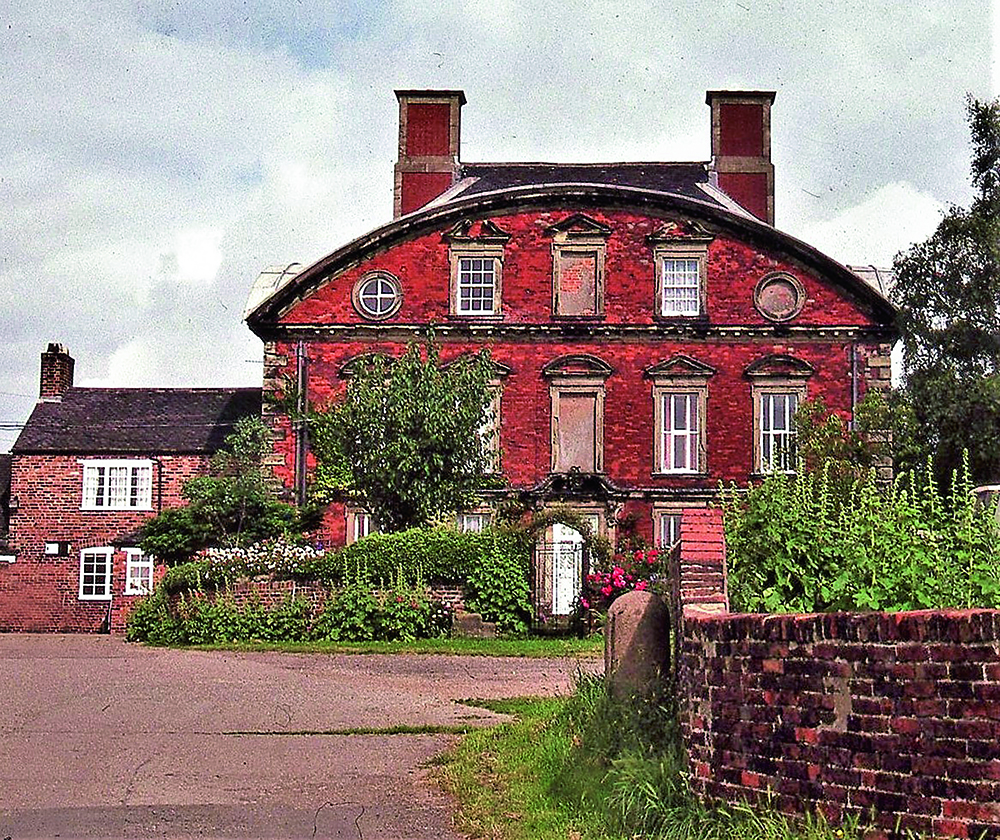
The present hall at Brizlincote is visible for miles around, set on its dominant hill and looking for all the world like an inverted helmet-type coal-scuttle with its legs in the air, represented, of course, by the chimneys and the giant segmental pediments which ensign the facades on all four sides. I have argued in the past that this extraordinary Baroque house was designed by Nottinghamshire’s famous ‘wrestling baronet’, Sir Thomas Parkyns of Bunny, for Lord Stanhope, eldest son of 2nd Earl of Chesterfield, and in the 22 years following, nobody has yet proved me wrong! Here, however, we have to consider the history of its long-vanished predecessor and although the parish (created from Winshill in 2003) is deemed to be in Staffordshire (since 1888) the hall still lies in Derbyshire. Originally, Brizlincote was part of the holdings of the great abbey of Burton, given as part of the foundation charter by the Saxon grandee Wulfric Spot in 1004. By the early twelfth century, the estate there was tenanted under the Abbot by one Mabon de Brizlincote, whose grandson Richard acquired the estate by grant of the Abbey c. 1175. The heiress of the Brizlincotes brought it to the Leicestershire family of Cuilly and the heiress of that family, Elizabeth, married John Stanhope of Rampton, newly arrived in Nottinghamshire from his native Northumberland in 1349. The de Brizlincote family probably built the first seat there, within a moat, substantial remains of which remain, slightly to the north of the present house, off Brizlincote Lane. These earthworks, which have never been investigated archaeologically, are said locally to hide vestiges of the house, too. The Stanhopes did not then have an interest in Derbyshire and thus they disposed of the estate to Robert Horton of Catton who died in 1423. Over a century later, his descendant Walter Horton sold it yet again to William, 1st Lord Paget of Beaudesert KG, an enormously rich courtier of Henry VIII, who had managed to engross almost all of Burton Abbey’s holdings at the Dissolution of the Monasteries in 1539. Paget clearly felt he needed a house near the epicentre of his extensive new holdings, Cannock Chase (in which Beaudesert lay) being some distance away, so having acquired the estate from Walter Horton, in January 1546 he obtained a licence from the king to ‘empark and crenellate’ the house. Thus, the land now lying between Ashby Road, the Beaufort Road/Violet Way estate, the A444 and the north west edge of Newhall (the clue is in the name: Park Road, Newhall) became Lord Paget’s parkland (something like 40 acres, if the size of the later farm is any guide) and his house, no doubt erected around a substantial courtyard, was suitably defensive in appearance, with plenty of – essentially ornamental – battlements, probably in the form of merlons. Although we have no illustration of the house (as we found with Bretby Castle: see March edition of Country Images) a 17th century writer said of it that it was ‘a large stone house that was set in its moat on a bleak ridge’ – probably cold and windy in winter but with incomparable views towards Needwood Forest and the Trent Valley! Lord Paget appears also to have walled the house round in stone, too, for we have 18th and earlier 19th century accounts of surviving stone walls but none remain today.. William Paget retired from state business in 1555, having survived his perhaps injudicious signing of Edward VI’s will – leaving the throne to the ill-starred Queen Jane – and the consequent obloquy heaped upon him by Queen Mary, to be re-instated by Elizabeth I. He died in 1563, having sold Brizlincote to a London merchant, John Merry in 1560. John Merry, of a Hertfordshire family, was a merchant tailor whose father had been clerk to the spicery of Henry VIII; he was a Roman Catholic, too. By 1560, recusancy was becoming an un-safe position, and expensive in fines, as well. His reason for buying in Derbyshire may have been influenced by Sir Christopher Alleyne, who had acquired the nearby estate of Gresley Old Hall only four years before. The fact that Merry’s wife Agnes was an Allsopp may also have been an influencing factor. Despite its prominent position, however, the recently rebuilt and fortified house may have enabled him to feel safe from the depredations of such as Lord Shrewsbury, bent on weeding out recalcitrant Catholics. Not that Brizlincote was his only acquisition. He also bought the estate of Barton Blount from the financially challenged Lord Mountjoy, as well as substantial land at Stanton-by-Bridge and at Sutton-on-the-Hill. John Merry appears to have lived at Barton, where he created a priests’ hole. His son John appears to have been settled at Brizlincote by about 1565. Meanwhile, his elder brother Henry of Barton Blount had four sons, of whom the third, Edmund left issue, settled at Radbourne where in 1670 his son Valentine paid tax on but two hearths, so was presumably farming as a tenant of the Pole family. The second son, John, succeeded his uncle at Brizlincote, but was a stout Royalist in the Civil War; he and his wife Anne found their estate sequestrated by the Commonwealth authorities in 1650 and he died not long afterwards. This Royalist left two sons and a daughter, the elder son, Gilbert, managing to recover Brizlincote Hall by compounding for his estate with Cromwell’s commissioners, but he then demised it to his younger brother, John Merry who was described as ‘late of Brisslincoate Esq.’ when he came into his brother’s other lands at Kniveton and Stanton-by-Bridge. John Merry left two sons, Gilbert of Stanton-by-Bridge, and George, the younger son, who had married Dorothy who, after his death in 1657 continued to live there with her second husband, William Dakin ‘of Brisslincoate, yeoman’ who seems to have farmed there. They were gone by about 1685, for we find it had a new tenant in the person of Worcestershire-born William Barnes,
From Hen Racing to a Bygone Industry What do you know about Bonsall?

Bonsall is tucked away in an upland bowl, high above the Derwent Valley and seems a place where time has passed it by. Nevertheless it has been home to a proud group of villagers since long before William the Conqueror’s scribes listed it as Bonteshall in the Domesday Survey. Its early prosperity was based on lead mining and the ore’s by-products, and also calamine (zinc carbonate) which when amalgamated with copper makes brass. Textile manufacturing followed the development of Richard Arkwright’s spinning mills at nearby Cromford, but before that came about, manually operated knitting frames were busy producing stockings in little barn-like sheds still recognisable up and down the village. Farming was Bonsall’s oldest activity, an occupation that took place as it still does on the rolling acres of limestone moors just beyond the village centre. Probably it is Bonsall’s remoteness that has preserved many of its old buildings and traces of the now dead industries. Access to the village is along the steep side road leading into Yeoman Street and the village centre before the road divides at Fountain Square, and then climbs to aptly named Uppertown by way of a winding tricky byway. The road up into the main part of the village is known locally as ‘Clatterway’, no doubt from the sound of mill workers’ clogs as they made their way down to Arkwright’s Via Gellia Mill. Now split into small industrial units, it was the unlikely birthplace of ‘Viyella’ fabric, the name a variant of Via Gellia, was invented by Hollins & Co, the firm which took over the mill. Red tape so loved by bureaucrats was briefly made in Bonsall. Standing on the corner directly opposite Via Gellia Mill is a house where the name above the door ‘The Pig of Lead’, recognises that it was until fairly recently a pub where miners could slake their thirsts before climbing back up Clatterway. The ‘pig’ has nothing to do with porkers but comes from the word for a lead ingot. A short diversion beyond the mill leads to another link with by-gone industry. A high wall separates what was once a lead smelting mill, but is now a storage depot for a skip-hire company from the busy road. This was latterly the site of a colour works where limestone-based powders were mixed with coloured sands for industrial use. It ceased production in the 1960s, but its sister company in Matlock Bath continued for a few more decades. At points along the Via Gellia road, occasional free-standing walls are all that is left of lime kilns where stone from nearby quarries was burnt to create valuable lime destined to sweeten farm fields far and wide. Turning up the Clatterway, the road passes groups of attractive cottages, once the base of no fewer than five separate industries. Within the space of around a quarter of a mile there was a blacksmith, a colour works (later moving into the Via Gellia site), a carpenter and finally a water-powered corn mill. There was even a small workshop making once fashionable combs from tortoiseshell. A ropewalk in a long narrow field made essential safety lines for lead miners. Bonsall Brook flows along a deep ravine to the side of Clatterway, its waters enhancing the attractive cottage gardens. Bonsall Brook seems to flow from below the lorry park next to the village recreation ground, but it starts life beyond the top of the village at Town Head and until it was culverted openly flowed down the side of Yeoman Street where every house had its own little limestone slab, which the locals proudly referred to as marble bridges. Traffic demands led to culverting the brook in order to widen the street; the nearby recreation ground is on the site of an in-filled dam made redundant with the reduced demand for water to power mills in Cromford. A fountain that once trapped the unwary by creating an ice rink every winter marks the turning into The Dale. Standing above it is a small café that was the ‘New Inn’, later it became known as the ‘Fountain’ until it closed in the 1980s. Next door is the village hall which took over the building from the local school when it was moved to larger premises next to the parish church, across the valley. To the left of the fountain and that increasing rarity these days, a well-cared for public toilet, a garage stands on the site of a private gas works; it belonged to the now completely demolished grand house called ‘The Study’, home of the Prince family. Yeoman Street and its continuation High Street can be said to mark the true centre of Bonsall. Although there are few indications of their former use, many of the houses lining both sides of the street were once shops. Due to its slightly isolated situation, the village was more or less self-supporting, with grocers, butchers, milliners, tobacconists, sweet shops and a corn chandler all serving the village’s needs. There were two Co-op shops, a post office and at least three fish and chip shops! The post office and co-op stood opposite the King’s Head public house and the premises have been so well converted it is hard to tell that the 19th century terraced house was once a shop. The mounting block outside the King’s Head is a sure indication of its 17th century origins. Its Jacobean links are continued by the low beams and totally unspoilt interior; all the past landlords are listed on a notice hanging behind the bar. The house next door known as the Queen’s Arms is of equal age and was also a pub that became a café and guest house. Facing both buildings is Bonsall’s stepped market cross which if local information is correct is built around a wooden framework, but nowadays rarely used as either a preaching cross or where produce was sold. Taking a right turn at the cross the narrow street first known
The Lost Houses of Derbyshire – Pilsley Old Hall

The last lost house about which I wrote was Coney Green Hall, bought in 1774 for £4,000 by Thomas Wilson, who also acquired Pilsley Old Hall, just over two miles away and still in North Wingfield parish, so it seemed logical to move right on to chronicle what we know about the latter. The Old Hall at Pilsley was a superb example of a minor Derbyshire manor house: seventeenth century in date, compact, gabled and sturdily built. It was deservedly listed II*, and was by no means too large to make a viable home for a modern family and by the time of its demise in 1965, it was in tatty shape but in reasonable overall repair. Its loss, therefore, prior to the 1968 Act came into force on 1st January 1969, which would have afforded it better protection, seems from today’s viewpoint well-nigh indefensible. The house was built of roughly coursed coal-measures sandstone and with a stone slate roof, topped by four stone chimneys, latterly with brick tops, neatly emphasising the hearth tax assessment of four hearths chargeable in 1670, although no doubt hearths were added to the bedrooms later. It consisted of two parallel ranges, running north to south, giving a twin gabled façade, each gable surmounting two bays on the principal floors and a central attic light, all originally being mullioned, probably the larger ones with single transoms. The windows had moulded surrounds and there was an unpretentious central entrance. The west side sported a ladder staircase window, lighting a fine quality Regency timber staircase (a replacement no doubt, for a more substantial original oak one) with a stick balustrade, triglyph carved tread ends over a Vitruvian scroll and a curled mahogany rail. Indeed, the tread ends are sufficiently old fashioned for one to suspect the staircase was perhaps at least a couple of generations earlier and was perhaps merely fitted up with a new balustrade by the Wilsons, possibly because the original one had become damaged. The east front was blind for two thirds of its length, ending with another staircase light, presumably for the secondary stair, and surviving superimposed two light mullioned windows beyond. Inside, the house was spacious and clearly intended for a gentleman rather than to act as a farmhouse, with a number of distinctive chimneypieces, most of which managed to survive into the twentieth century, that in the parlour even being flanked by a pair of arched niches complete with fielded panelled doors. Others boasted bolection mouldings, and some were of Hoptonwood polished limestone as, inevitably, were the cantilevered staircase and the floors in the hall and kitchen. Apart from modest cornices and dados, little superfluous ornament was applied and if there was panelling (highly likely), it had all gone by the time the Royal Commission of Historic Monuments for England photographed the house. At the time of Domesday, Pilsley was held in chief by Walter d’Eyncourt whose seat, Ayncourt, lay nearby (latterly a moated site, lost to coal mining in the later 19th century) and remained in the senior line of that family until 1442 when Robert, 7th Lord d’Eyncourt of Pilsley died without leaving any children. His barony fell into abeyance between the descendants of two aunts, and the estates passed to the then all-powerful Lord Treasurer, Ralph, Lord Cromwell, whose seat was Wingfield Manor. In 1456, he too, died without leaving issue when Pilsley passed to William 7th Lord Lovell of Tichmarsh. The son, Lord Lovell, Holland & Grey (of Rotherfield), was later attainted for high treason in 1484, when the estate reverted to the Crown. The estate at Pilsley then came to the Leakes of Sutton Scarsdale, although for whom it was built, probably c. 1630, is unclear: either a younger son, or for the estate’s bailiff or agent. Certainly, one junior branch lived at nearby Williamthorpe Hall and another might easily have been ensconced at Pilsley. Nicholas, 4th Earl of Scarsdale, spent a colossal sum rebuilding his main house at Sutton Scarsdale with one of England’s Baroque masterpieces (see May’s County Images), gambled heavily, dying without issue and essentially bankrupt in 1736, when it was sold to Richard Calton of Chesterfield a lawyer, who completed in 1743. He it was who probably converted the main fenestration to sashes in plain surrounds; the glazing bars were fairly thick, which invariably betokens an earlier eighteenth century date. His descendants lived there until the late 18th century when it was sold, along with Coney Green Hall, to Thomas Wilson, from a Nottinghamshire family snobbishly described in Throsby’s edition of Thoroton’s History of Nottinghamshire as ‘rich graziers.’ The fine regency staircase and other improvements were probably the work of the Wilsons, who, readers may recall, also set about making alterations to Coney Green as well. In 1850, William Henry Wilson, a land surveyor, was living there, and it was then that his family sold it to John Sampson a local brick and tile manufacturer. Later the Sampsons, in the person of the son, Luke, sold it again in 1880 but with only 23 acres, the remainder remaining in the hands of the Sampsons until the mid-1930s when, on the death of Thomas, Luke Sampson’s son, it was all sold up. The purchaser of the house, however, was E. A. Storer and in the Edwardian period, it was let to Granville Chambers, and later sold around 1930 to Mathew Eyre Wilde, JP who let it to Solomon Cutts. Post war, the last owner was F. Gardener of Littleover, but the house had fallen empty by the early 1960s, and architects Bestwick, Bowler and Hagg successfully applied for consent to demolish, and it came down on 13th August 1968, to be replaced – you guessed it! – by a new housing development. Why the developer could not have divided this venerable old hall into a pair of very pleasant period residences and built new houses, preferably out of local stone to a good design, beyond the immediate surroundings is a mystery; the
Places Pevsner Forgot III – Froggatt & Bretton
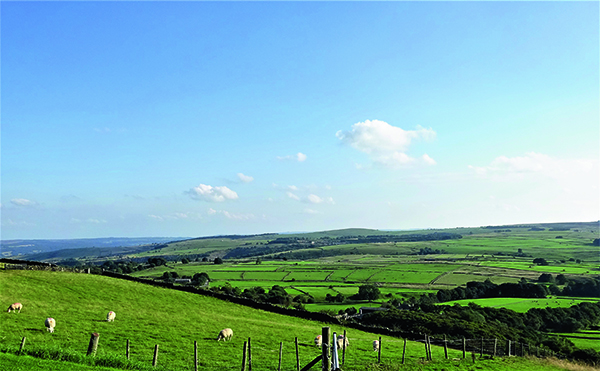
There have to be places that Sir Niklaus Pevsner omitted simply because the buildings there were not really worthy of record, but whilst one could not really say that about Froggatt, with Bretton it is different, for there are precious few buildings there in any case, but, like Aston and Thornhill, the scenery is electrifying. That said, there is not exactly a superfluity of buildings in Froggatt, either, hence the necessity of taking both together although, unlike Aston and Thornhill, they are not contiguous. Bretton lies half way up the ridge behind Eyam, whilst Froggatt is on the east side of the Derwent some three miles to the east of Bretton as the crow flies, but a deal further by car. Visiting Froggatt, which lies a couple of pastures east of the Derwent and overhung by the spectacularly craggy millstone grit Froggatt Edge, is best done by beginning at the lowest point. There are two ways of approaching the village, both equally rewarding. One is to take the A625 Sheffield road from Calver. One crosses the Derwent on a highish bridge over a miniature gorge, passing a grade II listed toll cottage and, having done so, one takes the next turning left, Froggatt Lane north into the village. The alternative is to drive up the B6001 Hope road from Calver up through a couple of turns until you meet the first tight turn, Stoke Lane. This gives one a splendid view of the exquisitely restored Stoke Hall, once the seat of the Simpson family, designed by James Payne no less, with help from James Booth, the gifted Stoney Middleton builder who contrived the octagonal church there. This lane takes one to a delightful 18th century stone bridge over the river (probably also the work of Booth and also grade II listed) which we cross and, in a short while, one arrives at a T-junction at which a left turn will bring you into Hollowgate, where both access routes converge. We left the car near the junction of Hollowgate with Spooner Lane, which runs level northwards, and Moorlands Lane, which diverges to your left and climbs. The cluster of mainly 18th century stone built cottages here make a delightful ensemble, and we were struck by the fact that the least pretentious, standing just by the junction, was a Wesleyan Reform Chapel no less, and indeed, its sheer undemonstrative charm seemed to us wholly appropriate. It bears the date 1832, but as the Methodist Reform movement was only formed in 1859 by a group which broke away from mainstream Methodism a decade earlier, the little building either began life as a barn or similar, or began life as a mainstream Wesleyan chapel. Adjoining it was (presumably) the former Manse, very early 19th century, with a pair of listed seventeenth century cottages beyond, whilst opposite, on the inside of the junction, stands eighteenth century Rose Cottage (also Listed Grade II), the giveaway being the unmoulded stone mullions to the windows. There are six or seven stone built cottages on the east side of Spooner Lane, too, which add charm to the ensemble at this point. However, we chose not to pursue this lane as it peters out in water meadows slightly further north, but instead turned up Moorlands Lane. This lane ascends through a number of gentle curves towards a junction with the Sheffield Road, well above the main village. It is delightfully bosky and affords excellent views of the valley, although most of the houses are 20th century ones. Whilst few are of any real pretension (and so would not have detained Sir Niklaus), they are all sequestered, and no doubt pretty expensive to buy for the punters from Sheffield, too which, one has to remember, is within commuting distance. The one house that did attract our attention was Frog Hall, a late Victorian stone-built villa superbly positioned overlooking the valley to the west but its façade largely obscured by a lush growth of creeper. The name seemed rather unlikely, and indeed, I recalled that I had a postcard of it, when it was relatively new, captioned The Moorlands, hence, of course the name of the lane (or vice versa); re-naming it so whimsically seemed to us a bit of a shame, really. Architecturally, it is Jacobethan in style with one section breaking forward, well furnished with mullioned windows and sprouting a cluster of diamond stacks on top, which the postcard shows were originally crowned by long salt-glazed cylindrical pots, now removed. Whilst it might be the work of a Sheffield architect, it may really be the work of a local firm, like John and Samuel Fletcher, father and son, builders and masons based in the village at this time and armed with a pattern book. We were amazed to find it unlisted but felt sure that Pevsner would have enjoyed critiquing it! The house was probably built for Harvey Foster, who was certainly in residence when the postcard was sent (confirmed by the directory for 1908); we imagine that he was possibly a Sheffield businessman. If so, he had died or moved away by 1926, when it became the home of the widow of Chesterfield manufacturer Charles Paxton Markham JP DL (1865-1926), Frances Margaret, née Nunneley. He had divorced his first wife and married her in 1925, but had barely survived a year before the excitement became too much for him. His younger brother Arthur survived to be made a baronet in 1931. By 1932 though, one Brian Cooke was living there and remained there at least until the war. We reached the top and turned hard right onto the main road, and were pleased to be able to descend, past the end of The Green, a pleasant if vertiginous street (ending as a path) running up from the village, before coming to rest at The Chequers inn, occupying a pleasant row of varied 18th century cottages on the east side of the road, with the woods below Froggatt Edge
Travelling Through History – Where Our Forebears Trod 3

Having looked at Rykneild Street going South West, I felt it might risk any enthusiast rather hanging in the air if I did not continue the story of the same ancient road in its opposite direction. After all it was the Romans’ major SW to NE route, and it seems rather to have pivoted at Derventio. According to the plan drawn in 1721 by the antiquary William Stukeley, it seems to have had a sort of bypass around Little Chester (as Derventio ultimately became). Once one had crossed the Derwent, as described last week, one reached the settlement itself by turning immediately north up what is now City Road to enter the Roman small town. But if you wanted to reach Chesterfield, the next settlement on the route, one passed Derventio to the east, along the alignment of the present Mansfield Road. Essentially, the route went due north along much of what is in part the A61, leaving the County boundary somewhere just NE of Dronfield. From the junction with Old Chester Road, Rykneild Street runs north along what is from the Old Chester Road called Alfreton Road (and Mansfield Road diverges east over the railway line). From there it went through Breadsall village, but its course thence has been utterly lost through the building of the Derby Canal (Little Eaton Arm), the Great Northern Railway line to Heanor and Sir Frank Whittle Way. But leaving Breadsall, drive between the church and the former school (founded by the philanthropic Harpurs in the Regency period) and you are back on the alignment. From there it runs straight as a die up Moor Lane to the entrance to Breadsall Priory, the original monastic house no doubt founded there for that very reason: ease of communication. From there it backs more to the NNE as Quarry Road and you can follow it from the comfort of your car until the T-junction with Brackley Gate/Cloves Hill. From there the course is barely visible, but is helpfully marked on the 1:25,000 OS map, from which you can tell that Horsley Lodge (where acceptable refreshment may be obtained) sits right by it and one suspects that the drive overlies it to a large extent. Unfortunately, the construction of the golf course around it, without an archaeological assessment, has probably led to the loss of much potential information along with stretches of agger – the bank on which it was pitched – is visible in part in the fields to the north. From Golden Valley to Bottlebrook (which it jinks as it crosses) it follows part of the modern road on the east of Kilburn, helpfully named Rykneild Road until it jinks at the point where Denby Lane goes off to the right, but continues as Ticknall Lane, Rykneild Hill, Station Road and then Street Lane Marehay, right up to the point where the alignment it cut by the modern A38 just west of Ripley. The course then backed NNW to ascent the ridge to cross the B6374 Upper Hartshay to ascend Bridle Lane across the A610 and up onto Pentrich Common. Pentrich is one of a select few Derbyshire places with a fully British name rather than Anglo-Saxon or Danish. It derives from penn (=hill) and tirch, plural of twrch (=boars), thus Boars’ Hill. On the highest point, just short of Castle Hill (and hence the name) are the vestiges of a Roman fortlet , built as the temporary home of a cohort sized detachment of soldiers probably in the first stages of the conquest of Northern England around 47-50. That it may have found use later is possible, for it must long have been a feature in the landscape to name the accompanying summit. Descending from there it meets the alignment of the B6013 and runs through Oakerthorpe, Fourlane Ends to Toadhole Furnace where it parts company from the road and proceeds along the hillside below the road until the two re-combine at Higham, where there was once an ancient cross on the alignment. Strettea Lane is another Roman Road (as one might gather from its name) running from Higham eastwards to Stonebroom and Morton. Just north of Higham the alignment becomes the A61 and runs through the diagnostically named Stretton-in-Shirland. Thence it follows the A61 un-deviatingly, all the way through Clay Cross, Old Tupton, Birdholme and thence across the Hipper (where the discovery of a stone paved causeway was reported in the local paper in 1932) to Chesterfield, Old English caestra (from Latin castrum = fort) + feld (= field). Here there was a fort, in use from around 68 to 120 but later used as a store prior to abandonment, although the civilian vicus around Vicar Lane probably supported a small wayside settlement including a posting station or mansio. In fact the site of the fort – the famous parish church of St. Mary & All Saints sits within its former enclosure – is now believed to overlie an Iron Age hill fort on this spur of land above the valley of the Rother, crossed by Ryneild Street possibly north of the town presumably via a causeway and ford, although no-one is quite sure. The real problem at Chesterfield is that the Romans appear to have abandoned it relatively early, so that when a new settlement eventually came about, no vestige was left to inform the street pattern, unlike many other places; only the walls of the fort, inside which the church was founded, were probably obvious several hundred years later. That being so, there emerges a real problem when it comes to following Rykneild Street north out of the town. William Bennet, the antiquarian Bishop of Cloyne, wrote at the beginning of the 19th century, ‘The country people have a tradition of the road going on still further to the north, and that after crossing the Rother near Chesterfield, it proceeded on the east side of that brook, passing on the west of Killamarsh church, and through the parish of Beighton
Lost Houses of Derbyshire – Langley Hall, Meynell Langley

The history of Langley, just north west of Derby on the road to Ashbourne, is complex to say the least. As a consequence, it is not without its fair share of lost houses, about one of which we have sufficient information to be able to say something about it. The manor of Langley originally consisted of a knight’s fee and, by 1108 had been granted by the Norman grandee Ralph FitzHubert to one Robert de Meynell, whose father was the Domesday tenant of FitzHubert in the NE of the county. Until the senior male line of the de Meynell’s failed in 1227, and the family’s extensive holdings were divided amongst the husbands of his four daughters, the family continued to hold it entire. At that date however, some family holdings survived the division of land, and a half knight’s fee at Langley was bestowed upon the next brother of the grandfather of the four heiresses, who was called William. Another half knight’s fee at Langley – half the original manor – was bestowed upon William’s brother-in-law, Nicholas son of Ralph of Langley, otherwise Nicholas FitzRalph. The division was basically made using the line of the ancient Derby to Ashbourne road as a boundary. Nicholas FitzRalph had everything to the south, including Nether Burrows, Langley Common and Langley Green. He also founded the church of St. Michael on his half, for it does not appear in the Domesday Book and is mostly of that date and later. Hence his portion was distinguished by the name of Kirk Langley or Church Langley, the use of the Norse derived term ‘kirk’ suggesting a substantial Danish-speaking population in the area since the fall of eastern Mercia to the Vikings in 874. A new settlement grew up around this church. Meanwhile, William de Meynell retained everything to the north and east of the road, including the original village, which henceforth became Meynell Langley. It was situated just to the north and east of the present Langley Hall, and was investigated archaeologically in 1980. William de Meynell, seems to have adopted the place as his chief seat and built a house for his son mentions a ‘capital mansion’ there in a charter drawn up a few years later. Probably he founded a chapel to serve the village, too, and this appears to have become absorbed by the house, as happened at Markeaton Hall in the Medieval period. Once the village had become de-populated, it eventually became the hall’s domestic chapel. Further evidence for old Meynell Langley Hall dates from 1555 when it is recorded as having a deer park. William Senior’s map of 1640, shows a house, more or less on a similar site to the present hall, orientated NE-SW and set around most of a large courtyard. Now, the chances are that it had once been twice that size by the early 14th century, for the Meynells had become very important figures, two of them (both called Sir Hugo) serving as stewards to the Ferrers Earls of Derby, all holding important administrative posts and two fighting doughtily in Edward III’s campaigns in France. They even briefly inherited a barony from the de la Wardes of Newhall. They were certainly of equivalent standing to the FitzHerberts of Norbury, a fragment of whose ancient house survives. We know from research carried out in 2010 that originally Norbury Hall was set around two courtyards which was par for the course with important knightly families in our area then. Therefore, the inference must be that the hall at Meynell Langley was similarly laid out. Meanwhile, the FitzNicholas family at Kirk Langley were followed by the Twyfords, and the Twyfords by the Poles, and until the latter family inherited the place, no one amongst these families with their chief seats elsewhere, needed a house at Langley. The Poles however, did build a house, beside the church, the site of which is marked today by some uneven lumps in the field, called Pool Close, the mutated name deriving from that of the family. We have seen that in 1227, the senior line of the de Meynells ended with heiresses, leaving a younger branch with a diminished holding – mainly half of Langley and other places. The same thing happened in 1397. Ralph de Meynell died in 1389 leaving four daughters, who all married. His mother, Joan, held the estate until her death in 1397, when she divided it up, mostly between the daughters’ husbands, but part was bequeathed to her brother-in-law Sir William Meynell, whose posterity moved to Willington and Yeaveley. Meynell Langley went to Reginald Dethick of Dethick, whose only daughter married Ralph Bassett of Blore, in Staffordshire. It remained with their family until 1602, and the Bassetts it was who must have reined in the size of the house. They also rebuilt the chapel in Henry VIII’s reign, the date being confirmed by a pair of Nuremberg jettons found beneath the floor when it was demolished in 1757. From the Bassetts (who had as well bought Kirk Langley from the last of the Poles in the 1590s, re-uniting the manorial estate) it all passed to Charles I’s most loyal supporter, William Cavendish, 1st Duke of Newcastle, who allowed various relations to live in the hall, and who commissioned the 1640 map. By this time the village had vanished entirely – probably through a combination of the catastrophic climate change event of the 1340s, the consequent Black Death and the creation of the park, though by the 1640s the park too was mainly divided up for agricultural purposes. In the end, the Duke was financially ruined by the Civil War, and was keen to sell. The buyer was Isaac Meynell, one of three brothers who made colossal fortunes in the City during and after the Civil War; all three were descendants of Sir William Meynell of Willington, and were clearly keen to see the family return to their ancestral acres, despite the passage of 272 years! It eventually came
Historic Steam Railway Posters

When I was just five Maude, my nanny, was charged to take me off on holiday to Plymouth. I have no idea to this day why my parents could not go with me, but we were to stay with a relative of Maude’s for a few days. Clearly my parents were staying behind for some special reason, for no expense was spared: we were to travel on the Devon Belle, a short-lived Pullman express as it turned out. As a consequence, I was beside myself with excitement! At Waterloo, I was allowed to go down to the head of the train to admire the big blue Merchant Navy class engine (so coloured as an abortive experiment by the newly fledged British Railways) and say hello to the driver and his fireman; we were also given a small paper-covered illustrated booklet which I still have. I recall the journey vividly, but apart from being on Plymouth Ho, I cannot remember the holiday at all. It was not so long afterwards that I saw a very famous poster used by Southern Railway before the war, of a child in almost the same posture as I had been at Waterloo (albeit down at track level), looking up at the crew of ex-LSWR N-15 King Arthur class No. 755 The Red Knight, preparing to head the Atlantic Coast Express. It was memorably captioned in supposedly child’s handwriting, ‘I am taking an early holiday ’cos I know summer comes soonest in the south’. A 1925 black and white version (showing the engine number), was taken from a photograph by Charles E. Brown of 1924 which has ‘South for Sunshine’ below the illustration, and a modified version of the child’s declaration ending ‘….because it’s safer and quicker by rail.’ Today that poster in a sale would be estimated at over £1,500, and the earlier version at around £800. Which tells you that collecting original British steam railway posters is a rich man’s hobby. Yet they combine two elements for the collector: railway history and astonishingly fine work by distinguished artists. The railway companies which existed in some profusion prior to their grouping into four in 1923, all issued promotional posters of varying types. Some Edwardian ones are only worth £350-450 simply because they’re not especially artistic, yet these early ones are still collected and some can be amongst the least expensive. Yet the most memorable is the 1908 Great Northern Railway image by John Hassall of the ‘Jolly Fisherman’ accompanied by the ‘Skegness is so Bracing’ slogan; an originally will set you back over £2000 in good condition. From Grouping in 1923 to Nationalisation in 1948 the four companies – Southern, Great Western, London North Eastern and London, Midland and Scottish – really took poster design to new levels, employing a number of very famous artists, including Norman Wilkinson. I mention him, because his first work was in 1905 for the LNWR, but it was his work for the LMS that is most striking. Indeed, his view of the launch of TSS Duke of York brings to mind his wonderful frescoes in the entrance hall of Derby’s Railway School of Transport at Wilmorton, not to mention his work in several famous cruise liners. Other well-known views include the GWR’s Cornish Riviera posters, Stanhope Forbes’s LMS ‘Permanent Way – Re-laying’ and my favourite, Fred Taylor’s LNER Cambridge showing James Gibb’s King’s College with the Chapel behind. These tend to sell for £1,000-1,250 or above, depending on the artist and indeed the status of the subject. Some can comfortably reach £4,000 in good condition. The years of Nationalisation were dog days indeed for those of us who were obliged to use the railways regularly, the 1950s and 1960s especially – filthy carriages, abominable time-keeping, out-of-date stock, surly station staff, closures of services and constant strikes – only those over sixty or so will remember them now and smile wryly, whilst those of tender years continue to insist that all the ills of our now much more heavily used railways can be cured by a re-nationalisation, to being run by civil servants and political stooges. Yet in poster-making, dear old BR excelled, notably by employing artists like Frank Sherwin, Leslie Carr, Reg Lander, Claude Buckle and above all Terence Cuneo (1907-1996). Needless to say it is the latter’s posters which invariably make the best prices, and his genius of draughtsmanship, mastery of composition and facility with oils (not to mention his trade-mark mouse, invariably hidden somewhere in the composition) mark him out as exceptional. At the time I loved his early 1960s view of Clapham Junction, taken in an era when I was going back to school via the Atlantic Coast Express and loving every second of it. His view of Brunel’s Royal Albert Bridge at Saltash (painted for BR (W) to mark its centenary) is also most memorable, and £2,000 is around the minimum you might expect to pay for one of his, although we at Bamfords usually estimate slightly worn ones at £500 to £800 (expecting and usually getting better), although his ‘Tracklaying by Night’ poster was recently estimated by Bonhams at £1500-2000 in excellent condition, although the original painting for a poster of the Golden Arrow express, c. 1962 also with them, failed to sell against an estimate of £40,000 to £60,000. Nevertheless, for the original oils, therefore, add noughts! Yet the inter-war years were a golden age for the railways, for people didn’t go abroad for holidays, they travelled to places in England; they’d go on golfing holidays or shooting to Scotland, eat dinner and sleep on the train, and then get woken up with a cup of tea and kippers in the morning. Accordingly it was a golden age, too, for railway poster art. Another notable example was the colourful and then slightly risqué scene of mainly female bathers advertising the charms of Southport, painted for the LMS in 1937 by the Italian artist Fortunino Matania. Recently one sold for over £10,000. Yet
Lost Houses of Derbyshire – Devonshire House, Derby

A great friend who is the senior caseworker for the Georgian Group, was asked by the City Council to comment on an application to convert the upper floors of 35, Cornmarket into flats. Our own Conservation Area Advisory committee, which until recently I chaired, had already questioned the applicant’s desire to remove the surviving staircase of a building which is the surviving portion of one of Derby’s greatest lost houses, Devonshire House, 34-36 Corn Market. This was where 18th century Dukes of Devonshire would reside when in Derby to preside over the three annual Race Balls and various civic business – bearing in mind that the Dukes were hereditary patrons of the Borough until 1974. In his report, in The Georgian, the house was described as ‘said to have been’ the town house of the Dukes of Devonshire. However, there is no doubt about the identification, for although little seems to have come to light at Chatsworth in the archive, other pieces of evidence confirm the identification of a building that was outwardly intact until 1969, when much of it was heedlessly destroyed in favour of an ugly brutalist Littlewood’s store (now Primark). The origin of the house goes back to the time following the death of Bess of Hardwick, whose last (fourth) husband, George, Talbot, Earl of Shrewsbury, was the builder of a grand house on the north side of the Market Place, which passed to his elder stepson Charles Cavendish, whose son William later rose to become 1st Duke of Newcastle. This house, Newcastle House was demolished to build Derby’s Assembly Rooms and its tale was recounted in Images for July 2014. The Dukes of Devonshire descend from Charles Cavendish’s younger brother, William, Lord Cavendish of Hardwick and later 1st Earl of Devonshire. A catalogue in Derby Museum asserts that the family town house was built in Corn Market in 1750 and although the catalogue was compiled in the late 19th century, the information was drawn from ‘jottings’ of John Ward FSA which include material dating back to the early 19th century. Tantalisingly, John Speed’s famous map of Derby, in showing the houses on the east side of Corn Market – then a bustling area funnelled out southwards towards St. Peter’s Bridge where grains were bought and sold from raised basins, set up on posts, called stoops – adds a number 25 just behind the position where we know the 1755 house stood. If you look up No. 25 in the key at the bottom, it says ‘Town House’. Could it be that Lord Cavendish even then had an important residence there? The house built in 1755 was in fact a re-fronting job, as early plans reveal three burgage plots on the site and later plans reveal a thoroughly irregular plan suggesting that the work was largely a re-fronting of more than one existing building. The resulting brick façade was very impressive, however, and very Palladian. There were three floors plus attics, and the building was nine bays wide. The ground floor was originally rusticated: that is faced in stone with prominent grooving between the blocks, a typically Palladian conceit, and traces of this appeared during demolition in 1969, as the later shop-fronts were being ripped away. The central three bays broke forward slightly under a pediment itself flanked by a stone coped parapet with recessed panels over the bays and originally without doubt embellished with urns. The bracket cornice below was deeply moulded and the windows on the first and second floors had bracketed entablatures over whereas on the central three bays, the middle windows had segmental pediments those flanking triangular ones. The attic windows were embellished with stone rusticated lintels, wavy along the bottom edge. Originally, the maps and plans inform us that there was a central carriage arch leading to a rather constricted courtyard behind, flanked by two non-matching rear extensions. No record seems to exist of the interior of the house, although there is a passing mention of fine plasterwork, earlier panelling and a fine oak staircase. At Chatsworth a bill survives dated 1777 from William Whitehurst, brother and works manager to John Whitehurst FRS, for a timepiece and case, which an attached voucher identifies as one installed in the kitchens at the Derby house. Probably it was a typical round dial oak cased long case clock, which are very rare as non-striking/chiming timepieces. A very similar one still stands in the almoner’s office at Chatsworth. There were also extensive gardens to the east, stretching to the Morledge and the Markeaton Brook as it swung NE through what is now Osnabruck Square. A stable block and carriage house were attached to close the rear courtyard off. The builder of this impressive occasional residence was William Cavendish, 3rd Duke of Devonshire who died in 1755. The identity of his architect for the house remains a mystery, for although James Paine was working at Chatsworth for the 4th Duke (from 1756), the façade in The Corn Market shows few of his usual conceits and if the 1750 date is correct, it is too early. William Kent had been employed by the same Duke to completely rebuild the fire-wrecked Devonshire House in Piccadilly, but apart from being severe and equally Palladian, there the resemblance ends. Personally, I suspect the house was built and the façade designed by the young James Denstone (five years later the architect of Markeaton Hall) perhaps working under his former master, Solomon Browne, but until some hitherto un-discovered payment vouchers appear in the Chatsworth archive, speculation will prevail. The curly lower edge of the attic story lintels, however, reappear on Leaper & Newton’s Bank (not the Thomas Leaper bar) in Iron Gate and once on the fenestration of the Babington Arms, Babington Lane, demolished in the 1920s. By about 1814, the area in front of the house had become too noisome and insalubrious for the 6th (Bachelor) Duke and, pulling rank as Lord Lieutenant of the County, he thenceforth requisitioned the 1811
Derbyshire Antiques & Collectibles – Vintage Telephones

Those of us over a certain age will know that, until 1984, when the GPO (Post office telephones) monopoly was broken up, one did not actually own one’s telephone, but rented it from the GPO along with associated installations. Thus there was very little choice over the type of telephone one could have. Collecting these instruments now is a relatively inexpensive hobby, with most types being available for under £50, although as usual condition is crucial and if an example has been adapted for modern plug in use, then the price is enhanced. When I lived in my mews house in London in the late 1960s we had two lines – KNI[ghtsbridge] 1136 and 9226 – both equipped with rather sleek plastic ’phones in two-tone grey and plastic flexibly spiral cord. Yet when I got my first place in Derby, in Littleover, I inherited a hefty Bakelite job with a fabric coloured platted cord – much inferior to my way of thinking. This latter was a GPO type 332 introduced in 1937 (expect to pay between £20 and £80 depending on condition, but add £250-300 if originally supplied in cream). It had a ledge under the rest with a recess so you could carry it around – provided that you paid the GPO for an extra-long lead. In contrast, my London ’phones were (then) up-to-the-minute type 706 ones, which also had the option of a wall-mounted version, one of which we had. For these today expect to pay as low as £10 and up to £60, much depending on the colour. The letters on the dial were to enable one to dial London numbers: three letters (part of a name identifiable with a distinct area) plus four numbers a system converted to all number in 1970. Yet my earliest memories of telephones included various elderly relatives with ‘candle’ upright instruments, from which the earpiece hung from a metal bracket which opened and cut the line when the weight of the earpiece was removed or applied. The earliest of these were Bakelite and brass-mounted, called a type 150L dating from the early 1920s. Today, expect to pay £80-120 or double that if sold by a dealer. The ones I seem to recall were a later modification eliding the brass mounts, although they had the refinement of a silver-coloured metal dialling ring for London subscribers with one’s ’phone number printed on a disc in the middle and covered by a bit of clear plastic. These can fetch £120 to £150 at auction, and the bell set alone can cost £25-30. These evolved after a while into the more compact type 162 which had its own bell incorporated, now selling for similar prices. For the purist, the 1890s Ericson-made GPO phones – very antediluvian in appearance and predominantly brass – were around until after the Great War and can fetch several hundred pounds. Yet by the 1950s most of my friends and relatives had the first type of pre-war ’phone with a horizontally placed handset, set on a slim neck, again, so that it could be carted around, and called by collectors a ‘pyramid’ ’phone. This was a heavy-ish Bakelite instrument called a type 232L; again, it came with a dial-less version called a 232CB; both had a little drawer in the base in which to put one’s friend’s numbers. One was sold with a £80-120 estimate by Bamfords a year or two ago, although the pre-war ones (check base for approximate dating evidence) can make up to £225, and cream examples from £275, even more with bell set and drawer to base. They were introduced in the early 1930s and kept going into the 1950s, although the type 332 was a later improvement, which continued to be supplied for years after the war – likely to cost £50-80 now, but a cream one might go to £300. In darkest Herefordshire, the cousins with whom I lived after my mother died had a wall-mounted exchange with a handle on the side of its timber body which one had to crank to put callers through to the appropriate extension on the estate; this was in service until at least 1970. I saw a similar one on sale at a fair for £130 recently. By the time the writing was on the wall for the GPO monopoly, one could buy a variant of the type 706 (called a type 746: £35-60) which came in a dizzying variety of seven colours, or a type 756 which had a push-button dialling facility (£30-50). Indeed, the current craze in the 1970s was for the type 722 ‘Trimphone’, the first instrument to ring with a different sound to the then-familiar double ring: they produced a horrible chirruping noise, much imitated on TV gameshows. Rt. Hon. Anthony Wedgwood Benn (formerly 2nd Viscount Stansgate, briefly MP for Chesterfield and the then Postmaster-General) presented the first one to a subscriber in 1965, but it was not actually available until 1968. Incidentally, ‘Trimphone’ is an acronym: Tone Ringing Illuminated Model. These go for £30-40 nowadays, colour being important. There was also a lightweight version of the type 746 which looked more like the familiar US domestic ’phones of the era, but which never seems to have caught on – at least amongst those of my acquaintance but despite rarity, cheap to buy. Going back to the early days in the 1890s the telephones were subject to infinite slight variations, all of which came with a separate bell unit, usually attached to the wall nearby (a phenomenon which endured to some extent to around 1970), no dial and a crank attached to a magneto wherewith to raise the exchange. It was only when the type 150 came in that standardisation largely prevailed. There were also various later types with buttons on the top by the rest for business use, or for domestic premises with extensions, and larger, more complex office installations, too. All the types had wall-mounted variants, although the candlestick variant was
Derbyshire Antiques & Collectibles – Railway Locomotive Name Plates

Last year we had a whole bunch of railwayana through Bamfords, mainly authentic relics of the great age of travel, but amongst them the nameplate of a locomotive built by the Southern Railway just after the Second World War and known to enthusiasts (in my time at least) as a ‘spam can’. These were large mixed traffic semi-streamlined engines, partly called after places in the West Country (where they were intended to serve) and partly after matters connected with the Battle of Britain and destined for service in Kent. The particular item was Battle of Britain Winston Churchill – the very locomotive which had pulled the late prime minister’s funeral train to Bladon, Oxfordshire, where he was buried. I am old enough to recall seeing it (despite poor reception in mountainous North Wales) on a black-and-white TV that January day in 1965. Such was the fame of this relatively short-lived machine that I knew that what we had was a full sized replica, and it duly sold for a couple of hundred pounds (non-replica) money, as it were. There are plenty of these around, although a new replica can cost you quite a bit more. Look out for one of the initial locomotive of the ‘Lord Nelson’ class (SR again) and you’ll have to shell out £790 for a solid brass copy in full size. But it got me thinking. If you can pay nearly £800 for a replica of a nameplate of a famous – say an ‘iconic’ – locomotive, what might the cost of an original be? Locomotives have borne names ever since Rocket and its rivals vied for supremacy at the Rainhill trials in 1829, so there are nominally a lot around. Yet 19th century survivals are fantastically rare most, sadly, were scrapped with the time-expired bearers of the name. Nearly everything now available for sale comes from the last generation of steam locomotives (I leave aside nameplates from diesel and electric locomotives: they are less sought after, usually of less good quality materials and commoner, despite still making relatively good money). Most engines with names were express passenger ones of various sizes. The handsomest were those on the locomotives of the old Great Western, cast in brass on heavy plates, often curved to fit over a wheel splasher. Modest Cobham Hall fetched £5,800 in 2010. Other companies used steel ones, usually smaller, although the Southern Railway did brass ones until the war. Rarity is often an indicator of price, so one works out the number of a particular class of engines built and multiplies the total by two (there being a name plate on either side of the engine). Thus Derbyshire-born Sir Nigel Gresley designed the not particularly memorable ‘Hunt’ & ‘Shire’ class of 4-4-0 locomotives in the 1920s. The LNER built forty two of them, meaning there must have been 84 nameplates, mainly counties but also names of particular Hunts. I recall sitting with my father around 1961 when we learnt from his newspaper that British Railways were scrapping these engines and, by applying to BR one could acquire a nameplate of one’s choice for about £75 – scrap value plus cartage. As one of these machines had been called The Craven, I urged Papa to put in an offer for it, but when they told him the price (which in retrospect he could well have afforded) he demurred. Yet it would have made a splendid investment today, 57 years later, for one sold not so long ago for £15,100! Another reason for them being scarcer than they are is that many were presented by BR to the institutions after which the engine had taken its name. Thus many ‘Battle of Britain’ class engines had their squadron number nameplates with their accompanying badges, enamelled onto a large attached oval, were presented to the relevant squadron HQs. Football clubs whose names had adorned LNER B17 class engines were presented with the relevant plates, and to all sort of stately homes received plates from Great Western Railway ‘Castle’, ‘Hall’, ‘Manor’ and ‘Grange’ class locomotives.. But to acquire these wonderful items, one requires fantastically deep pockets. Top price to date was a sister engine of world speed record breaking Mallard, called Golden Fleece. One plate alone went for £60,000 in December 2014, whilst another from its sister engine Golden Eagle fetched £31,000 two years ago. Mind you, less romantic names suffer price-wise: Another Mallard sister, prosaically named after a director of the company, Sir Murrough Wilson, only made a paltry £19,600! The nameplates from the equivalent top-link locomotives on the rival LMS also make similar money, although neither are much to look at compared with one from a ‘spam can’ or a GWR engine: ‘Princess Coronation’ class Pacific City of Liverpool made £36,900 (place loyalty, no doubt!) whereas Queen Elizabeth from a similar engine, but from its days as a streamliner, made £51,500. More affordable are brass nameplates of the Southern’s likeable but modest ‘King Arthur’ class engines, retailing at around £8,000 at present, although the obscure Malorian Sir Durnore made £8,600 not long ago, so heaven knows what King Arthur himself might command! In other words, it is fame and popularity which makes the big money. Take the sister engines of Flying Scotsman. Most were named after racehorses which had won classics in the forty years or so before the engines were named. This in itself resulted in some oddities, like Dandy Dinmont (survivor of a serious collision before the war), Call Boy and Galopin (geddit?). Thus, Minoru has recently sold for a very modest £7,000, but one of the more famous members of the class could add a nought easily – or very nearly. Industrial locos also often carried names. They were usually simple little engines and accordingly had simple names, like Jane, Mersey, Powerful, Diamond or Colliery No. 1. These plates can actually be affordable, and start at something in the order of £250 rising to £1,250 for better known ones. The added pleasure