Lost Houses of Derbyshire – Rough Heanor Manor

By Maxwell Craven If you drive from the Royal Derby Hospital to the A38, you might notice that, between the two is an island of overgrown vegetation with a busy slip road on either side of it: a rather desolate place surrounded by roads. Although it is not visible, inside stands an 18th century brick farmhouse and some mainly modern outbuildings: Rough Heanor Farm. It all looks frightfully unprepossessing. Yet in truth the site has a very long history and one not without significance, in the main all well recorded in Medieval charters and post-Medieval estate records. Originally, its name was simply Heanor (Henovere), part of a suite of three names in Mickleover ending with the modern English suffix ‘-over’: Mickleover, Littleover and Rough Heanor. Heanor is a combination of Saxon heah (= high) and ofer (= ridge), thus ‘High Ridge’. A thousand years ago Rough Heanor was part of the large and important manorial estate of Mickleover, first recorded in Domesday Book, and then also consisting of Mickleover itself, Littleover, Findern and Potlock. For reasons now lost to us, the entire manorial estate was, at some time after 25th December 1066 and 1st January 1085 granted by the King to the Abbot and canons of the Abbey of Burton. (Rough) Heanor itself is first named in the early 12th century, in a land grant of Geoffrey, Abbot of Burton, confirmed in a charter issued between 1150/1159 by his successor, Robert who ‘…concedes the grant made by my predecessor of blessed memory Geoffrey…to Robert son of Walchelin…that land in [Mickle]over called Heanor’. This Robert son of Walchelin, or ‘FitzWalchelin’, held the land in perpetuity in return for an annual payment of 5/- (25p) – a nominal sum, representing that although the grant was hereditary, the Abbot remained technically feudal overlord of the estate. Abbot Robert’s successor, Bernard, in 1160/74 increased the annual payment of half a mark (thus 6/8d = 34p). Robert’s father Walchelin held the neighbouring manorial estate of Radbourne. He had married a daughter of Henry de Ferrers, one of the great feudal barons of the Conquest who was by 1086 in possession of 115 manorial estates in Derbyshire alone, including Radbourne. Walchelin’s name suggests that he was already a kinsman of some kind of Henry de Ferrers, too. Robert had three sons, of whom the eldest, Robert III FitzWalchelin became the ancestor of the Chandos and Pole families, the second was settled upon an estate in the NE of Derbyshire, and the youngest, Peter, was settled at Rough Heanor, which was then clearly considered a viable enough estate to support him and his family. This Peter is referred to both as Peter FitzWalchelin and as Peter de Heanor, the latter style clearly implying that he lived on his holding and thus strongly suggests that some kind of a dwelling of élite character must have come into being from this time, the manor house. Peter’s grandson, Nicholas, seems to have achieved considerable status, for we find him holding the manor of Shipley in 1242 and in 1258 sub-divided portions of the manors of (Rough) Heanor and (Kirk) Langley. The family seem to fade from record after the first third of the 14th century, being most probably wiped out in the Black Death ravaging the country 1348-1350. Subsequently the manor and site of the settlement devolved on the de Heanor’s closest kin, the heirs of Robert III FitzWalchelin of Radbourne and became part of the wider holdings of the Chandos family, by that date the FitzWalchelins’ successors. There is also plenty of charter evidence for a settlement as part of the manorial estate, too, although it probably ceased to be viable after the Black Death and the ‘climate anomaly’ that immediately preceded it, which plunged the county into cool wet summers and much colder winters after some 600 years of warmth. There was living in (Rough) Heanor in 1327 a Richard ad Crucem – ‘Richard near the Cross’, suggesting a preaching cross was then still extant. It was probably positioned on the border between this part of Mickleover and Littleover, thus on or by the Uttoxeter Road, as a focus of Christian preaching established before the churches came into being. There is also compelling evidence for the manor house having had a domestic chapel at (Rough) Heanor, too. The fact that this has not been noted previously is that the history of the church of St Mary at the modern town of Heanor has become entangled with references to this chapel at (Rough) Heanor and a lost parish church of St. Mary in Derby. Nevertheless, although not in existence before 1160, the chapel seems to have been founded soon afterwards, probably when Robert FitzWalchelin was granted the estate, as a domestic chapel to the house which Peter FitzWalchelin chose to build there. This chapel may have been dedicated to St. Nicholas, perhaps explaining the congruence with the name of the two successive Nicholas de Heanors, who seem to have been lords of the manor in the 13th century. One 19th century source indeed, avers that Mickleover church to which the chapel belonged, was once so dedicated itself, probably as a confusion with the chapel-of-ease nearby. After the late 1340s, then Rough Heanor became a deserted medieval village (DMV) and the house was probably abandoned, or reduced to act as a farm for a Radbourne estate tenant. Yet documents dating to 1398, 1408-1409 and 1492 mention only a leased messuage (house and land), at one stage successively the residence of younger sons, Thomas and John de la Pole, second and third sons of Sir Peter de la Pole, the man who had acquired Radbourne by marriage with the heiress of Sir John Chandos KG, hero of the Hundred Years’ War. In 1713 William Woolley recorded that ‘In 41 Elizabeth [1597] Germain Pole had an estate here…which he left to his son Thomas. I suppose they may have it still and it is now called Rough Heanor.’ This is the
Lost Houses of Derbyshire – Old Radburne Hall
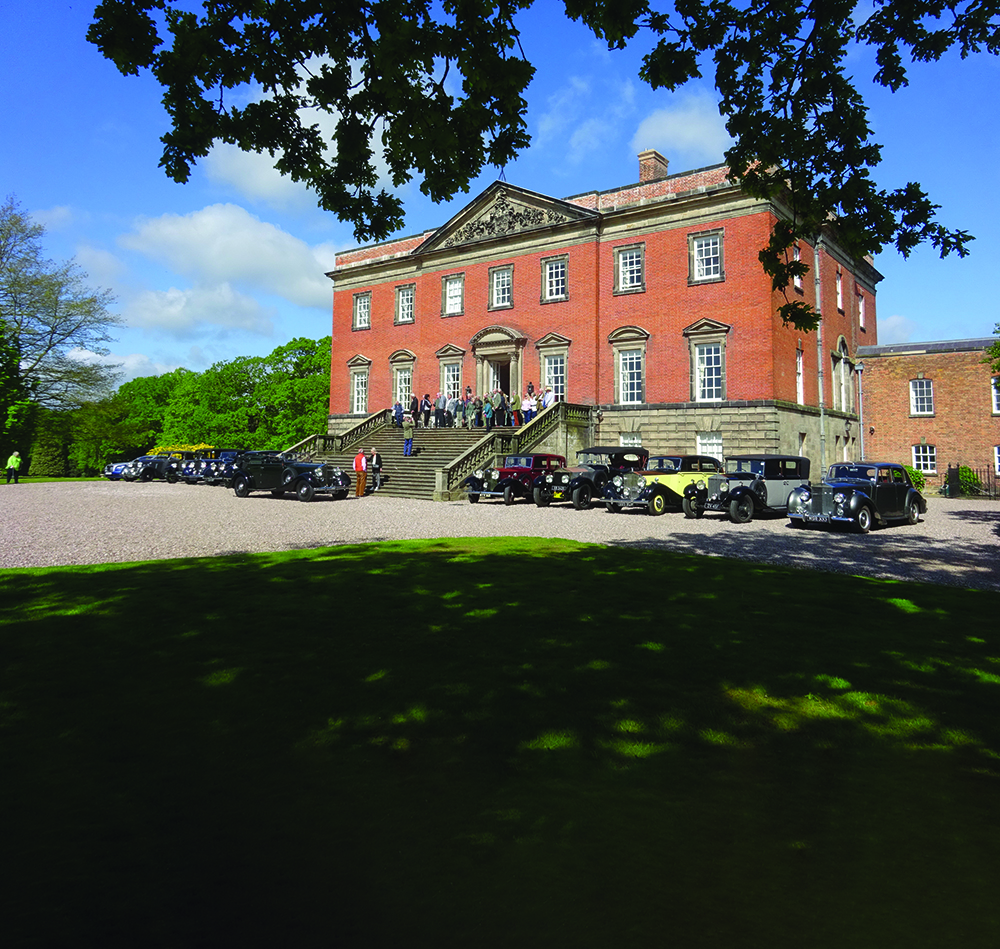
By Maxwell Craven One of the most delightful, sequestered and ancient parish churches in the county is that of St. Andrew, Radbourne, set beside the Radbourne Brook (effectively a tautology: the clue is in the name, the ‘red bourne’, or stream) in a hamlet which hardly seems to exist, despite being barely four miles from Derby. It is well hidden from the unfrequented road, although well signposted. As you descend the path to the church you can see across a broad pasture to the brook and the ridge beyond, atop which stands the fine Georgian mansion that is today’s Radburne Hall (the spelling differs from that of the settlement, by hallowed tradition), although it is slightly beyond one’s eye-line. The pasture itself is full of strange hollows, and was originally the site of the first known houses on the site. Radbourne is one of those rare landed estates: one that has never been sold since its first recorded owner obtained it. It has, however, passed via an heiress four times since its first record, the first three in the Middle Ages, the fourth currently, but the blood of the first recorded tenant, Wakelin de Radbourne – who is on record for 1100, but was almost certainly the 1086 (Domesday Book) tenant – still flows in the veins of the incumbent family. Who exactly Wakelin was is not clear, although it has been suggested that he was reasonably close kin to his overlord, the tenant in chief, Henry de Ferrers, lord of an hundred Derbyshire manors, other members of whose family certainly used the name. The monumnet to Sir John, now at Mazerolles The grandson of Walkelin left no son but a daughter and heiress, who married John de Chandos who was of a minor gentry family from SW Herefordshire, Chandos being a locality in Much Marcle parish in that county. John’s great-great-grandson was Sir John Chandos, KG, the great hero of the Hundred Years’ War, Constable of Aquitaine and Seneschal of Poitou, created by Edward III Viscount St Saveur-le-Viscomte in the Contentin in 1360. Sir John, born around 1320, was a close friend of the heir to the throne, Edward, the Black Prince and, in 1348 joined his patron in being nominated one of the first ever Knights of the Garter. Described by the medieval historian Froissart as ‘wise and full of devices’, as a military strategist, Chandos is believed to have been the mastermind behind three of the most important English victories of the Hundred Years War. He was chief of staff to the Black Prince at the Battle of Crécy in 1346, was a leading commander a decade later at the Battle of Poitiers and also in the Battle of Auray, in the War of the Breton Succession in 1364, following which his commander, John Duke of Montfort, was able to succeeded as John IV, Duke of Brittany. In addition to his other honours, Chandos was created the lieutenant of France and vice-chamberlain of England. In 1369, the French launched a successful counter-attack, regaining much territory and forcing Edward to recall the retired Chandos, who attempted to deal with the French attempts to regain a foothold in Poitou, of which he was made governor. In a skirmish following an unsuccessful attempt to re-take St. Savin, Chandos met the French on the bridge at Lussac. In the ensuring melée, Chandos’ long coat led to him slipping on the frost. James de Saint-Martin, a French squire, struck Chandos with his lance, piercing his face below the eye although Chandos’ uncle, Edward Twyford of Kirk Langley, standing over his wounded nephew, repulsed the attack. The wounded Chandos was carried on a large shield to Monthemer, the nearest English fortress, but died, unmarried, in the night, either on the 31st December or the early hours of New Year’s Day 1370. Sir John Chandos as Knight of the Garter, 1348 from the Bruges Garter Book Such was Sir John’s reputation that Charles V (‘the Wise’) of France is reported to have said that ‘had Chandos lived, he would have found a way of making a lasting peace’ although French chronicler Jean Froissart was more circumspect, saying ‘I have heard him at the time regretted by renowned knights in France; for they said it was a great pity he was slain, and that, if he could have been taken prisoner, he was so wise and full of devices, he would have found some means of establishing a peace between France and England.’ He added of Chandos that ‘Never since a hundred years did there exist among the English one more courteous, nor more full of every virtue and good quality.’ He certainly comes across much in the heroic mould of those other two hammers of the French, the Dukes of Marlborough and Wellington, although his reputation lost nothing in having been killed in battle. The estate passed to Sir John Lawton, married to one of Chandos’s sisters, although the loss of the original patent creating Sir John a Viscount means that no one is sure whether it was remaindered to his sisters and their issue, failing any heirs of his body, or not. As a French title, albeit granted by the King of England (but as King of France), this may well be true, meaning that Lady Chichester might well be Viscountess de St. Sauveur. Certainly, his heiress brought all his property to her husband to Sir Peter de la Pole from Cheshire. The Poles, too burgeoned mightily once ensconced in the county, for younger branches settled at Kirk Langley, Barlborough and in a moated house north of Hartington, now marked by a farmhouse called Pool Hall; one of this latter branch, John Pole, became the outlaw after whom Castleton’s Poole’s Cavern was (phonetically) named. Nevertheless the Radbourne Poles have been there ever since, although they assumed the additional surname of Chandos in the Regency period as homage to the enduring renown of Sir John. At Radbourne Sir John is reputed to have had a ‘mighty large howse of
Lost Houses of Derbyshire – Old Walton Hall, Chesterfield
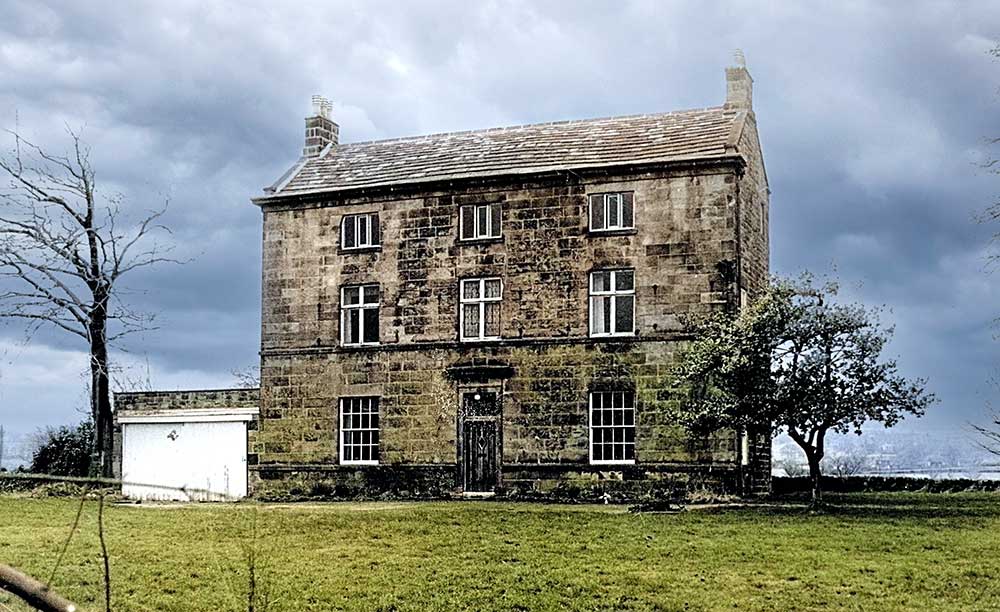
The present Walton Hall, built in the closing decade of the 18th century as a fairly substantial farmhouse, nowadays survives entirely surrounded by modern housing, its lush farmlands lost to a succession of extractive industries followed by the SW expansion of Chesterfield, which gobbled the unpretentious village of Walton up towards the close of the 19th century – and didn’t stop. The site, however, is an ancient one, held by an otherwise unknown man called Hardulf at the time of the Norman conquest, and from him, doubtless compromised by supporting or fighting on the losing side at Hastings, it came into the hands of the King. Who the King’s tenant was at Walton, we seem not to know, but by the next generation it was in the hands of Roger le Brito, otherwise le Breton. Roger, whose name suggests Breton origin – a good number of William the Conquerors comrades-in-arms were Bretons – is otherwise thought to be identifiable with Roger, son of Steinulf, the Domesday Book tenant of Calow, but as the name Steinulf is Nordic not Breton, this may not be a tenable supposition. However, whilst Calow descended amongst more easily attested descendants of Steinulf (bearing the name Calow, of course), Walton descended to the posterity of this Roger. His grandson, Sir Robert le Breton, received a licence from the king to found a chantry on his land at Walton, clearly suggesting he also had a capital mansion there, too. Nevertheless, the family continued for eight generations until Isabella, daughter and sole heiress of another Sir Robert brought the estate to the Lowdhams of Lowdham, in Nottinghamshire. In the next generation another heiress brought it to Thomas, a younger son of the Peakland grandee Sir Thomas Foljambe of Tideswell, around 1390 and his family held it until 1633. The old house was one of many Derbyshire manor houses to host Mary Queen of Scots, in this case, for two nights in February 1568. The last hall to be occupied prior to the building of the present one was that built by Godfrey Foljambe, who inherited the estate on the death of his father, Sir Godfrey, in 1585, and the existence of two chimneypieces and overmantels bearing his initials and dated 1591 (one was dismantled and reconstructed for installation at Dene Park in Kent; the other came into the hands of Sir George Sitwell but is lost) suggests that his new house was being fitted out in that year and was thus ready for re-occupation, perhaps before the end of the year. The house’s predecessor was set in a park, bordered on the north by the Hipper and this had a tower therein, which can be picked out on both the map of Christopher Saxton of 1577 and that of John Speed of 33 years later, probably a hunting stand, like that at Chatsworth. The new house is only known from a survey of 1633 by surveyor William Senior, and consisted of an entrance front with end gables, from which ran cross wings, with two further lesser gables flanking the entrance. This ensemble formed a deep courtyard, and was closed at its open end by a timber screen, beyond which lay the stable block. On the other side of the house was the domestic chapel, founded as a chantry by Sir Robert le Breton, by 1623 embellished with a tower, spire and extended chancel. Sir Godfrey Foljambe, who lived there ‘wherein great contynewall housekeeping was mayntayned’, died in 1595, whereupon his widow, Isabella, was left a life interest in the estate, allowing her to live there with her second husband Sir William Bowes. She outlived him, too, and died in 1623; both were very keen Puritans. In 1609, they had been host to Lady Arbella Stuart, the King’s cousin and Bess of Hardwick’s grand-daughter. The house by then was surrounded by gardens, orchards, a bowling alley and pleasure grounds extending to twelve acres, the estate itself running to over 2,336 acres. The building itself was described as in good repair. However, once Lady Bowes had died, the male heir, Sir Francis Foljambe, 1st Bt. (the title created in 1622) inherited it. He was MP for Pontefract (his main estate then lay at Aldwarke in Yorkshire) and High Sheriff of Derbyshire in 1633, in which year he decided to sell up and the house seems never to have been properly lived in ever again. The purchaser was Sir Arthur Ingram MP of Temple Newsham, Yorkshire, a colourful character described by one contemporary as ‘a rapacious, plausible swindler who ruined many during a long and successful criminal career’, but it would seem that his purchase – at an eye-watering £16,000 – may have been an element of some other transaction, for within three years he too had sold the estate, this time to Paul Fletcher, a local ironmaster. Fletcher’s heir was another local merchant, Richard Jenkinson, who in 1648, with the Civil War still raging, decided that the old house – un-lived in since 1623 and in decay – was too large for him and he reduced it considerably, supposedly to make it more convenient. His son, Sir Paul, was created a baronet (of Walton) in 1685, but the family allowed the building to continue to decay, until in 1713 William Woolley could write of it: “The ancient seate Walton nere Chesterfield….is utterly ruyned, plucked downe, and sould, no materiall, as ys reported left, nor almost any mencyon made were so greate hospytality, and that in my tyme used.” With the death of Sir Jonathan Jenkinson, 3rd Bt. in 1739, his niece and heiress inherited it and forthwith bestowed it upon her mother Barbara, widow of Sir Paul, who had died in 1714. By this time, she was married to John Woodyear who, like the Jenkinsons, lived elsewhere and promptly cleared the site of the old hall, in order to convert what was left of the estate (after several parcels had been sold off to local coal-masters) into a working farm.
The Lost Houses of Derbyshire – Kirk Hallam
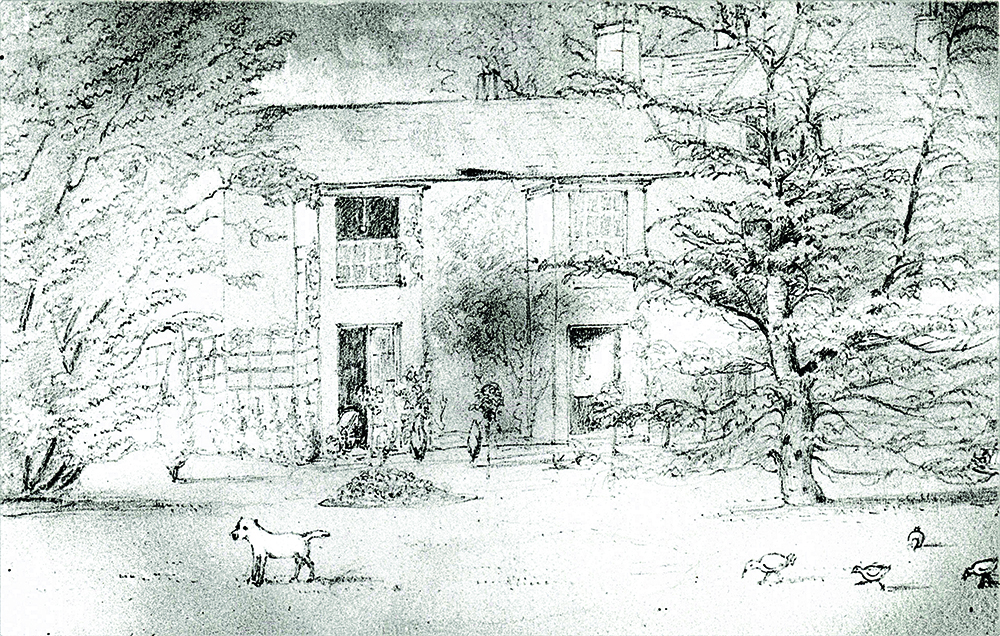
by Maxwell Craven Kirk Hallam was originally a small hamlet atop the ridge that overlooks the Nut Brook and the homonymous canal as one travels east towards Little Hallam and Ilkeston. It takes its name from the Old Norse hallr (= a hill) + kirk (= church) which perfectly describes the settlement, even as it appears on the 1880 OS map, on which there is little to be discerned bar the church, the hall and a scatter of houses to the south of the main road. It is thought that the ‘Kirk’ element was added in the early 12th century as the later settlement that became West Hallam expanded, to differentiate the two. In 1066, the manorial estate was held by one Dunstan, but two decades later, when Domesday Book was compiled, it had come into the hands of Ralph de Burun, one of the great barons and few chief lords holding land in Derbyshire and, under him it was held (so later charters establish) by a family taking their name from the place. In 1155, Hugh de Burun of Horsley Castle, the last of his line, died and the estate passed via his daughter Aelina to Peter de Sandiacre, son of a Viking called Toli, who not only held Sandiacre, but a great amount of property in Derby, too. His son, another Peter, married Beatrice de Hallam, a member of the family that were Peter’s sub-tenants at Kirk Hallam, and we can only presume that they had a capital mansion of some description there. From maps, we know that the later hall lay just slightly SSW of the ancient church of All Saints, and it would be reasonable to assume that the ancient manor house would have been on or very near the same spot. As with one of two of the other lost houses we have looked into, it was never the chief seat of the family that owned the land, so always ranked as a secondary residence. Furthermore, in 1260 John de Sandiacre granted the patronage of the church and much of his estate at Kirk Hallam to the Abbey of Dale, so whoever lived in the manor house was from the later 12th century, a tenant of the Abbot and Canons there. In fact, the generous John de Sandiacre died shortly after his gift to the Abbey, in 1277, leaving two daughters and co-heiresses, of whom one carried Sandiacre and Kirk Hallam to her husband, John de Grey, a younger son of Henry de Grey of Codnor. The estate remained thereafter with the great English baronial house of Grey until it was bestowed upon the daughter and co-heiress of the last de Grey who brought it to John Leake of Hasland in 1409. Yet, once again, the manorial estate had fallen into the hands of a fairly grand, but definitely upwardly mobile, family with a primary residence elsewhere, this time at still extant Hasland Manor House. They also inherited Sutton Scarsdale from the de Greys, too, and the family had also married another heiress, that of the d’Eyncourts of North Wingfield, so they found themselves, by the time of the beginning of the Tudor dynasty, very rich and well endowed with estates, in Derbyshire particularly. The Leakes later built a great house at Sutton Scarsdale and Sir Franics Leake, made one of the very first baronets by James I in 1611, added a hunting lodge nearby called Staveley Hagg, which survives as Hagg Farm. He also aggrandized Sutton Scarsdale, and found much favour with Charles I, who made him 1st Lord Deincourt (the title chosen from his antecedents the d’Eyncourts), a favour he returned by great loyalty to his sovereign during the Civil War, for which he had his estate compounded by Parliament as a ‘delinquent’. The impecunious King rewarded him with an earldom for his pains, and he became 1st Earl of Scarsdale in 1645. We have no information about the manor house at Kirk Hallam through all this time, and it may have decayed through neglect, as we saw at Chellaston. However, the Leakes got their estates back at the Restoration, and the 1670 hearth tax records a house assessed on five hearths at that time, split between a father and son, both called William Blunstone, and it seems likely that the elder was then the tenant. Indeed, the Blunstones were long lived in that area, having come from Sandiacre – probably co-incidentally – at the beginning of the 17th century. However, another William Blunstone was farming in Kirk Hallam in 1827 and his family were still there a generation later, but by then at Ladywood Farm as copyholders, rather than as tenants of the Hall. One wonders if any descendants still live in the area. Meanwhile, their feudal masters had been going from strength to strength until, that is, the time of Francis Leake, 4th Earl of Scarsdale, who managed to blow the family’s considerable fortune, mainly through the expense of building a vast new house (but incorporating parts of its predecessor) at Sutton Scardsdale, designed by Francis Smith of Warwick in 1724 (see Country Images May 2021). Having completed it, he gambled away much of what remained, before dying, broke, in 1736, the last of his line. The estate was, needless to say sold, including the Kirk Hallam elements of it. The purchaser was Francis Newdigate of Nottingham. He, for once, actually decided to live at Kirk Hallam, and elected to build himself a new house. We only have a pencil sketch of this house, although it survived well into the 20th century, so it is difficult to say just what it was like. It appears to have been of brick with gabled cross wings with attic windows, the rest being of two storeys. The roofs were tiled and it was set on a modest park just west of the church. Clearly, Mr. Newdigate was a modest sort of fellow, although by the time of his death in 1764 he
The Lost Houses of Derbyshire – Burdett’s House, Full Street, Derby
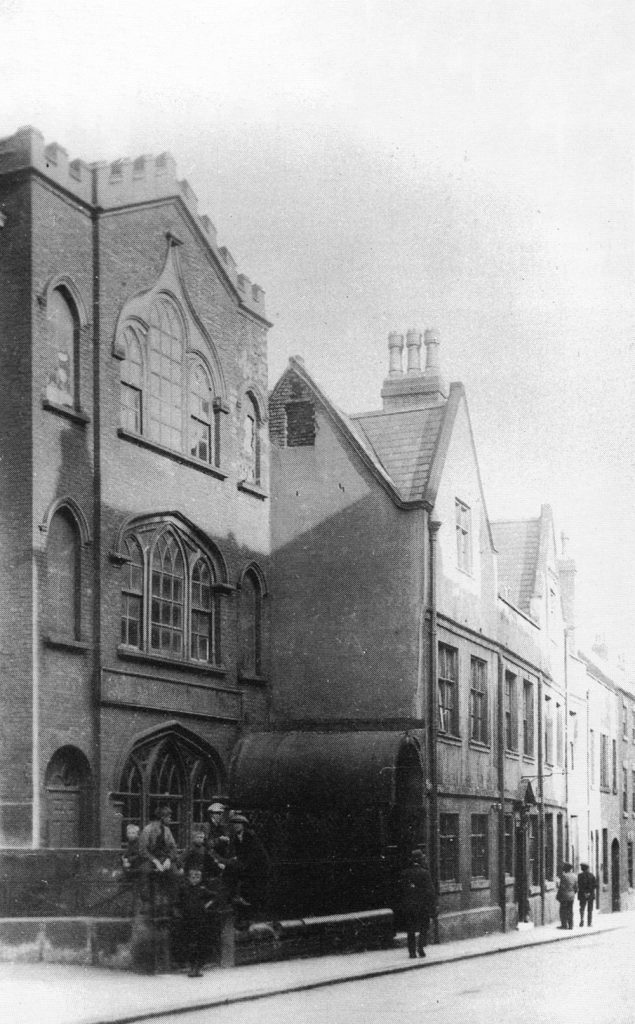
Peter Perez Burdett is an important, enigmatic and tantalizing figure. He is best remembered as a cartographer, having surveyed and drawn only the second one inch to one mile UK county map of Derbyshire and he repeated the exercise with Cheshire. He was also a talented artist, he claimed to have invented the mezzotint, and was an amateur astronomer, a talent that drew him into the circle of Washington Shirley 45th Earl Ferrers FRS. He appears to have been born in 1734 or 1735 — making him a contemporary of Joseph Wright — the son of William Burdett and his wife Elizabeth, younger daughter and sole heiress of the Revd. Peter Perez, vicar of Eastwood, Essex, who died in 1750. It is also unknown what his background was, for he moved in the highest circles throughout his life with the greatest ease. It seems clear that a double portrait of Peter Burdett and his wife Hannah by Wright was carefully posed at Knowle Hill, the (then) dismantled secondary seat of the Burdetts of Foremark, the background being the still stunning vista towards the north east — the topography is unmistakable. Yet, whilst staying with Earl Ferrers at Staunton Harold c. 1760-1764 and later, living in Derby he was never exposed as a fraud by the Burdetts or anyone else. Burdett may have been in the army, for he must have learnt his surveying skills somewhere, but the 1750s finds him in Manchester – doing precisely what has never been clear – where he married and had a family. Yet by the time he appeared in Derby, we hear no more of them and he re-marries the widow of a Leicester businessman and much later still, the daughter of a Bohemian count! He was certainly a very accomplished man; he even played the ’cello to a good enough standard to perform with the Derby Society of Musicians: a good quality education is implicit. Certainly, he and Ferrers were close enough to observe the Transit of Venus in 1761 and to write up their findings for the Transactions of the Royal Society and for the latter to lend him considerable sums of money. In 1763 Burdett had a bond from Lord Ferrers which allowed him to pay Joseph Wright – clearly by then a friend – £160 plus interest from the 200 guinea (£210) fee that Wright charged Lord Ferrers for painting A Philosopher Lecturing upon an Orrery in 1763. This sum, however, was thought by the late art historian Judy Egerton to have been in part a disguised loan to Burdett. Hence, Wright only received the first £50 of his fee and we find him chasing Burdett for the balance for years thereafter and right up until the ever-impecunious Burdett, hard pressed by creditors, left Derby in a hurry in 1768. He was still chasing some of the money when Peter Burdett left Liverpool for the Continent in 1774, when Wright was still £80 short! The original idea of the bond was for Lord Ferrers to pay Burdett the whole sum to pass on to Wright, deducting from it as a loan half to Burdett. The intention was to tide Burdett over whilst he built himself a house in Derby (and thus get Ferrers’ lodger out of Staunton Harold, then being extensively rebuilt to his own design). Once settled, the idea was for Burdett to pay the balance back to Wright when he had got established and recovered his financial position by publishing his map of Derbyshire, which happened in 1767. So where did the money go? What we strongly suspect is that it was spent on his new house in Derby’s Full Street, separated by one substantial building from Bess of Hardwick’s almshouses. Burdett’s house was later 11, Full Street, and was unique in Derby in being of brick with stone dressings and designed in Strawberry Hill Gothic – invariably termed ‘Gothick’ by architectural historians – the form of Gothic revival pioneered (indeed, trumpeted) by man of mode, the Hon. Horatio (‘Horace’) Walpole, later 4th Earl of Orford, 1717-1797) and much taken up amongst the cognoscenti in the middle years of the 18th century. As Burdett seems to have only paid £100 or a little more for his house, it also seem likely that it was an existing building which he merely re-fronted and internally up-dated before moving in early in 1764 (in which year he was first described as ‘of Derby, Gent.’) The house narrow end to the street, was of a full three storeys, with a wide central section breaking slightly forward under a crenellated parapet the middle section being a broken pediment, into which protruded the crocketed top floor window, a Gothicised Venetian window set in an ogee panel. The first floor central window was tripartite set in a Tudor-style four-centered arch as was that on the ground floor, which was flanked by a door on each side. The fact that the top floor was the tallest, suggests that the original building may well have been 16th century or early Jacobean in origin. The late Edward Saunders, Joseph Pickford’s biographer, has plausibly attributed this re-fronting to the Derby architect who is known to have been a close friend of both Wright and Burdett. Pickford is not notable for having worked in Gothick, but his Gothick Temple at Kedleston is closely related to 11, Full Street, as was Knowle Hill (since reduced) and the Chalybeate Well head at Quarndon, also attributed to Pickford by Edward. Pickford also competently restored parish churches at Coventry and Nottingham St. Mary. Regrettably, we have no record of the interior, although, like his neighbours, Burdett’s garden ran down to the bank of the Derwent and included a patch of ground on the bank opposite, too. Burdett was a Strict Observance Freemason – a continental and rather strange version of Freemasonry – and appears to have been fairly high up in its ranks, too, for he was visited at the house by a
The Lost Houses of Derbyshire – Grangefields, Trusley
Grangefields lies in the northern part of the parish of Trusley and has a long history going back to the compilation of the Domesday Book in 1086, and maybe before, for it lies only a quarter of a mile south of Long Lane, the alignment of the Roman Road from Derventio (Little Chester) to Salinae (Middlewich, Cheshire) via the fort at Chesterton, Staffs. A Roman villa has never been identified in Derbyshire, but if one ever was, a gentle south facing, well-drained slope is the most likely place and the area of Long Lane is a promising one. Whether Grangefields was on or near one has yet to be ascertained, but it would not surprise me if one day such a villa did turn up nearby. Thus, in 1086, both the manorial estates at Trusley had been bestowed on a great lord, Henry de Ferrers, who made a man called Hugh his hereditary tenant of both there. Later charters establish that Hugh’s full name was Hugh le Arbalaster. The name derives from arcuballista a Latin term for a crossbow, which rather suggests that Hugh might have acquired this name from his day-job, so to speak, as a leader of a group of crossbow-men. It would be fun to think that he was wielding one at the battle of Hastings and that Trusley was his reward! Hugh had a son called Serlo, who adopted the surname of Beaufei (spelt in a number of confusing ways), indicating that, whatever Hugh had been up to at Hastings, he probably hailed from the small Norman settlement of Beaufai, Département de l’Orne, not far from the Mesnil, in Normandy. Serlo’s great grandson, Robert de Beaufei, started granting pieces of land to various monastic houses, a habit which his like-named son continued. Between them, the two Roberts made grants to the Abbeys of Croxden, and Burton in Staffordshire, the Priory of St. Mary de Pratis in Derby and the Knights of St. John of Jerusalem at Yeaveley. These were nearly all made from the northern part of Trusley, from just one of the two manorial estates, that away from the village, manor and church, and all between the 1260s and 1290. Indeed, this part of Trusley seems to have originally had its own name, Thurmundesley, as a pair of early charters make clear. This derives from the old Norse personal name ‘Thormund’ + leah = ‘ley’, a meadow or clearing. It would probably have mutated to ‘Thurmandsley’, ‘Thurmsley’ or even ‘Thursley’ today. This may be a clue, indeed as to which of the two men holding Trusley in 1066 had this part of the settlement, for as Ulfketel is also a Norse name, it would be tempting to think of him as Thormund’s descendant or heir, and that Thormund himself must have arrived long before, cleared the land and settled. It was the Cistercian monks of Croxden Abbey, however, who were granted the site of Grangefields, part of a 40-acre gift made by the younger Robert de Beaufei in 1180 and topped up with further land later. Here they established or took over a farm. Sometimes, monks were sent to work such farms, which were called ‘granges’, but more usually lay families were given the tenancies. In time, therefore, the place became known, not as Thurmundesley, but Grangefields, just as a nearby holding granted to the Nuns of Kings Mead Priory in Derby, gradually came to be called ‘the meadow of the nuns of Trusely’, eventually Nunsfield. Certainly, the name Grangefields was recorded (as Graungefeld) in the documents relating the dissolution of Croxden Abbey in 1538. The land and farm at Grangefield was assessed in value by King Henry VIII’s bean-counters at £4 – 6s – 3d (£4.33) – worth £1,817.10 in today’s values, or three cows, or 143 days’ wages in 1538. Thus, Grangefields was acquired speculatively by Dr. Thomas Leigh and William Cavendish (later to become the second husband of Bess of Hardwick) on 17th September 1538 to be assessed, the price fixed and offered for sale. The tenant at the time was William Glossop, of a Wirksworth family and when the estate was sold on in 1545 to Robert Fitch, he appears to have been left in place. Indeed, the sparse surviving records suggest that the Glossops continued as tenants before buying the freehold some time between 1571 and 1598. He did not keep it long though, for he sold it on again first to Edward Kynnersley of Brailsford and then to Francis Curzon a younger son of Francis, of Kedleston. However, at some stage, Francis Curzon seems to have decided to sell it on yet again and it would appear that Robert Glossop, or his father, had become wealthy enough to buy the farm, for Robert was in possession in 1600 when, on 26th October, he mortgaged it to raise money. Unfortunately, whatever Robert needed the money for, the mortgage appears to have been foreclosed with the result that it passed by 1608 to John Gregson ‘yeoman’ of Sutton-on-the-Hill who immediately sold it on to Robert Hope. Unfortunately, not much is known of the family, but Robert was born to Charles Hope at Etwall, not only did Robert Hope buy the estate, but he also appears to have built a fine new house, or more probably, rebuilt the late medieval house which he acquired, adding a crosswing and generally modifying the building, producing an irregular but delightful timber façade. It was described by William Woolley in 1713 as ‘,,, a pretty private seat formerly a grange belonging to Croxden Abbey’, whilst Stephen Bagshaw added, ‘it is a long, half-timbered building having many gables.’ The only comparable house locally are perhaps the earlier West Broughton Old Hall or the slightly later and more symmetrical Wakelyn Old Hall at Hilton. The house fortunately lasted into the age of photography (by a whisker) being the subject of the Calotype photograph which may have been taken by photographic pioneer W. H. Fox-Talbot, who was married
The Lost Houses of Derbyshire – Rose Hill, Chesterfield

by Maxwell Craven The publication in 2019 of Chesterfield Streets and Houses by Philip Riden and Chris Leteve throws much fascinating and detailed light on the history of the built environment of Chesterfield, although is a little light on architectural history and evaluation. Yet, when it comes to the early history of Rose Hill, a substantial villa on the western edge of Chesterfield, it fails to address the early history of this important house, which is a shame: however, Country Images to the rescue! Rose Hill stood on rising ground facing south on the norther side of West Bars and indeed, we looked at the history and fate of West House, adjacent, in Country Images some time ago – in September 2019. Indeed, the array of impressive residences there are well encapsulated in the view painted by George Pickering in 1812 (now in the care of Chesterfield library) where they can be seen in their prime with the crooked spire away to the right. The story of Rose Hill begins with Henry Thornhill (1708-1790), fourth son of John Thornhill, who had inherited the Stanton-in-Peak estate through Henry‘s mother Anne Bache, along with extensive lead mining and other interests. Henry was the son (there were many) who showed real flair for carrying on the family tradition in the lead trade. He was set up by his father at the age of twenty as a lead smelter in Chesterfield and it was he who took these enterprises on. Henry not only made a great success of them but pioneered considerable expansion of the family’s interests elsewhere, as well as eventually taking on the Pleasley Vale estate and founding the mills there that gave us Vyella and similar formerly well-known products. Around 1735, Henry took himself off to live in Chesterfield. Indeed, he eventually remained in residence there long enough to have become an alderman of the town and, on the basis of that, a member of the Chesterfield bench. He also served twice as Mayor, in 1750 and 1755. As Chesterfield was the prime lead trading centre in Derbyshire and on the route from the Derbyshire mining areas to Bawtry in Nottinghamshire, where the lead pigs were transhipped onto Trent barges, it was a natural choice of base for the ambitious trader. We also know where Thornhill lived in Chesterfield, for the house, latterly known as Rose Hill, is recorded as having been ‘built by the Thornhills in the 1730s.’ This is re-inforced by the mention of Henry in a deed of 1744 as ‘of Brickhouse in Chesterfield, Gent.’ As Rose Hill was indeed brick, the identification would appear to be secure, although the subsequent destruction of the house seems to have been reflected in the loss of any papers relating to it. In fact, a deed of 1736 reveals that Henry had obtained a mortgage of £330 – 14s – 9d from his wife’s uncle, Alexander Holden of Newark, which suggests that this was to fund the building of his new house. A final clue in the Thornhill records is a lease from the Mayor and Aldermen of Chesterfield of the site of Rose Hill for twenty years at £9 per annum dated 20th March 1735, later converted into a freehold. The lessee was one George Sims (1693-1761), a joiner and builder, acting as Henry Thornhill’s agent, and who was indeed contracted to build his house on the site. Knowing what the house at this period looked like is difficult as no view of it is known. According to some accounts of the house after it was rebuilt, the entrance front was more like that of neighbouring West House – pedimented, with more ornate detailing: quoins and architrave surrounds to the windows – which sounds like an arrangement more closely matching the traditional date for the house of the mid-1730s. Nevertheless, not only does the name ‘Brickhouse’ confirm the basis for the old story – unlikely to be strictly true – that Rose Hill was in its day the first substantial brick house in the town, but also confirms its distinctive name when first built. Indeed, the first reference to the house as Rose Hill (the name of the eminence on which it stood) only occurs in the mid-19th century. To the north of the house was a large quadrangular stable block, and the parkland stretched away west to the municipal boundary. After being constrained by business pressures to leave Chesterfield in around 1761, Henry retained the house as a town residence as well as for the use of his nephew Bache Thornhill of Stanton Hall. However, it was let in the 1770s to Robert Lowndes, by which time it was called The Mansion House. Lowndes, who had been involved with Thornhill in a number of lead-centred transactions, was married to the heiress of Richard Milnes, the second son of James Milnes of Chesterfield, a member of the Ashover branch of that family. It was Lowndes who rebuilt Rose Hill in the plain neo-classical style seen on the garden front, the only aspect of which illustrations are known, which, once rebuilt, was of five well-proportioned bays and two and a half storeys, under a hipped roof. The house was of brick with sparing stone dressings and was beautifully proportioned, the windows having rubbed gauged brick lintels, but was largely devoid of ornament. The only decoration was provided by a plat band below the sill band on the first floor with balustrading below the first floor windows between them; even the cornice was plain. Inside, sales particulars of 1851 inform us that there were four reception rooms on the ground floor (probably drawing room, dining room, library/study and breakfast room) and four bedrooms (three with dressing rooms) on the first floor with further bedrooms above in the attic storey. The date of these works is unknown but they were certainly in place ‘by 1779.’ The architect is not known, but what we see in the surviving views and given the urbanity
The Lost Houses of Derbyshire – Parkfields, Derby

by Maxwell Craven A notable surge in prosperity in Derby during the Napoleonic wars and afterwards, led to the building of nearly a dozen Regency villas on the fringes, in the suburbs and in the immediate area of the borough, of varying size and quality. Most were built by prosperous merchants and a few by landed gentlemen who, like the Batemans of Hartington Hall, found their town houses becoming unlivable, as the town infilled and industrialised. Unfortunately, many have been demolished, no less than three in the first decade of the millennium. The unfortunate demise of another casualty, Parkfield, occurred even earlier, in summer 1993, despite it being locally listed. Yet, although its merits were perhaps less than apparent in its later years, it was a villa of some style. Parkfield was originally one of the vast common fields belonging to the ancient borough of Derby, grazing and cultivation rents from which helped provide the town with income. However, this kind of income, along with fairs and tolls, did not bring in enough money for the corporation to spend on infrastructure, so in the 18th and early 19th century, improvement acts were obtained enabling parcels of it to be sold off so people build houses, great and small on the land thus released. Ironically, no less than four substantial villas were built on portions of the old Parkfield, three called Parkfield! One lay on the north side of Kedleston Road, called Parkfield House – still standing now on Park Grove, although divided into three dwellings now and listed grade II – another in 1818 just to the west of it, called Parkfield Cedars (lost, see Country Images June 2016) and the third, Parkfields, on the west side of Duffield Road, not far north of Five Lamps. Originally the plot was bought by a family called Bingham, who had iron founding interest in the town, but they later sold it to the Columbell family who were Derby’s fashionable tailors and drapers of the period. One of the improvement commissioners who had originally sold the land on behalf of the Corporation in 1812 was Alderman John Sandars JP (1782-1867). He was a scion of the gentry family long settled at Cauldwell in the south of the country, and of their most notorious son, Col. Thomas Sandars of Little Ireton, the fierce republican commander under Sir John Gell’s command on behalf of Parliament during the Civil War. John himself was a second generation bookseller, however, and he served as Mayor of Derby in 1839-40. Indeed, it was thanks to his fascination with the borough’s ancient records, that he had a considerable number of them at home with him in Parkfield for study when the 1828 Guildhall burnt down on the night of Trafalgar Day, 1841, when those that remained were irretrievably lost. Sandars built his house in 1833-34, although we are not clear who designed it; quite probably it was a fellow Alderman and prolific amateur architect, Richard Leaper (1759-1838), who had built Parkfield Cedars for himself in 1818. It was in brick under a low hipped roof, was sparing of stone dressings, with facades of varying dispositions. Yet it betrayed some sophistication, having brick Tuscan pilasters at the angles, with stone bases and capitals, a moulded frieze and cornice with stone lintels over the sash windows grooved in a Greek revival manner clearly derived from Sir John Soane’s confected Boetian Order, all similar except for a sarcophagus shaped one over the original front door set in its contemporary iron trellis portico. There was a curved bow on the west side, and a service wing adjacent; inside there was a good ironwork balustrade on the cantilevered Hoptonwood stone stair, mahogany doors, moulded plaster cornices, polished limestone chimney-pieces and one room was decorated in French revival neo-classical boiserie-style mouldings. This seems to have been something of a favourite with Richard Leaper, because his surviving (but much extended) villa which now houses the Boys’ Grammar School in Littleover has a similar room and there is another at Allestree Hall (another Derby building at risk!) which Leaper modified for J. C. Girardot. The grounds were landscaped by William Barron and at least one of the stone urns from the 1731 Derby Guildhall ended up being rescued by Sandars and used as garden features. John Sandars died at Parkfield 10th January 1867 at a great age and in 1869 his son sold it to Charles Henry Smith, one of the directors of Boden’s Castlefields Lace Mill. He was succeeded by his nephew, Alderman Sir John (‘Brassy’) Smith, who served as mayor of Derby in 1872 when he was knighted, as was the convention, for being en poste during the Prince of Wales’ visit on 17th December that year. He was also co-founder of Smith’s important white metal (essentially brass for railway rolling stock building) foundry in Cotton Lane which ultimately became a nation-wide concern. Brassy Smith was one of Derby’s super-rich and set about enlarging the house sparing no expense, with a westward extension, essentially a little taller than the original part, but in matching style, even down to the window lintels, and in so doing, he altered the way the interior plan worked. The new entrance had a stone portico with a fanlight resembling one in Becket Street (suggesting R. Ernest Ryley as the architect) and led into a new lobby and a new main stair was installed, lavishly panelled in mahogany, leading to luxuriously fitted out new bedrooms, and plenty of up-to-the-minute modern plumbing, furnished by Thomas Crump of Friar Gate. Needless to say, there was plenty of opulent looking brass fittings almost everywhere. Sir John died in 1909, when the house was sold to Thomas Carline Eastwood, a director of Eastwood and Swingler’s foundry (now the new HQ of Great Northern Classics). Eastwood, however, soon moved out to the country, and let the house to Capt. Lionel Morley but, when he left after the Great War, it was sold to Gerard Hamilton
The Lost Houses of Derbyshire – West Hallam Hall

No native West Hallam resident, of course, would acknowledge being resident of Ilkeston – they are fiercely independent folk – but the loss of the hall caused this unexpected expansion, and the man responsible was bullish Nottingham developer and bigwig, Alderman Sir Albert Ball (1863-1946), as with one of two other lost Derbyshire houses (not to mention Nottinghamshire ones!) The manorial estate at West Hallam came very early into the hands of the Cromwell family, later famous for giving us Lord Treasurer of England, Ralph, Lord Cromwell KG, who built Wingfield Manor in the 1440s. When he died in 1455 his daughter and heiress was long married to Sir Richard Stanhope KB of Rampton, Nottinghamshire, but her daughter Maude, who inherited the West Hallam element of Lord Cromwell’s estates from her mother, sold it in 1467 to Thomas Smith, otherwise known as Powtrell. The Powtrells were an ancient Nottinghamshire family, seated since the late 12th century at Thrumpton; a junior branch was at Atlow in Derbyshire in the 13th and 14th centuries, another at Prestwold, Leicestershire a little later. Richard Powtrell had been Receiver General of Edward III, but died without issue in 1399; his heiress Isabella, his brother’s daughter, had by 1420 been long married to Thomas Smith of Breaston, and their son, Thomas, is the man who inherited West Hallam in the right of his wife, and assumed the surname and arms of Powtrell in lieu of Smith. The Cromwells may have had a house there in the very early period – there is a moated site called The Mot, fed by the Stanley Brook, in nearby Fox Holes plantation where Ralph de Cromwell II is said to have established a residence – but seem not to have lived there after their rise to fame and power in the 14th century hence, when Thomas Smith (or Powtrell) decided to build a new house, it would have been an entirely new affair, arranged around a courtyard. In 1670 it was taxed on 20 hearths, which is quite a healthy number for a medieval house, so the house was probably a fairly grand affair of coal measures sandstone. Like a number of the grander houses in the county, West Hallam Hall also had a domestic chapel, served by a priest, probably the incumbent of the parish church, which stood immediately to the east of the house. This arrangement was only thrown into sharp contrast after 1536 when Henry VIII broke with Rome and declared himself Supreme Governor of the church in England. John Powtrell (died 1544) could not stomach this upheaval and remained staunchly Roman Catholic, becoming classified as a recusant and being fined for non-attendance at church on a regular basis, thus diminishing (as the Crown intended) the family’s financial resources – in the hope that to save their patrimony – Catholic gentlemen would conform. His son Sir Thomas continued this stance after Queen Mary’s death, although the younger son Nicholas, a lawyer, was content to conform and became ancestor of the Powtrells of Egmanton, Nottinghamshire and Chilwell. This persecution intensified after the arrest of Mary, Queen of Scots, Lord Shrewsbury being the chief instigator of various campaigns of suppression in Derbyshire, culminating in the execution of the Padley Martyrs and Richard Simpson at Derby in 1588. Despite this, the Powtrells seem to have managed to keep their heads down until 1680 when the Catholic priest George Busby was arrested at West Hallam Hall, where his predecessor had had a loyal following of 40 local people. He was tried before a grand jury empanelled with the cream of the local (Protestant) landed gentry, and executed in 1681 – this in the wake of the hysteria surrounding the conspiracy called the Popish Plot which came to a head at that very time. By this time, too, the Powtrells had lost the estate, for in 1666 when Henry Powtrell died, the house and lands passed to Sir Henry Hunloke of Wingerworth, brother of Mrs Powtrell (and of the wife of Henry’s brother, John), by deed of gift which allowed the Powtrell family to continue to live in the house, which they did until the death of John’s younger nephew, William, in 1687. This arrangement was almost certainly because the recusancy penalties had finally taken their toll on the family fortunes. The Hunlokes, also recusants, but, with much coal under their estate just south of Chesterfield, were bullet-proofed against the depredations of recusancy fines, used West Hallam Hall as a place for younger sons and widows to live, but by the mid-18th century it was lying empty, and they demolished it a few years after 1770 – except for the chapel which served a flourishing if select Catholic community in the area. Once the hall had been demolished, a two and a half storey brick farmhouse was built to replace it, yet with the chapel still attached. What did for it, the last surviving fragment of the old hall, was the Duke of Wellington’s Catholic Emancipation Act, passed in 1829. From thence the local Catholics could worship openly again for the first time in 300 years, and could travel to Chapels in Derby, Ilkeston and Nottingham to worship on Sundays and feast days. Hence, in around 1833, the old building was finally taken down. Its stained glass, some of which is claimed to have been rescued by the Powrtrells from the dismantling of the Abbey of Dale nearby, was installed in the parish church next door. The very ancient cruciform sandstone font had, much earlier, found its way to Holy Trinity, Mapperley, but in 1815 it was identified and recovered by Revd. Thomas Bloodworth, who gave it to Sir Robert Wilmot, Bt., of Chaddesden Hall who, in turn, presented it to Revd. William Hope, a Derby bigwig, who bequeathed it to the Museum at Derby. It was subsequently presented to St. Barnabas, Radbourne Street, Derby on its consecration in 1885 where it remains. Meanwhile,
The Lost Houses of Derbyshire – Beaufort House, Derby

By Maxwell Craven “Some years ago, a friend who is a keen collector of local postcards, Don Gwinnett, sent me a copy of a postcard of a delightful house with Gothic windows, labelled Cowsley Fields. I loved the look of the house, and decided to try and identify it, which I may say I had great difficulty in doing. Being on the edge of Chaddesden and just down the slope from the termination of the memorable Stanley Footrill Colliery Tramway, but (just) within the Borough boundary, I consulted Peter Cholerton, who has researched and understood the history of Chaddesden most thoroughly, and he was very helpful.” What emerges is that this photograph is of Beaufort House in Cowsley Fields – the area due north of Nottingham Road, abutting the cricket ground/racecourse (as was) and a few hundred yards north east of St. Mark’s Church – hence, of course, Beaufort Street, which runs N-S across the site, and is the only street in the area not named after a British or Irish county. We came to the conclusion that the name on the card got there because the house lay in Cowsley Fields and not because it was itself called that, although it wasn’t called Beaufort House either prior to 1853. Nearby Cowsley Field House and Cowsley Farm (also long vanished) looked completely different. Peter told me that by 1853 the house was The Pavilion Tea Gardens, built as a place of public resort and refreshment which faced west and would have provided a pleasant view across the racecourse. The racecourse at Derby had been on The Holmes from the turn of the century, but in 1833 racing was discontinued and, by the time a new committee had been set up to effect a revival, plans to build the new Trijunct railway station on the site had been mooted. A new venue had to be found. For some years the new Derby Race Committee – chaired by the Duke of Devonshire – had a struggle to find a new venue. Eventually, some of the land in Little Chester, to the east of the canal, including Cowsley Fields, was lighted upon and after some years’ development, the first meeting at the new racecourse was held in May 1848. This upheaval therefore, led to the foundation of the Pavilion Tea Gardens for, in that era of temperance, it was clearly felt that a place of refreshment should be available for racegoers. Furthermore, temperance notwithstanding, it is clear from the sale particulars of 1853, that it was not only tea that was on offer! That the house was there before the racecourse though is clear from its appearance and from its design: it does not have the partly open-fronted façade of those tea rooms one sees in architectural pattern books of the period. From the only extant (to my knowledge at least) photograph of the building, it was of brick with stone dressings, of two storeys and seemingly five bays wide, with a eastward (rear) extension for kitchen and services. The entrance, sheltered by a picturesque timber gabled portico, was centrally placed and was flanked on either side by Tudor Gothic fenestration with depressed pointed arched tops and filled with cast iron glazing bars set out as elongated hexagons, of a type being produced locally from the first decade of the 19th century. Coach house of Richard Leaper’s demolioshed Rycote House, Kedleston Road, c 1828 Beyond this set-piece portion of the façade it sported an extra bay in the picture, clearly added, with more conventional fenestration and one suspects that the bay to the right of the person taking the photograph was similar. The house, from its absence from early maps, must have been built in 1835 or ’36, and its architectural congruence with various ancillary buildings designed by the amateur architect, Derby Alderman Richard Leaper, at Rycote House, Kedleston Road, and the neat lodges to The Pastures, Littleover (now the Boys’ Grammar School), Hilton Lodge and Bladon Castle would suggest the hand of Leaper himself, although at 76, he might well have given up by this date and we are more likely looking at the hand of a follower, like his former right-hand man, Joseph Cooper. Either way, we know that the ground later occupied by the racecourse and that lying east of it, 50 acres in all, was owned by George Wallis (1791-1851) stage coach proprietor and the third of his family to be landlord of the New Inn, Bridge Gate, Derby (on which see Country Images November 2022). The Wallises had begun as blacksmiths in King Street, but had built the New Inn and established an ever-increasing network of coaching routes. George’s uncle John had married Sarah Yates, son of John Yates, a notable Crown Derby China painter and close relative of Joseph Wright, whilst George’s sister Anne married his fellow China painter George Robertson and her sister later became the sister-in-law of the most famous China painter of all, William Billingsley. Recently widowed and with a young family of five, George had also succeeded to the proprietorship of the King’s Head, a coaching inn in Corn Market, by marrying in 1834 Joanna, the relict of John Hoare of Litchurch Lodge, its previous landlord, and seems to have disposed of the land to the Race Committee for the new racecourse. That part of the land not required, however, he sold to Chaddesden freeholder and gentleman farmer William Holland, ‘Gent’ who seems to have built the house before the end of the 1830s. Secure in the knowledge that the races were coming to the fields below his house, Holland only a few years afterwards decided to adapt his new house to serve as a refreshment establishment to cater for racegoers, adding a plan bay at each end and rebuilding the service wing. He called it the Pavilion Tea Gardens, wisely put it into the ownership of an independent trust and installed a manager, called John Ward. 1852 Board of