Places Pevsner Forgot – Makeney, Derbyshire
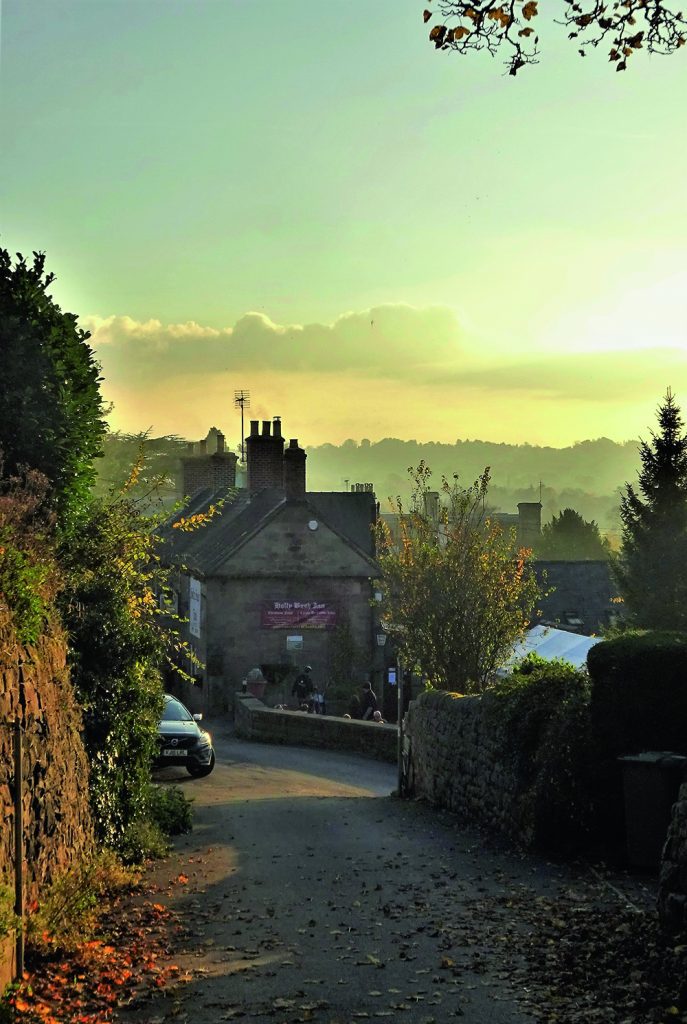
As we wandered round sunny Makeney, we wondered how Pevsner could ever have forgotten to include the place, for although historically a miniscule hamlet within the huge parish of Duffield, it gained in importance in the 19th century through its proximity to the various expanding Strutt family enterprises at Milford and gained two important houses as a result, although there never was either church or chapel. Furthermore, there is an historic inn, the Holly Bush, probably of 17th century origin with an historic turnpike trust way-marker set against its wall. How could he possibly have missed it, we wondered, especially as the hamlet is clearly visible from the A6 going north. No matter, however, we were on hand to make our own assessment. The village is situated on the east side of the Derwent on the unclassified (but remarkably busy) former turnpike road from Duffield church, along Duffield Bank to Milford, which originally ran past the pub and down the other side, but which acquired a new section cutting off this loop, now Holly Bush Lane, pitched around 1870. Holly Bush Lane also has a steep lane leading off from its apex called Dark Lane. We decided to park well clear of the Holly Bush, the narrow road outside which tends to clog up with parked Chelsea tractors, instead leaving the state chariot parked on the road near Red Lane, which winds up from a point just south of the village to Holbrook. This enabled us to see a very smart Regency cottage orné by the junction called Makeney Lodge, still with its original cast iron sliding jalousies at the windows, an adjunct to refined living famously made in Derby at Weatherhead, Glover & Co.’s Britannia foundry, Duke Street. The interior is very fine, and is illustrated in Bobby Innes-Smith’s 1972 Derbyshire Life book on local houses, from which we may infer that the cranked-out stair balustrade was also sourced from the Duke Street foundry. This should occasion no surprise, as the house in its current form was built around 1825 for Anthony Strutt (1791-1875), and probably designed by his uncle, William Strutt FRS, a keen amateur architect. It also incorporates a datestone bearing the legend HP/1784 which are apparently the initials of Henry Peat, who is believed to have rebuilt an earlier farm house there, dating from c. 1730. This may be true, for a Henry Peat married Elizabeth Beardall at Duffield in 1730, and a son may have effected a rebuild. Either way, there is no visual evidence in the existing fabric that the house you see today is anything but a new build. Why it escaped being added to the statutory list defied us; perhaps in 1981 when the County was re-listed they failed to drive along on that side of the Derwent! By 1846, Strutt had moved up Dark Lane to another new house, confusingly named the Old Hall, and sold the Lodge to Maj. Alfred Holmes (1816-1895) son of Charles, of the famous Derby coach building company. His heirs sold it to Judge Henry Raikes, chairman of Derbyshire quarter Sessions, and his family sold it to the Heyworths in 1954, connections by marriage of our own family. It has changed hands again since, most recently in 2015. Strutt was a restless fellow, however and he acquired yet a third large house in the hamlet. This we never saw as we wandered along past Hollybush Lane, because it failed to survive, its site being taken over by the stable block (now converted as residences and a business) built by George Herbert Strutt, Anthony’s great-nephew, when Makeney House was built. We reached this point by walking along the main road, past an elevated row of eight artisans’ cottages under a continuous roof built by Anthony Strutt for the Milford Mill workers in the 1820s and called Makeney Terrace. These, although a little altered, are listed grade II. Beyond them is a real gem: the original Makeney Hall, later Old Hall farm. Built by Richard Fletcher around 1814, and later sold to a branch of the Bradshaws of Duffield. The old guides claim that Judge John Bradshaw, a regicide in 1649 was born there, but in fact he was a Cheshire Bradshaw with no connection here. It was later acquired by the Heath family, which in the 18th century produced three brothers who founded a bank in Derby (which went bust in 1779). They turned it into a farm, sold it back to the Bradshaws, from whom it passed to Charles Mould who built the house Anthony Strutt acquired, and remained a farm until the mid-twentieth century, when it was divided into four tenements under the name Makeney Yard (deservedly listed grade II). It is a stone gabled building of considerable charm, but the frontage of which is rather marred by the parked cars of the four occupying families. It was immediately north of that where the converted stables are positioned. The house (called the Hall) was built in 1813 on his marriage, possibly by adapting a wing of the old hall, by local iron founder Charles Mould on land bought from the Bradshaws. However, in 1856, a sale was agreed between Mould and Anthony Strutt of both house and estate, most of which lay on the water meadows to the west of the road. In a letter of 10th March 1869, Strutt wrote to a friend, “I found it [Mould’s house] a strange mixture of some modern additions and ornaments made when the young Charles Mould got married, very absurd indeed, [but the] main stone work of old building very good.” He goes on to say that he had begun work to ‘make the house habitable’ but by 1869, had lost heart and offered the place to let. The rebuilding works, which were begun in 1858, were probably overseen by the Derby-born architect of Buckingham Palace, Edward Blore (1787-1879), who had recently built Kingston Hall (Notts.) for Strutt’s nephew, Edward, recently elevated to the peerage