Walk Derbyshire – Along Lover’s Walk – Ilam

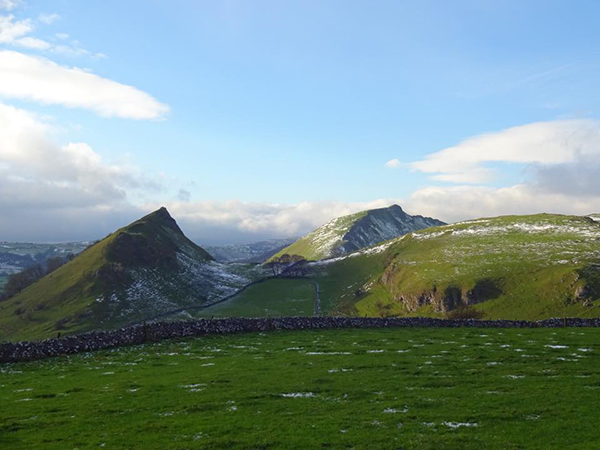
The popular village and National Trust property of Ilam and its hall, are based on a Saxon settlement, later expanded in Victorian times. In its early days it was where the early Celtic Christian missionary St Bertram baptised his flock, using a well on the slopes of Bunster Hill to the north of the village for that purpose. The Saxon villagers took advantage of the comparative safety offered by the sheltered hollow created by the joining of the rivers Dove and Manifold. In the mid1800s Jesse Watts-Russell a shipping magnate and industrialist, employed the services of the Victorian architect James Trubshaw to replace the Elizabethan mansion and farmhouse with the picturesque Gothic palace with its fairy-tale embellishments. As part of Watts-Russell’s grandiose scheme, the old village, a mixture of cottages hundreds of years-old, he employed George Gilbert Scott to design the alpine style cottages which, complete with their attractive gardens, are a never ending delight for today’s visitors. He is often confused with his ennobled son of the same name, who moved on from designing pretty cottages, to being responsible for grandiose schemes such as the design for the rebuilt House of Commons, Battersea Power Station and Liverpool Anglican Cathedral, along with the now fast disappearing GPO red telephone boxes. Jesse Watts-Russell erected the Eleanor-style cross at the road junction beside the pretty cottages of Ilam village. Meant as a memorial to his first wife unfortunately if historical folk-lore tales are right, she was never popular with his estate workers. Intended as a competitor to the standards of the Earl of Shrewsbury’s estate at Alton Towers, the Watts-Russell family despite the expense and upheaval only lived at Ilam for a couple of generations. Since then the hall had a short life as a country hotel, then having been gifted to the National Trust, it became a popular venue for youth hostellers. Despite the current slimming down of YHA’s property portfolio, Ilam will be one of YHA’s four Peak District hostels, making it an ideal base for school parties and family groups exploring Dove Dale and the surrounding area. While the walk does not visit the popular Dove Dale Stepping Stones and manages to keep well and truly inside the Staffordshire section of the Peak District National Park, it does, however visit the Manifold Valley, the lesser known dale within the south-eastern section of the national park. Not only is the Manifold an attractive dale steeped in history both archaeological and political, it once had a light railway, designed to serve the needs of dairy farms and cheese factories based on the lush pasture offered by the underlying limestone rocks. It is this limestone that gives the Manifold another unique feature, which together with its tributary the Hamps is its most unusual feature. In dry weather long sections of both rivers seem to dry up. This apparent ‘drying up’ is not actually correct, because the rivers still flow, but are underground from near Wetton Mill in the Manifold, emerging rather coyly in dribs and drabs along a section of the Manifold half a mile upstream of Ilam Park and Lover’s Walk. This walk is an ideal way to explore the western bank of the Manifold Valley, well away from crowds flocking to the magnetism of Dove Dale’s Stepping Stones. Climbing the steep by-road winding above the wooded slopes of Hinkley Woods to the tiny hamlet of Blore, a view of the little known Weaver Hills opens to the west, across the Churnet Valley to Alton Tower’s mechanical amusements. The walk, however does not go so far, but turns right and then goes downhill to cross the maybe dry River Manifold in order to join a woodland path, back to Ilam Hall and its ever welcoming tea rooms and the dramatic view of Bunster Hill, guardian along with Thorpe Cloud of the famous Dove Dale Stepping Stones. THE WALK :: THE WALK :: THE WALK :: From Ilam Park National Trust car park, walk with the hall on your right, cross the grassy playing field between the hall and St Bertram’s church. Go down to the river and cross the hump-backed ancient stone bridge. Climb the wooded slope for about fifty or sixty yards, until you reach an open field. Follow the faint path as it curves to the right, uphill until it reaches the unfenced road. Cross over the road and follow a faint path, gently curving, still uphill, past a narrow belt of trees, keeping to their right for about a quarter of a mile until you reach the cross roads outside the tiny village of Blore. Turn right at the cross roads and follow this road for about half a mile until it starts to bend left where there is no enclosing wall on your left. N.B. If using the 1:25,000 scale OS map as an alternative, you will be off the map for a few yards at this point, but the way is clearly marked on the Images map attached to this article, or on the Ordnance Survey 1:50,000 scale Landranger map as recommended in the introduction. Turn right just before the bend and follow a grassy path towards, then to right of a small hill topped by a clump of trees (Hazelton Clump). Begin to go downhill towards a larger stretch of woodland on your right (Hinkley Wood), but do not enter. Cross a shallow dip and descend towards Upper Musden Farm. Reaching the farm, but not entering its yard, turn right and go downhill again for about three quarters of a mile. Cross a series of six small fields, following their boundaries by stiles and gates. Go past Musden Grange Farm and then walk through woodland, downhill to a path coming from your right. Turn left on the path and follow it for about 100yards as far as a minor rod. Turn right and follow the road downhill to Rushley Bridge. Pause and look over the side of the bridge and see if