The Lost Houses of Derbyshire – Hearthcote House, Swadlincote

by Maxwell Craven Hearthcote House was a deceptively ancient and complex building by the time of its demolition in 1980. At first glance, it appeared to be an eighteenth century two storey L-plan brick farmhouse, lit by sash windows both conventional and side opening (the latter usually called York sashes), under cambered heads and with brick string courses in between – all reminiscent of the later Georgian Era. In fact, this external fabric was dated 1793. The entrance looked plain, too, but showed signs of having once had a stone surround, but at the NW end, there rose a mighty stone built external chimney breast which once rose in stages and which was latterly topped by a brick chimney stack, also in two stages. This feature betokens an early Tudor date or even the mid-to late-fifteenth century and was clearly once attached to a much more ambitious house. Inside, all was not as it seemed, for it was actually box framed in timber, in the style of the mid-17th century, with a particularly interesting oak staircase with balusters tenoned into two posts which ran up the whole height of the house, a feature only paralleled to my knowledge by the 1640s staircase at (not lost!) Sturston Hall, near Ashbourne, also a timber framed house of similar size, later cased in brick (and stucco in this case). I might add that this important staircase was safely removed from the house prior to demolition in 1979 and stored dismantled with the County Council’s important collection of agricultural machinery at the excellent Working Estate Museum, Elvaston Castle, from which, needless to say, it was subsequently lost when the museum was suddenly closed by the County Council and the collections – including much agricultural material given by the late Lord Vernon – auctioned off. No one has been able to discover its fate, despite efforts by the South Derbyshire District Council heritage officer, Philip Heath. At the time Domesday Book was compiled, Drakelow and Hedcote are combined as one manorial estate, listed at the head of the list of those held directly from the King by Nigel de Stafford, whose posterity settled here and took the name of another manor, Gresley, as their surname, but they lived at Drakelow until 1933. The name Hearthcote is directly analogous to ‘Heathcote’, meaning the house or domestic property on the heath, and indeed the area is well scattered with names ending in ‘-cote’: Swadlincote, Brizlincote and Chilcote being further examples. The spelling varied wildly, but remained mainly as ‘Heathcote’ until the Stuart period but, by the time Peter Burdett drew his map of the County in 1767, he had labelled it ‘Hearthcote’ although 19th century directory compilers must have become confused on hearing the name spoken in the local argot, rendering it both as ‘Earthcote’ in 1846 and as ‘Arthcote’ in 1895! It was reckoned part of Stapenhill by 1185 when the place was granted to Burton Abbey, and it may well have had a capital mansion on the site, as the grant included a long vanished chapel, almost certainly a domestic one. Later though, it seems to have reverted to the Gresleys, for Sir John de Gresley granted it to Gresley Priory in 1363. It was leased by the Prior to the Verdons, one of whom appears to have had a capital mansion here – presumably on the site of Hearthcote House. By 1296, Hearthcote was held from Theobald de Verdon, with Newhall and Stanton (by Newhall), by Robert de la Warde of Upton, Leicestershire. Three years later he was summoned to Parliament as 1st Lord Warde of Alba Aula, which quaint Latin designation probably equated to the appearance of his newly built seat at Newhall and indeed, there was a Whitehouse Farm there until a century ago, having survived Lord Warde’s new seat by several centuries. Also, from that time and for many centuries, Hearthcote, Stanton and Newhall all had the name ‘Ward’ suffixed. The descent of the estate went from his son to Sir Hugo de Meynell and the evidence seems to be that he lived at New Hall and members of his family occupied the secondary houses at Stanton and Hearthcote, but after his male line failed, it passed to the Dethicks and thence through several successive heiress. When Gresley Priory was dissolved in 1536, the estate at Hearthcote was valued by the commissioners at £13 – 6s – 8d (£13.33) the same as Church Gresley, which they also held, suggesting both were then pretty small. The Commissioners sold Hearthcote to the Alleynes of The Mote in Kent, who built Gresley Old Hall, and the house became attached to their estate there, although Hearthcote itself seems to have become an extra parochial liberty of Church Gresley – that is, separate from the main parish and free from shrieval control. The Alleynes pulled down the old medieval Hearthcote House (probably built around a courtyard) and replaced it with a timber framed farmhouse attached to a stone chimney breast retained from the old house, being strongly built of ashlared stone – waste not, want not! This probably happened after 1597 when Hearthcote was still described in a document as ‘an old howse’. In 1730 John Alleyne sold the estate, including Hearthcote, to the somewhat egregious Littleton Poyntz Meynell of Bradley, who intended to use it as a shooting box, but his son decided to move to Leicestershire the better to hunt and, in 1775, the Meynells sold it all to the Gresleys, so Hearthcote thereby came full circle. It was without doubt the Drakelow estate that re-cased the old house in brick, and seems to have continued with the three-life tenancy of the Newbold family. However, change was again on the cards for, in 1828, Sir Roger Gresley, Bt. sold Gresley Old Hall and Hearthcote separately, the latter becoming the property (probably due to the lure of good quality coal being available on the estate) of Stanley Pipe-Wolferstan DL JP (1785-1867),
The Lost Houses of Derbyshire – The Grove, Darley Dale

The name Alsop (with multitudinous variations of spelling) is by no means uncommon in Derbyshire, if only because it derives from an unique place name, Alsop-en-le-Dale, next to Parwich, just north of Ashbourne. The Alsops had a Norman or Norse ancestor, called Gamel (probably derived from the Latin for ‘twin’- gemellus), who took his name from the place when granted the sub-tenancy of the manorial estate there by Henry de Ferrers before 1086. His descendant remained there until poverty forced a sale in the late 17th century and a tall portion of the family’s Elizabethan house remains as an ornament to the village to this day. As the place name is unique, it is likely that all Alsops today descend from Gamel, although you would need to DNA test everyone bearing the name to establish that most were actually of the same blood, so to speak. Furthermore, the preservation of the uniform spelling of names was in the hands, before the 1870 School Board Act, of semi-literate parish clerks which is why many surnames have sometimes quite extraordinary phonetic variants. With the Alsops, it rested with the duplication or otherwise of ‘l’s and ‘p’s. Hence, TV personality Hon. Kirsty Allsopp and her ancestors, back to Derby tobacco merchant Thomas, all spell with two of each. When her ancestor, Sir Samuel Allsopp, Bt., 1st Lord Hindlip, was first ennobled, he wanted to take the title Lord Alsop of Alsop, but he failed to establish his descent from the ancient family, and the Heralds in 1886 refused and whilst such a descent seemed likely, lack of proof forced him to take the name of his Worcestershire country house, Hindlip Hall (now the West Midlands Police HQ) as his title, becoming ‘Lord Hindlip of Hindlip and of Alsop-en-le-Dale’ (of which parish he had thoughtfully acquired a modest amount of land). He also had to accept changes to the historic coat-of-arms. Back in Derbyshire, lead trader John Alsop of Snitterton who wrote his will in 1798, was a similar case. His descent, possibly from Luke Alsop of Wirksworth, living in 1693, cannot be provably traced to Alsop-en-le-Dale either, although for all his family’s skyrocketing wealth, he was never offered a peerage! John Alsop had two sons, the elder Anthony, was barmaster (legal controller of lead mining) at Wirksworth and was ancestor of the Alsops of Wensley Hall, three generations of whom were barmasters at Wirksworth. The younger son, John Alsop was a lead merchant like his father and settled at Lea Wood, dying there in 1831; his memorial still graces the wall of the former chapel there to this day. He had two sons and two daughters, of whom the elder son Luke lived at Lea Hall, a delightful Baroque villa (albeit facing the chilly north winds) high up in Lea, and married Lydia the daughter of his father’s brother Anthony. The house at Lea Wood stayed in this branch. The younger son was John who was also a lead merchant and acquired some land on the east side of the main road (now the A6) through Darley Dale. Here, about 1790, he built a decent, four-square three storey and three bay wide villa with a top parapet, which he named The Grove. Some twenty-five years later he decided to increase the size of his house, adding a pediment over the whole width of the original villa, and two bay wings of two storeys on either side, but containing somewhat loftier rooms than those in the original part, with the result that the wings were nearly as tall as the main, central, block. At the same time, he provided the garden front with a cast iron trellis verandah with an iron roof. The grounds ran to over 50 acres, but who undertook the landscaping is not known. John Webb, in the 1790s active at Willersley Castle, is a possibility. Indeed, we was working in conjunction with Thomas Gardner of Uttoxeter there, formerly assistant to Joseph Pickford of Derby, and it is not impossible that Gardner might have built Alsop the original villa. The finished house was, therefore, of some size, and was inherited in 1834 by John Alsop, the son, also a lead merchant who, for reasons not wholly clear to me (one assumes financial difficulties or the lure of becoming a gold trader) emigrated to Australia in about 1850. He let the house to Revd. William Hiley Bathurst (1796-1877) the second son of Charles Bathurst MP (formerly Bragge) who had inherited the Lydney Park estate in Gloucestershire from an uncle, Poole Bathurst, in 1804. Incidentally, the ‘a’ in Bathurst is always short. W. H. Bathurst himself had married Mary Anne Rhodes, the daughter of a Leeds businessman, but in 1863, his brother died and he inherited the Lydney Park estate, moving there that year. His successor was a lowland Scot and an Indian ‘nabob’, Robert Keith Pringle (1802-1897) of an old Selkirk family, who had risen high in the Indian Civil Service at Bombay (now Mumbai) under the Honourable East India Company. In 1848 he married Mary Jane, daughter of General George Moore of the Indian Army, but the couple had moved back to England in 1862, following the changes brought about in the wake of the mutiny. At the Grove, now re-christened Darley Grove (confusingly, bearing in mind there was then a substantial house in Derby of the same name – see Country Images August 2015) the couple added a canted bay to the south front along with a conservatory, supplied by Messenger & Co. of Loughborough. Here, at Darley Grove, they reared a brood of five sons and five daughters, and it may have been lack of space that persuaded them to sell up, in 1876 to a Manchester millionaire, William J. Roberts. Within a few years, Roberts decided to replace the house with something more befitting his status, so in 1884 demolished The Grove and set about building a completely in-your-face essay in Jacobean revival, of
The Lost Houses of Derbyshire – Foston Hall
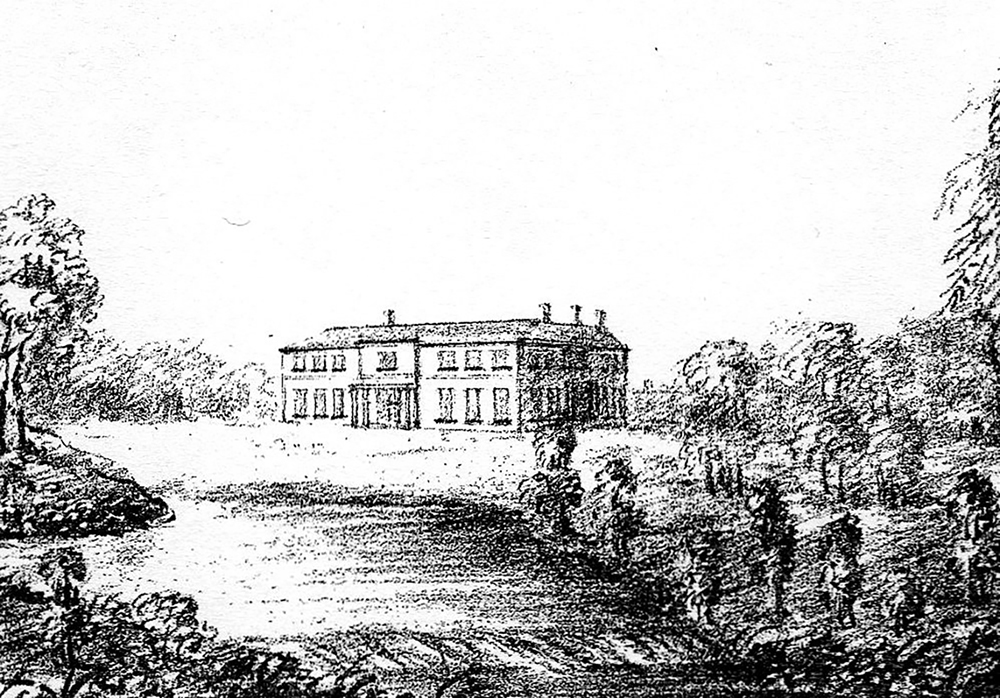
Most readers, on seeing the title of this piece, might instantly be tempted to pen a letter to the editor complaining that Foston Hall is not lost at all, but a prison for convicted women criminals, easily seen from the modern A50. Well, that is true, but we know of two previous houses on the site, both significant and worth recording. The first, of which no known picture exists, was built in the Tudor or early Stuart period, but was replaced in 1809 by a very stylish Regency house, of which some vestiges remain embedded in the present structure. We do not know who the sub-tenant of Henry de Ferrers was at Foston at the time of the Domesday Book in 1086, but it came to Henry de Derby in around 1100 (he may have married the heiress of the first sub-tenant) and was in the hands of his son Robert when the latter died without issue in 1130 and left the manorial estate to his younger brother John. It is unclear exactly who these de Derbys were; a family of that name (and of Norse descent) were virtual rulers of Derby from shortly after the Conquest until they were finally decimated during the Black Death, but Henry does not show up on their pedigree as reconstructed from surviving charters. By 1286 one Walter de Agard held Foston and we are told by one ancient document that he was fifth in descent from the first of his family to settle at Foston (presumably by marrying the heiress of the de Derbys) and that this man, Richard de Agard, was from Lancashire. Allowing 25 years per generation this would suggest that Richard Agard married a daughter or sister of John de Derby, which at least fits: only positive documentation is missing. All this suggests that there must have been a capital mansion at Foston from an early date, but where it stood is unclear. The park was landscaped in the late 18th century (perhaps by William Emes, a lake enthusiast) and the complex of lakes to the south of the present house, fed by the Foston Brook, may have been adapted from a moat. (I must confess to being unable to say whether these survive, for on my visit to Foston over thirty years ago, I was told by my personable hostess, Miss Scriven the then governor, that a survey of the grounds was understandably not possible for security reasons, and of course, I forgot to ask about any surviving features.. The Agards take their name from the Danish Ǻgǻrd, a habitation name (which does not appear to have survived to be entered into modern gazetteers) comprising the Norse elements à (= river) and gard (= enclosure), which hardly hands us any clues as to where in Lancashire they may have come from! They continued as proprietors of Foston, Scropton, Sapperton and Osleston into the Tudor period, when Clement Agard’s second son Arthur (1540-1615), was appointed Escheator and Coroner to the Honour of Tutbury and of the Bailiwick of Leek (Staffs.), a post he held for an astonishing 45 years. He was succeeded by his nephew, Sir Henry whose right to hold these profitable offices was challenged by the Crown, but he maintained he held it by tenure of ‘A white hunter’s horn, garnished with silver, inlaid with gold, in the middle and at both ends. To which is fixed a girdle of black silk, adorned with certain buckles of silver embellished with the arms of England’ which he claimed Arthur had received on appointment by and from his predecessor, and that the item had descended from Walter de Agard in the late 13th century. The coat of arms on the horn (which still exists) is in fact that of John of Gaunt, as Duke of Lancaster (but used to represent the honour of Tutbury, the seat of the Duchy’s control in our area) impaling the arms of Ferrers, once Earls of Derby, which confirms its status as a hereditable badge of office so the article must date from after about 1375. The horn continued in the family until the death of Sir Henry in 1635, when it passed to as distant cousin, Sir Charles Agard, previously of Mackworth, Croxall and Osleston. He was assessed for tax on 12 hearths at Foston, suggesting a medium sized Tudor or slightly later manor house, the first hint we get of anything about the place. Unfortunately Sir Charles found himself, at the Restoration, facing financial disaster as a result of having supported the King in the Civil War, a predicament that even holding the High Shrievalty of the County in 1660 had failed to ameliorate. His son John, having died before him, he sold Foston in 1675 and died five years later, when his remaining property passed through marriage of his daughter to the Stanhopes of Elvaston, including the horn and what by then was its remaining perk, the right to appoint the coroner for the area. Later, one of the Earls of Harrington sold it with its privileges to Samuel Foxlowe and from him it descended to the Bagshawes of Ford. The Foston estate, was sold to Col. William Bate, who owned an estate in Barbados too and was a colonel of militia there. His father had come into the property through shrew conduct, having arrived in the Caribbean as a surgeon. William’s son Richard married Mary, daughter of John Newton of King’s Bromley and it was her brother Samuel who was living in the hall when Woolley wrote of him in 1712 as ‘…having a very good commodious seat there and to complete its pleasantness there is a pretty brook runs through his garden.’ The brook being the same that probably formed a medieval moat round the first house and was later to be dammed to created the double lake which was the centrepiece of the modest parkland from the end of the 18th century. Richard’s son married Arabella, one
RHS Chatsworth Flower Show

Brian Spencer looks back on 2018 when describing what will be on offer in 2019 Unlike Show Gardens at Chelsea, those at Chatsworth are far more practical, giving ideas for what can be created in the average domestic plot. Now in its third year at Chatsworth, the Royal Horticultural Society’s (RHS) newest Show, RHS Chatsworth Flower Show partnered by Wedgwood Pottery will return to the magnificent 1,000acre Chatsworth Estate. Following the popularity of 2018 themes, the show will be bursting with exciting new content including a mass planting of thousands of Dahlia (Dalina Maxi) ‘Salinas’; an impressive Power of Trees feature and a spectacular floral immersion experience, to wow visitors and thrill the senses. The main theme of this year’s show celebrates the five senses of horticulture with the taste and smell of edible herbs, plants and flowers, the touch of a variety of natural textures, the sight of high summer colours and the sound of bees, grasses and tree listening. Inspired by the resounding success of last year’s Cosmos display when banks of that delicately colourful flower complimented the warm hues of the freshly cleaned stone of Chatsworth’s venerable walls, a mass planting of thousands of dahlias will create a striking vision of lilac and white. Designed to echo the iconic parterres of Chatsworth House, visitors will be able to walk amongst the blooms to fully enjoy the beauty of this vibrant summer flower. Well placed alongside Chatsworth’s magnificent woodlands, the important role trees play within our world will be explored in the new Power of Trees feature, showcasing some of the great ways trees enhance our lives. Derbyshire Wildlife Trust, RSPB and Forestry Commission will showcase the vital and extensive role that trees have in our lives. Visitors will be encouraged to plant them at home in a bid to help battle climate change. There’ll be a tree nursery, storytelling, woodland crafts, carving, arborist talks and even tree listening in this exciting new zone. A virtual reality experience created by 3D expert and VR designer, Simon Mabey will engage visitors further in tree display as they experience the wonder of wildlife from the trunk to the treetop. Unlike show gardens at Chelsea, often far more suitable for the entrance to a top company’s head office foyer, those at Chatsworth are far more practical, giving ideas for what can be created in the average domestic plot. One of the highlights will include a show garden inspired by one of the RHS founders, John Wedgwood in ‘The Wedgwood Garden’ by horticulturalist and RHS Ambassador Jamie Butterworth. This colourful garden celebrates the power of horticulture and plants to connect people and unite communities. A special feature ‘The Brewin Dolphin Artists’ Garden’ will showcase the skills of a variety of artists from across the UK, including textile art, Japanese porcelain and basket weaving. Many of the themed gardens should give ideas for someone wanting to transform a domestic plot into a feature that will give pleasure and pride to its maker for years to come. If last year is anything to go by, there will be no over the top designs, such as the upside-down monstrosity one year, or concrete blocks rather than flowers. Local BBC listeners can see their station’s winning designs, the results of a competition across radio waves of the east Midlands. Judged by award winning designer Lee Bestall, the region is represented by three winners: BBC Radio Derby’s Haydon Vernon’s – ‘The Brewery Garden’ uses water as the theme which helped make Burton Upon Trent a prosperous brewing town. BBC Radio Sheffield’s Emily Barnes’ – ‘Elements of Sheffield’ celebrates the links the city has with the nearby Peak District. BBC Radio Stoke’s Colin and Mary Bielby’s – ‘An Imagined Miner’s Garden’ commemorates the Minnie Pit disaster on 12 January 1918 when 155 men and boys were killed – 2019 marks the 100 years since the last body was taken out of the mine in 1919. Experts will be speaking in the Potting Bench and Dig theatres at advertised times, alongside commercial growers on individual stands. Not to be missed will be the Floral Marquee bursting with the best on offer from 80 growers and nurseries throughout Britain; included alongside these will be RHS Chatsworth’s Master Grower Pennard Plants. There’s shopping galore and great community and schools competitions; there will be something for everyone at the RHS Chatsworth Flower Show from 5-9 June. 00
The Manifold Valley

Two major Peakland rivers, the Dove and Manifold, begin their lives a little over a mile apart, high up on the gritstone moors of Axe Edge, between Buxton and Leek. They both flow south west, almost parallel to each other, separated by limestone ridges, before joining below Thorpe village; here they continue, now known simply as the Dove, southwards to enrich the waters of the River Trent. The river and its valley we are exploring is the Manifold. Unlike the Dove whose birthplace can be identified by a well that once provided drinking water for a farm at Dove Head, no single place can be identified as the true birthplace of the Manifold. Several streams rise from the bleak shales of Axe Edge, but they soon join to make the Manifold. But if one source must be identified then perhaps being the most northerly, it is the stream which rises near the Traveller’s Rest close by Flash village. Few if any tributaries join from the east, but several including the Hamps, the Manifold’s major side stream, flow in from the west. At one time there were plans to flood a wide shallow basin below Longnor, but fortunately they were abandoned in favour of Carsington Reservoir. The underlying rocks are shales as far as Hulme End. Here the river starts to meet limestone, a rock so porous that further down the dale, the Manifold frequently disappears underground, only to surface at a well in the grounds of Ilam Hall. Tiny farm-based villages dot the moors, with Longnor traditionally their focal point. The village sits on a high ledge above the Manifold and is where until recent memory that farmers brought their produce and animals for sale. Overlooking the cobbled square, the market house with its scale of charges on a board above the entrance, is now a craft workshop and café. Classified as a Conservation Area, Longnor is one of those places where quiet wandering down narrow side alleys leads the traveller to the discovery of attractive cottages and scenes. The village was once part of the Crewe and Harpur Estate, a fact highlighted by the name of the inn opposite the old market house. Although Longnor church was rebuilt in the 18th century, it stands on foundations at least 8oo years old. Look for the tombstone of William Billinge, who, if we are to believe records of the day, was 112 when he died in 1791. He was a soldier who fought under the command of the Duke of Marlborough and faced death so many times in action, that he believed it had overlooked him. A complex pattern of moorland roads run west then south above the headwaters of the Manifold’s higher tributaries. One of them leaves the Buxton/Leek road beyond the Royal Cottage pub where Bonnie Prince Charlie is supposed to have rested on his march south. This side road, never dropping much below 1400 feet, winds its way south across the Morridge moors where the remote Mermaid Inn is the only habitation for several miles. As befits such a remote spot, a nearby pool is said to be the haunt of a mermaid who drags the unwary to their doom. The inn once looked after the needs of coal miners who worked shallow pits on the surrounding moors, but is now much more upmarket. For several days on either side of mid-summer’s day, the sun when viewed from the Mermaid Inn appears to set twice when it passes behind Hen Cloud to the north-west. Warslow is on the Leek/Hartington road, a focal point for the surrounding farms. Again like Longnor, Warslow was a Crewe and Harpur estate village where the Calke Abbey dwelling family had a shooting lodge nearby. Moving east along the B5054, limestone appears at Hulme End, continuing south towards Ashbourne. Engine sheds and station buildings are now an information centre at Hulme End using what was once the northern terminus of a light railway that joined the standard gauge Leek-bound line at Waterhouses. Intended to find most of its trade carrying milk, it was also popular with passengers who travelled in its yellow-liveried coaches hauled by locomotives resplendent with massive headlamps; they came this way seeking the delights of the Manifold valley. Never profitable The Manifold Valley Light Railway became known as the railway that went from nowhere to nowhere, it was opened in 1904,but only ran until 1934. Since then the track has been converted to a cycle and walking trail. A large round hill dominates the landscape immediately to the south of Hulme End. This is Ecton Hill, a hill which gives little hint of the fortunes won and lost beneath its green slopes. Copper and lead were mined here for over three centuries, and although at one time its profits paid for the Duke of Devonshire’s plans to develop Buxton as a spa town, all that is left upon the surface are overgrown spoil heaps, the outflow from one of the mines close to the valley road and the restored Agent’s House (privately owned), with its green-coloured copper spire peeping through the trees. While the Manifold Valley Trail follows the old railway, the riverside road leaves the valley at Wetton Mill. There is a small car park and café here, making it easy to venture further afield by climbing up to Thor’s Cave where our ancestors dating from pre-historic to Romano-British times once sheltered. Earlier still, the shallow cave became the lair of hyenas and sabre-toothed tigers. At Wetton Mill, the river makes the first of its disappearing acts beneath the fissured layers of limestone, only reappearing finally at a ‘boil hole’ below Ilam Hall, about seven miles downstream. A waterwheel once powered Wetton’s mill by water carried along a leat that can be still traced from where it took water from the main river about a mile upstream. Three villages sit high above the valley. To the west is Butterton and across the fields, its neighbour, Grindon. Both are peaceful,
The Dahlias of Biddulph Grange Garden

A little way beyond the northern limits of the Potteries, just off the Congleton road, Biddulph Grange Garden is one of those places where each season has something to offer. It is this special changing of interest and variation of plants looking their best which draws us back, time after time. This year our visit coincided with the dahlias at their flamboyant best, but while admiring them we discovered a hidden secret in the history surrounding their position in this unique garden. Biddulph Grange Garden was created in 27years from 1842-1868 by James Bateman, a local businessman and his wife Maria, together with Edward Cooke, a marine artist friend. The garden was dug out of the side of a valley that flows down to the River Trent and by constructing ‘compartments’, microclimates were created to make homes for the trees and shrubs collected by famous plant explorers commissioned by Bateman. With differing areas created by the microclimates, the garden was divided into small, inter-connected zones, some warm, others damp and cool and sometimes almost shadeless. Each ‘compartment’ became home for magnificent trees, shrubs like rhododendrons, azaleas and ferns as they settled into a copy of their original environments. In this way it is possible to walk from country to country without travelling more than say, half a mile. Within the space of a few yards inter-connected rocky paths lead from Italy, to Asia, then onwards to a Scottish glen. Beyond a rocky tunnel the garden explorer will find themselves inside the tranquillity of a Chinese temple complete with tinkling bells and a bamboo shaded pond full of golden carp; a Willow Pattern bridge completes the effect of being on the other side of the world. Passing beneath the gaze of a magnificently gilded buffalo, the path climbs past a short section of the ‘Great Wall of China’, by way of a ‘stumpery’, inverted trees roots, to arrive at a half-timbered Cheshire cottage. Beyond the ‘cottage’ Egypt is described from the imagination of some Victorian sculptor who, it must be said had obviously never been to that ancient country. Round the corner from the rather strange reproductions of the sphynx and the ape god, Thoth, is the long double-sided avenue lined with Deodar Cedars, backed by Red Horse Chestnuts. Although still known by its original title of the Wellingtonia Avenue, there are no specimens of this most ancient of trees. They were removed by Robert Heath, a later owner of Biddulph Grange who possibly could not wait until the Giant Sequoias, Californian Redwoods, mature in 3,500 years. The beds where the dahlias we had come to see are grown, disappeared beneath a mountain of rubble during a less prosperous time for the garden. Throughout its life, Biddulph Grange and its garden has had several owners, many of whom could not afford, or be interested in its upkeep. Almost from the start, Bateman almost bankrupted himself with the cost of developing such an imaginative project. Other owners did not have quite the drive or interest as he had and to cap it all, the house was almost totally destroyed by fire in 1896. With the passing of time, two wars and sundry recessions, Biddulph Grange Garden became a vandalised wilderness. In 1923 the house was turned into a cottage hospital, then in the 1960s the NHS took over the hospital, but with the inevitable demands on finance the NHS could only afford to pay one gardener to care for the 15acre garden. Vandalism and neglect took its toll and it was at this time that the Dahlia Walk as it is called, was filled to the brim with rubble from building work on the hospital. What had been one of James Bateman’s pride and joys simply disappeared. When the National Trust took over the garden in April 1988, it embarked on its most ambitious restoration project: to return Biddulph to the glory of its Victorian heyday. Fortunately the garden despite its neglect was resilient and over the intervening years James and Maria’s vision came back to life. One of the major projects was to open up the Dahlia Walk, rediscovered in 1988, and this meant removing the tons of rubble and junk dumped there by builders. Beds making up the ‘Walk’ follow a gentle slope rising to the east towards the vantage point of the Shelter House. A series of neatly clipped yew hedges create small interlinking beds, each filled with what is possibly the most exotic plant to flower in British gardens. Dahlias similar to now extinct cultivars that were popular in Victorian times, together with herbaceous plants of which Mrs Bateman was especially fond make a pleasing spectacle in late summer, almost until the first frosts. Tight-headed pompoms vie with flamboyant larger flowered varieties, all in the brightest of colours bring the ‘Walk’ to life. This would surely have met with the Bateman’s approval, especially if the stroll leads up to the Shelter House, another result of the National Trust’s successful knack of restoring something for which only plans and old photographs remain. When the dahlias finish in autumn, the garden has one last explosion of colour as leaves on the deciduous trees turn to different shades of reds and yellow. 00
The Lost Houses of Derbyshire – Romeley Hall, Clowne

At Romeley, one gets two lost houses for the price of one. The early history of Romeley (or Romiley) in the extreme SW of the parish of Clowne, but often erroneously listed under Barlborough, is obscure to say the least, but the first we hear of a capatial mansion there is in 1455 when one on site was in the possession of Stephen atte Wode, (Wood), a member of the same Eckington family whose name later mutated into Sitwell, as of Renishaw. A descendant, William Wood sold the estate in 1604 to William Routhe of Birley and Waleswood (now Wales) both just over the county line in Yorkshire. They seem to have rebuilt the house in coursed rubble of High Hazels Coal, quarried locally, of which the main surviving doorcase is carved from a single block. Unfortunately, this house was abandoned towards the end of the nineteenth century, having been described as an ‘ancient farm house’ since the mid-18th century, in favour of a new house built contiguously, of which more anon. No illustration of the old house survives, but the L-shaped surviving portion has two storeys over a high basement, suggesting a house of some pretension, the more so for Thomas Bulmer in 1895 recorded a lost first floor long gallery of some sixty feet, a four yard (12 foot) square rannel balk and chimney and a kitchen fireplace boasting a twelve foot wide cambered bressumer, the latter still in situ (or was when Mick Stanley and I visited in 1980). The house under consideration today, however, is its successor, Romeley House, occasionally and confusingly also called Romeley Hall. This was built by Thomas Wright Bridgehouses, in Sheffield (1679-1741), who bought the estate from the heirs of Francis Routh of Brenley, Kent, whose father, Sir John, had left Yorkshire and had been financially hammered for loyalty to the King during the Civil War. This villa, built possibly as a place to which he could retire from the smoke and pollution of Georgian Sheffield, seems to have been erected immediately after his purchase in 1711. The need for a new house being that the Clayton family had a three-lives lease of the old hall and were still in occupation. In 1741 this new house passed to Wright’s nephew, Revd. Thomas Wright, who lived in the rectory at Birley, Yorkshire and did not use Romeley House, which fell into some disrepair by the 1780s. Thus in 1788 he sold house and estate to Daniel Thomas Hill. He was the well-heeled son of a London distiller, living near Aylesbury, Bucks., but had business interests locally, living at Chesterfield, where he died in 1811. Daniel Hill clearly had no desire to live at Romeley either, so he let the new house and estate for life to Dr. Thomas Gisborne (1725-1806), a member of a prominent local dynasty, a noted physician, Fellow of St. John’s Cambridge and President of the Royal College of Physicians in 1791, 1794 and 1796 to 1803. He had also been appointed Physician in Ordinary to George III on the recommendation of Erasmus Darwin, FRS, made when the latter had been approached but was keen to avoid being appointed himself.1 Although a bachelor, Gisborne decided to put the house into good repair and to improve it as a fashionable country seat for himself and to improve the setting to create a modest Elysium around it. The brick building he acquired was nothing if not architecturally quirky. It was of five closely- set bays facing south, with side elevations also of three bays, and boasted two storeys and attics. The main façade was notably arresting, rising from a prominent podium and approached by a full width set of stone steps with end and central balustrades. The ground floor was enclosed by angle pilasters rising above the plat band into plinths (or chimneys), whilst at first floor level the façade rose at a slope in a series of reverse curves separated by steps to attic level where they ended against two further full height pilasters which enclosed the central three bays and all of the attic, forming a sort of giant shaped gable. The attic itself consisted of a single sash flanked by a pair of blind lights. The windows had stone lintels and those on the ground floor moulded brick labels beneath the sills, although the sashes one sees on the only view of it, drawn by Samuel Hieronymus Grimm (1733-1794) in 1774, probably replaced stone mullion-and-transom cross windows. There is a naive sophistication about this extraordinary provincial Baroque façade, and its impression on the viewer of a giant shaped pediment is very reminiscent of a group of south Yorkshire houses, one of them, Hellaby Hall, only some ten miles away at Maltby on the east edge of Rotherham, just north of Junction 32 of the M1. This was built on the same scale, with similarly shaped gable (albeit resting upon volutes) and banding, although its façade, of smooth local stone, is not broken up by odd pilasters as is Romeley’s. Another house, Grimethorpe Hall, just NE of Barnsley, is, like Romeley, in brick with stone dressings, and again of five bays. The pediment was once shaped but got simplified in a Georgian rebuild that led to the installation of sash windows. Both houses seem to lack the odd plasters, but in fact Grimethorpe does have attenuated ones to first floor level, flanking the entrance. Both houses have lain derelict and at risk for decades, although the former has been rescued and is now a thriving hotel. Hellaby was built in 1692 by West India merchant Ralph Fretwell (a remote descendant of the Freschevilles of Staveley), whilst Grimethorpe dates to a similar period – at least between 1670 and 1713 , being the adult lifetime of its builder Robert Se(a)ton. This trio probably owe their inspiration to Robert Trollope of York an architect who revelled in the provincial Baroque and who died in 1686 having designed a very similar but
Lost Houses of Derbyshire – Devonshire House, Derby

A great friend who is the senior caseworker for the Georgian Group, was asked by the City Council to comment on an application to convert the upper floors of 35, Cornmarket into flats. Our own Conservation Area Advisory committee, which until recently I chaired, had already questioned the applicant’s desire to remove the surviving staircase of a building which is the surviving portion of one of Derby’s greatest lost houses, Devonshire House, 34-36 Corn Market. This was where 18th century Dukes of Devonshire would reside when in Derby to preside over the three annual Race Balls and various civic business – bearing in mind that the Dukes were hereditary patrons of the Borough until 1974. In his report, in The Georgian, the house was described as ‘said to have been’ the town house of the Dukes of Devonshire. However, there is no doubt about the identification, for although little seems to have come to light at Chatsworth in the archive, other pieces of evidence confirm the identification of a building that was outwardly intact until 1969, when much of it was heedlessly destroyed in favour of an ugly brutalist Littlewood’s store (now Primark). The origin of the house goes back to the time following the death of Bess of Hardwick, whose last (fourth) husband, George, Talbot, Earl of Shrewsbury, was the builder of a grand house on the north side of the Market Place, which passed to his elder stepson Charles Cavendish, whose son William later rose to become 1st Duke of Newcastle. This house, Newcastle House was demolished to build Derby’s Assembly Rooms and its tale was recounted in Images for July 2014. The Dukes of Devonshire descend from Charles Cavendish’s younger brother, William, Lord Cavendish of Hardwick and later 1st Earl of Devonshire. A catalogue in Derby Museum asserts that the family town house was built in Corn Market in 1750 and although the catalogue was compiled in the late 19th century, the information was drawn from ‘jottings’ of John Ward FSA which include material dating back to the early 19th century. Tantalisingly, John Speed’s famous map of Derby, in showing the houses on the east side of Corn Market – then a bustling area funnelled out southwards towards St. Peter’s Bridge where grains were bought and sold from raised basins, set up on posts, called stoops – adds a number 25 just behind the position where we know the 1755 house stood. If you look up No. 25 in the key at the bottom, it says ‘Town House’. Could it be that Lord Cavendish even then had an important residence there? The house built in 1755 was in fact a re-fronting job, as early plans reveal three burgage plots on the site and later plans reveal a thoroughly irregular plan suggesting that the work was largely a re-fronting of more than one existing building. The resulting brick façade was very impressive, however, and very Palladian. There were three floors plus attics, and the building was nine bays wide. The ground floor was originally rusticated: that is faced in stone with prominent grooving between the blocks, a typically Palladian conceit, and traces of this appeared during demolition in 1969, as the later shop-fronts were being ripped away. The central three bays broke forward slightly under a pediment itself flanked by a stone coped parapet with recessed panels over the bays and originally without doubt embellished with urns. The bracket cornice below was deeply moulded and the windows on the first and second floors had bracketed entablatures over whereas on the central three bays, the middle windows had segmental pediments those flanking triangular ones. The attic windows were embellished with stone rusticated lintels, wavy along the bottom edge. Originally, the maps and plans inform us that there was a central carriage arch leading to a rather constricted courtyard behind, flanked by two non-matching rear extensions. No record seems to exist of the interior of the house, although there is a passing mention of fine plasterwork, earlier panelling and a fine oak staircase. At Chatsworth a bill survives dated 1777 from William Whitehurst, brother and works manager to John Whitehurst FRS, for a timepiece and case, which an attached voucher identifies as one installed in the kitchens at the Derby house. Probably it was a typical round dial oak cased long case clock, which are very rare as non-striking/chiming timepieces. A very similar one still stands in the almoner’s office at Chatsworth. There were also extensive gardens to the east, stretching to the Morledge and the Markeaton Brook as it swung NE through what is now Osnabruck Square. A stable block and carriage house were attached to close the rear courtyard off. The builder of this impressive occasional residence was William Cavendish, 3rd Duke of Devonshire who died in 1755. The identity of his architect for the house remains a mystery, for although James Paine was working at Chatsworth for the 4th Duke (from 1756), the façade in The Corn Market shows few of his usual conceits and if the 1750 date is correct, it is too early. William Kent had been employed by the same Duke to completely rebuild the fire-wrecked Devonshire House in Piccadilly, but apart from being severe and equally Palladian, there the resemblance ends. Personally, I suspect the house was built and the façade designed by the young James Denstone (five years later the architect of Markeaton Hall) perhaps working under his former master, Solomon Browne, but until some hitherto un-discovered payment vouchers appear in the Chatsworth archive, speculation will prevail. The curly lower edge of the attic story lintels, however, reappear on Leaper & Newton’s Bank (not the Thomas Leaper bar) in Iron Gate and once on the fenestration of the Babington Arms, Babington Lane, demolished in the 1920s. By about 1814, the area in front of the house had become too noisome and insalubrious for the 6th (Bachelor) Duke and, pulling rank as Lord Lieutenant of the County, he thenceforth requisitioned the 1811
Lost Houses of Derbyshire – Melbourne Castle

Some castles grew from purely Norman military motte-and-bailey castles, constructed by William the Conqueror’s knights to keep a firm hold on England. Others are later affairs, fortified houses built later in the middle ages or even in the Tudor Age more as symbolic castles than effective defensive buildings. Later still, houses like Elvaston or Bretby had ‘castle’ added in lieu of ‘hall’ for effect. If one was a member of the medieval elite, with a largish house built around one or even two courtyards, adding defensive works was sometimes felt advisable, as during the barons’ wars in the mid-13th century, or during the wars of the Roses in the mid-fifteenth century. In that case one applied to the King for a licence to crenellate, or to put it simply, to adapt one’s house to make it to some extent defensible. Such houses are usually termed defended manor houses rather than pure castles, and locally included Codnor, Bretby and Melbourne. There never was a Norman castle at Melbourne. The King had granted Melbourne to the Bishops of Carlisle, a place often made too hot for comfort by marauding Scots, hence the epic scale of the Norman church there. Yet it was not until 1246/1248 that we have evidence for a manor house at Melbourne. In the very beginning of the fourteenth century Sir Robert de Holand, held a manor house there under the ambitious Thomas, Duke of Lancaster of whom he was a leading confidant. He duly obtained a licence to crenellate in 1311 and in 1314 the mason Peter de Bagworth is recorded and undertaking extensive works there, ‘there’ being the area on the SE side of Castle Square at Melbourne, although this work was being done for Lancaster, not Holand himself, that year created a peer by writ of summons. Indeed, whatever arrangement there was between Lord Holand and the Duke, it was clearly intended to enable the former to reap the fiscal benefits of ownership whilst his master retained control of the site. Indeed, this was the year of the disaster at Bannockburn and for the next four years Lancaster was effectively in control of the government. In 1322, however, the King had his revenge, defeating the Duke at Boroughbridge, although, strangely enough, Holand had deserted to the King just prior to the encounter, thus saving his neck. What Holand created was a fortified manor house and he was later confirmed in his possession of the manor of Melbourne, held this time from his former mentor’s younger brother, Henry, Earl of Lancaster, again raised to a dukedom in 1351. The Castle is specifically referred to as such in the documentation generated by his death ten years later. The manor and castle passed by marriage to John of Gaunt, also created Duke of Lancaster, and when his son became Henry IV, his possessions were made into a separate principality, called the Duchy of Lancaster which still owns much land in England and especially in Derbyshire. By this time there was an extensive park, now attached to the Melbourne Hall estate, surrounded by a pale – an earthen bank designed to stop the deer jumping out – still extant in several sections, and equipped with two lodges, one (moated) situated at SK392241 and recorded as in existence from c. 1262 until the late 15th century. There was also a moat and bridge. After Agincourt the castle was developed into a palace-like residence and became the very luxurious PoW camp of the captured Jean, Duc de Bourbon and other notable French prisoners. Poor Duke Jean was there for no less than nineteen years; clearly no one at home was in any hurry to raise his ransom! Their gaoler and the Constable of the Castle was local landed magnate Nicholas Montgomery of Cubley, the younger. It was later granted to Henry V’s French queen after his death in 1422. A drawing of 1602 in the PRO (subsequently rather well engraved in 1733 for the Society of Antiquaries) shows it to have been embowered with something like a dozen round and square section towers, all embattled, the external walls having plentiful slit windows but high up, one or two elaborately traceried Gothic ones too. A pedimented lantern visible in the midst of the pinnacles seems to indicate the position of the great hall and there was an impressive elaborate door with a crocketed ogee moulding above it in the outer wall, compared by Anthony Emery with that at Mackworth (see last month) and presumably the main entrance, reached by the bridge over the moat. Emery also suggests that it must have been built, like Haddon and Wingfield Manor, around two courtyards and points out that the original drawing (rather than the engravings taken from it) clearly suggests this. In its time it must have been most impressive. Yet its apogee was brief and, with the French wars at an end, it swiftly became a white elephant although exactly what it was used for in the later fifteenth and earlier sixteenth centuries is not at all clear, but it was still in good repair when the itinerarist John Leland saw it in the early1540s, writing that it was ‘Prety [pretty] and yn meately [very] good reparation.’ Yet under Elizabeth it appears to have become completely redundant. Hence it was referred to in 1576 when it was reported that the castle was in a fair state of decay though the stonework was good. In 1583, it was recommended by the Privy Council that the queen move her cousin, the imprisoned Mary, Queen of Scots, to Melbourne, and a description of the castle was provided which throws interesting light on its appearance at the time in that it was said to be constructed of lead-covered ashlar, had large spacious rooms that would need to be partitioned, floors of earth and plaster, walls that appear to have needed repointing and rendering since they were described as being too easily scaleable, and no paths or wall about
Lea Rhododendron Gardens

For a few short glorious weeks in early summer, the wooded hillside above the Derwent Valley at Lea is a blaze of colour. This is when Lea Rhododendron Gardens come into their own every year. Brian Spencer tells the story of one man’s vision that has been backed up by three generations of a devoted family. It was John Marsden-Smedley (1867-1959), owner of the John Smedley manufacturers of quality woollen knitwear who made his residence at Lea, rebuilding the farm house of Lea Green into a house echoing his position as the local squire. Today the house and its immediate grounds are used as a residential and day centre by Derbyshire County Council Education Department as an outdoor activity centre. Marsden-Smedley was a keen horticulturist, growing flowers, vegetables and fruit trees behind high sheltering walls. As the site was comparatively exposed at an altitude of around 1,000 feet (305m), to aid existing woodland, he planted masses of trees to act as wind-breaks. These trees were to become a useful addition in his soon to follow, love of rhododendrons and azaleas. In order to find the most suitable site for these plants more suited to the high sunny slopes of the Himalayas, Marsden-Smedley tried planting them in various sites around his estate; the remnants of these trials can still be seen dotted around woodland clearings. In 1935, at the age of sixty-eight and inspired by a visit to Bodnant Gardens in North Wales, together with one to the Rothschild family’s Exbury gardens in Hampshire, he decided to develop his own rhododendron garden. One site in particular provided the ideal locality and became the present site of Lea Gardens. Surrounded by tall Scots pines, sycamore, yew, chestnut, oak and silver birch, some already there and others planted by Marsden-Smedley in order to create wind-breaks and provide shelter. Using a shallow hollow of an ancient quarry on the opposite side of the road surrounding the estate, skilled estate craftsmen used the abundant stone to build retaining walls, paths and beds for the plants which were soon to follow. Soil was brought in from other parts of the estate in order to top up the naturally occurring sandy soil. Coal ash from the furnace at his woollen mill was also used to add to this topping-up process. It was during this work that several Roman quern-stones were discovered (used for hand grinding flour). Apparently the garden is built on the site of a small quarry where a particularly fine-grained layer of grit-stone suitable for these stones can be found. Records from that time speak of purchases from all the major specialist growers throughout the British Isles. John Marsden-Smedley also decided to try to establish less-hardy varieties normally only successful in sheltered gardens on the west coast. To his delight he found that by careful planting in sheltered parts of the quarry-garden, they could survive the rigours of most Peak District winters. Many of his original specimens still flourish, almost a century after their planting. Together, over 350 varieties of species and hybrid rhododendrons and azaleas were planted by him and had begun to establish themselves in the 2-acre (0.8 ha) site before his death in 1959 at the age of ninety-two. When the estate was divided and sold, the gardens were bought by Peter and Nancy Tye. They were joined by Joyce Colyer a year later, who came with her expertise as an estate manager for John Marsden-Colyer, also bringing her intimate knowledge of the gardens and their collection of colourful plants. Nancy Tye had an artistic flair for rockery and garden design and it was she who created the alpine scree garden that complements the entrance to the rhododendron collection. The main garden was expanded under Peter and Nancy’s care by the introduction of new plants, ornamental shrubs and a small water garden. In 1960 the gardens were opened to the public and seven years later they built their attractive house overlooking the garden. The next generation to care for Lea Rhododendron Garden was Jonathan and Jenny Tye who retired from the Royal Air Force in 1980. Instead of flying Vulcan bombers, Jonathan and Jenny expanded their inbred flair for horticulture and increased the garden with new plantings. They were later joined by their son Peter, who specialises in the growing and marketing of rhododendrons. As plants begin to exceed their natural lifespan, they are gradually being replaced with new plantings, using the opportunity to bring in unusual varieties. Exciting new hybrids such as the American kalmias below the house, and flamboyantly coloured Japanese yakusimanums collection blooming near the alpine scree garden; almost every colour in a kaleidoscopic spectrum is there, ranging from white, through yellow, orange, pink and bright red; blue is even featured when the exotic Himalayan meconopsis poppy comes into flower in the alpine garden. Backing them is the breath-taking azalea bed which must feature on countless amateur photographs. Paths meander up and down the sloping site, past massive orchid-like flowers of huge rhododendron bushes, where there is colour all around. While the best time to visit Lea Rhododendron Gardens is in mid-May to the end of June and often well into July – there is one variety aptly named Christmas Cheer whose tiny single-petalled flowers come into bloom in late December. With the opening of a tea room, Lea Gardens has become a popular attraction. Visited by plant lovers or those who simply want to enjoy the eye-catching display, it now covers about 4 acres (1.6 ha), planted with over 550 different varieties of rhododendrons and azaleas. Plant sales on site offer a wide range of the varieties which might have caught your eye as you wander round this idyllic place. 00