Taste Derbyshire – Bottle shops, tap rooms & micro-pubs

It was 2005 when Thornbridge Brewery, in Derbyshire, started producing one of the UK’s first craft ales. There are now 70 micro-breweries in the county and there’s been a huge rise in the number of outlets – bottle shops, tap rooms and micro-pubs – on a mission to bring these bespoke beers to the public. Taste Derbyshire’s Amanda Volley visited award-winning micro-pub and bottle shop Maison Du Biere in Ashbourne to find out why there is such a thirst for artisan ales. It has been the best part of two years since Matt Warren and his partner Jo Glover opened Maison Du Biere but the couple still savour the slack-jawed reaction of customers confronted by the 400-odd varieties of beers, ales and ciders. “We don’t give too much away as, from the front, the shop gives the illusion of being a little beer shop so the first thing they say is ‘wow’ followed by ‘oh my word’,” explains Jo (51), originally from Barnsley. “Then they notice we also have a bar area and ten cask beers on tap and they get a bit flummoxed by it all.” Her partner Matt (59), laughs; “I wish we had a pound for everyone who says they’ve walked into Willy Wonka’s factory.” “It’s either that or a sweet shop for adults.” The Ashbourne-based bottle shop and bar may contain a mind-boggling amount of beers (and gins) but the couple are confident they can match everyone, from serious ale buffs to timorous first-timers, with their perfect tipple. “We spend a lot of time talking to people about the beers and how and where they’re made,” says Matt who hails from Bristol. “Some people need a lot of help, others know more about beer than we do. It’s a relaxed place where everyone’s welcome and I think people love us for it.” There is a lot of love flowing in the direction of this cracking shop-cum-bar. In the first year, they were named ‘Pub of the Season’ 2018 by the Ashbourne & District sub branch of CAMRA with the couple praised for their ‘friendliness and enthusiasm’. In January, Maison Du Biere was runner-up in CAMRA’s Ashbourne’s Pub of the Year 2020, pipped only by the Barley Mow at Kirk Ireton; one of the area’s oldest pubs. “We’ve had an amazing reception. The minute we opened our doors in July 2018, it was just ‘kaboom’. The shop was packed and we smashed our weekly sales target on the first night,” says Matt. “People like the fact that we’re an independent retailer and that we stock beer from around 40 local breweries. Our customers enjoy taking a bit of the Peak District home.” Incredibly, considering all the praise flowing their way from industry experts, the couple had no experience of the speciality beer market before throwing themselves into Maison Du Biere. Matt and Jo both worked in sales for a national bookseller. “I knew a little about the hospitality industry as I’d had part-time jobs in pubs since my son Luke (now 26) was born,” explains Jo. “My brother, Nigel Mount, opened the original Maison Du Biere in Barnsley and he invited us to spend a day there. We loved it and, with his blessing, we decided to open our own branch.” Matt admits he also owes Nigel a debt of gratitude; “He took me along to a bar specialising in Belgian beer. I bought a round of four beers which came to £35 even though they were all just one third of a pint and mainly froth,” he laughs. “When the beer touched my lips – I got it. That beer blew everything else out of the water. It was beautiful and delicate. I’m now an evangelist on a mission to convert others to great beer.” Deciding they wanted sell beer was one thing, finding the location was another. The couple were living in Cheshire (they’ve since relocated to Clifton, near Ashbourne) but decided the area was too well-served with independent beer shops. “We knew Ashbourne pretty well from coming to walk here but we decided to drive down and have a proper look,” says Matt “I think we knew instantly it was the right spot as it had a lovely vibe. When this shop came up, Jo went on her own to have a look. She walked in and rang me to say ‘This is it.’ It had been an antique shop housed in a gorgeous 18th century mansion built for Lord Beresford. We didn’t have to do anything other than putting in fridges, shelving and second-hand finds like old trunks and church pews – our approach to furnishings has always been ‘no expense spent’.” Matt says local support has been overwhelming; “I like to think we’re helping to put Ashbourne on the map because it’s a beautiful town with amazing people,” “We lived in Cheshire for 16 years and could probably count the number of close friends on one hand. Now I could name at least 20 who I could call on for favours – day or night – and they’re more like family than friends. The same goes for our suppliers. The craft industry as a whole is very tight-knit. A lot of the beer producers are now our besties or ‘crafties’.” With this, Matt bounds over to the shelves to ‘introduce’ some of the beers. “On the one shelf we have world beers with most coming from the great beer producing nations like Belgium, Germany and Czechoslovakia. They are brewed to traditional recipes which haven’t changed in hundreds of years,” he says. “On the adjoining wall, we have craft beers. Typically made by young brewers who are trying to stamp their identity on a beer. This is where you’ll find people really innovating with flavour. For instance, there’s one tasting of marshmallow while another features chocolate, cinnamon, vanilla and chilli. One of our latest additions tastes of caramel brownie and peanut butter, it really is dessert in a can.”
Taste Derbyshire – How Green is your Kitchen?
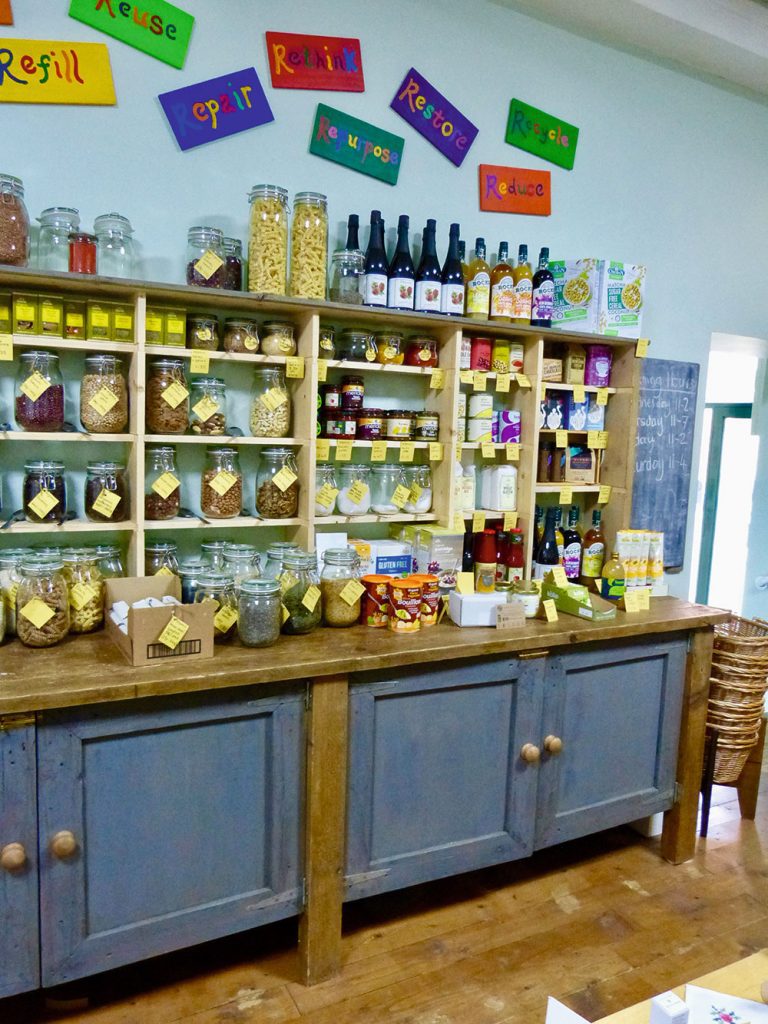
The pine worktops may give off the clean scent of zesty lemon but the kitchen of Taste Derbyshire’s Amanda Volley contains a dirty little secret. Each week she is putting three bags of non-recyclable packaging into her wheelie bin. Desperate to clean-up her act, she reached out to Sue MacFarlane who runs a low impact shop in Belper. A week before meeting with Belper’s Sue MacFarlane, a woman at the forefront of the battle against single use plastic, I saved all the food packaging which normally gets pushed into the deepest recesses of my 30-litre touch top bin. I might recycle seven wine bottles a week, use tatty tote bags for shopping and my old fridge was removed by the council rather than dumped on a country lane, but the shameful amount of non-biodegradable plastic in my bin bags proved two things; – 1. I am no friend of the earth. 2. I have a serious crisp addiction. Fortunately, Sue MacFarlane (58), is happy to act as fairy-godmother to the eco-curious. People who want a greener home but are not ready to exchange loo paper for a family cloth (it’s a thing – Google it). Instead of slapping you across the knuckles with a bamboo dish brush, she guides you gently towards greener habits. Sue runs regular workshops for people who want to cut down on their plastic. A year ago, she launched Sue’s Sustainables – a scoop shop where you can buy loose food for your evening meal and refill on eco-friendly washing-up liquid for the dirty plates afterwards. “Getting started on the sustainable journey can be daunting,” Sue says when I tell her about the pile of plastic waste my two-person household produces in one week. “People are often made to feel they are at fault for all the environmental problems and, if it’s getting worse, it’s because individuals aren’t doing enough. Big businesses are very skilled at putting responsibility on consumers for something they didn’t create.” Then she looks at a picture of my rubbish; “Oh wow – that is a lot,” she laughs. “I think you’re at the start of the journey towards a low impact life.” Sue’s own journey began in 2013 when she and husband Will (63), moved to Belper to pursue a simpler life. “Working for a bank in Sheffield, I saw at first hand the waste that goes on a corporate level – like being asked to fly across the country for a business meeting. When the bank restructured, I decided I didn’t want to be part of that world anymore” she explains. “When Will and I moved back to Belper (the couple had previously lived there from 1997-2004) it was a ‘wow’ moment as the town was more vibrant with lots going on in the community. I became the chair of ‘Sharing not wasting’ which re-distributes food not wanted by supermarkets. In addition to her Green Party commitments, Sue began work as a part-time singing teacher (she is a Natural Voice Practitioner who believes everyone – regardless of talent – should be encouraged to sing) and as a celebrant. She also found time to offer free advice to people who wanted to reduce their own plastic consumption. “I’ve been interested in the environment and ecology all my life,” Sue explains. “In 2017, I decided to look for plastic-free alternatives to everything I was still using in the home and started sharing my tips on-line. The one which really got people talking was finding out that some tea bags contain plastic.” For Sue, a lot of her personal changes meant embracing thrifty habits of the past; “My late my mum Janice was part of the war generation and it was natural for her to re-use things instead of throwing them away, making and mending clothes and never wasting food,” she says. “I can recall her buying the pretty margarine tubs so she could use them as containers afterwards.” Sue became so well-known for her friendly tips; a regional TV news channel did a piece about her low impact life and even followed her to the local chippie where she was filmed getting a glass jar filled with mushy peas. But it was never Sue’s intention to launch an eco-business; “It came about in July 2017 when I went along to the opening of Vegan Revelation Cafe and met the owner Leise Taylor,” she recalls. “I became a regular customer and, when the space next-door to her cafe became available, Leise told me Belper needed a vegan food and refill shop. I asked if she had anyone in mind to take it on and Leise replied ‘Yes – you,’.” Catching up with Leise for a coffee, a week after my meeting with Sue, she tells me there was no one else in the running. “I remember the first time Sue walked into the restaurant – dressed in pink – and she was the picture of positivity. Belper needed a sustainable living shop and there was only one person who could run it,” she laughs. “It had to be Sue.” Sue decided to take on the business in August 2018 and recalls the mad ‘whoosh’ between that decision and opening a month later. Sue timed her launch to coincide with a local screening of Plastic Ocean – a film which documents the devastating effects of plastic pollution on the world’s oceans. “It’s a life-changing film like Blue Planet II. Once seen – you can’t un-see it. When we opened the next day, we saw many of the film-goers,” Sue recalls. “In fact, it was mad all day. A lot of my customers said they’d been waiting for it to open. A massive amount of people just said ‘thank you’. They still do, it makes all the effort worthwhile. It’s such a lovely place to work.” Just over a year later, the shop is a testament to all that effort. Over the past twelve months, she’s doubled the stock
Taste Derbyshire – Derby’s Bustler Market

Market food used to be all about simple, rib-sticking snacks like hot dogs piled with fried onions and thick wedges of cheese on toast. The height of sophistication was asking for a serviette with your bacon butty. But times have changed. Avocado is now our national fruit of choice; you can get liquorice in your gin and the pop-up street market is the place to find exciting young chefs producing daring, cutting-edge food. I’m ashamed to say – even though it was launched in May 2017 – I am a late-comer to Derby’s own Bustler Market; a monthly gathering of some of the best street food vendors in the country. Formed by four friends – Liv Pritchard of Hide Burger Bar, Stuart Costen, founder of Love Derby website, Ben Edmonds of Blok Knives and Tom Erskine from Marketing Derby – Bustler Market came about out of their mutual passion for the city and food. “We came together to create something fresh and less formal than the atmosphere in many pubs and restaurants,” explains Liv. We were all fans of street food events like Peddler Market in Sheffield and the Digbeth Dining Club in Birmingham and we wanted to create somewhere different for Derby people to come and eat, drink, socialise and relax.” The friends were thrilled with how well visitors embraced the concept; “I think we knew young people would love it but it appeals to all generations,” explains Liv. “We can get upwards of 5,000 visitors through the doors over the two days.” What adds to the excitement is the ‘pop-up’ nature of the market. It’s on for only two days (Friday and Saturday) on the last weekend of every month and there’s a rotating list of street food vendors. There’s always an air of anticipation to see which stall-holders will set up and, according to Liv, people like to ‘mix and match’ from all the different outlets. “Our visitors often sit together to socialise and share their plates,” Liv says. “Yes, we do get people asking if they can reserve their own table but generally most are happy to muck-in and have fun. For the visitors and traders alike, we’ve become a tight-knit community united by our love of good food.” Visitors Gemma Byrne and Chris Wilson, of Sinfin, are big fans of Bustler; “We’d been to lots of street food markets in places like Copenhagen and it was great when one opened in Derby,” says Chris. Gemma agrees; “We’ve attended nine Bustler markets since it opened and we’ve never had a bad thing to eat. Our daughter Sienna, who is one, really enjoyed the waffles.” ‘Taste Derbyshire’ writer Amanda Volley took a stroll down to Bustler Market to sample some of the food – and drink – highlights. Get Wurst There’s nothing like the aroma of sizzling hot dog sausage on a cold winter’s night to get people flocking Bisto-kid style around a stall. But forget flabby frankfurters. Get Wurst use Bratwursts from the Munsterland region of Germany, sourced by Paul and Lindsay Melbourne of Sheffield. “We had great holidays in Berlin and loved ‘Currywurst,” says Paul when asked what inspired him to put curry and pickles on a hot dog. “We couldn’t get anything like it at home so we launched the business three years ago.” Paul’s assembly of the ‘currywurst’ begins with a portion of rosemary salted fries, topped with his bespoke tomato-based curry sauce. He coats the food with a dusting of curry powder and sticks a few pickled gherkins on top. “I’ve never had anything like this before,” beams customer Will Hughes. “It’s ideal for street food. I love the curry powder – it’s like a massive sock of flavour at the end.” Paul says these reactions make sacrificing his weekends worthwhile. “I used to work as a charity fund-raiser. I don’t miss the office at all – except when it’s really cold.” Find more by visiting www.getwurst.co.uk The Italian Stallion Converted horse boxes are firm favourites of pop-up food companies – but odds are you’ve not seen one sporting a wood-fired pizza oven. “I love street food markets and Italian food and everyone loves pizza,” says Holly Beasley, owner of The Italian Stallion. “I’ve travelled a lot in Italy and wanted to start a career in food. Pizza was a perfect choice. You can put anything on top of it – like wild honey with a chilli infusion.” Small wonder people make a bee-line for her stall. “I always laugh when children run about because they’re so excited to see us,” Holly smiles. “Afterwards, people walk away with a glazed, happy expression we call the ‘pizza zombie’ look.” Holly, who comes from Hinckley in Leicestershire, has a Monday to Thursday job in therapy but doesn’t mind working on weekends. “We go to lots of fun places, meet nice people and make pizza for them – what’s not to like?” Contact Holly via theitalianstallionpizza@gmail.com The Kebab Cartel When two brothers with design back-grounds launch a street food brand – you just know it’s going to be a perfect fusion of on-trend style and yummy substance. Matt Zalepa, of Darley Abbey, left his job in fashion because he ‘had to’ work with street food. “My brother Jay and I asked ourselves what people like to eat – and came up with kebabs. We take our inspiration from the Middle East, Turkish and Lebanese food and they’re seriously addictive,” he laughs. Jay agrees; “Events like this make quality food accessible to all. We also love working in a busy, party atmosphere.” The brothers – self-styled kebab ‘gangstas’ – may have fashioned a brand which is cooler than a hipster’s beard but they become dewy-eyed when they talk about their food; especially their pillow-soft lamb and pomegranate molasses and tahini yoghurt. “And don’t forget to mention the Kurdish flatbreads,” adds Matt. Customer Martin Broadhurst, of Derby, was raving about the succulent lamb and the ‘duvet thick’ bread of his shawarma. “It was delightful
Taste Derbyshire – From Nut Sprinkled Discs to Chocolate Drenched Honeycombs

Two pints of lager and a cream truffle may not be the average round for most pub-goers but The Three Horseshoes Inn at Breedon on the Hill is not your average pub. Yes, it has the roaring fire, real ales and quarry-tiled floors – but they’ve also thrown in a chocolate shop for good measure. That’s right; a chocolate shop. And not just any old chocolate shop but one supplied with all manner of award-winning, artisan goodies. Moreover, re-stocking is never a problem. The Bittersweet Chocolate Co. – run by Nigel Holling and wife Dianne – is housed in nearby outbuildings; just a short stroll across the pub garden. In truth, I had been expecting the ‘shop’ to be little more than a shelf behind the bar. It turns out to be a gleaming, grandiose Victorian display counter straight from a chocoholic’s dream. It’s several feet long and decadently stuffed with all manner of moreish delights – from fruit-centred truffles to chocolate-dipped dates, nut-sprinkled discs to chocolate drenched honeycombs and fat caterpillars lying beside luscious lollipops. “The chocolate counter always stops people in their tracks,” says landlady Jenny Ison. “My business partner Ian Davison has owned it for more than forty years. We think it was a Victorian confectionary counter but Ian’s family used it to store boating paraphernalia at their chandlery at Sawley Marina. Ian was about 12 when he rescued it and it’s been moving around from garage to garage ever since. But when we bought the pub, Ian realised we’d got the perfect space for it.” Jenny says the counter – and its contents – attract people from all over the country; “People tell us it looks magnificent and it’s definitely a talking point when I tell them we have a real-life ‘chocolate factory’ in the pub garden,” she laughs. “We have a chocolate menu which is very popular as people have truffles instead of, or as well as, a desert. But we also get people having some chocolate with a bottle of wine or Prosecco. We can’t get our hands on enough salted caramel.” “We’ve been based at the pub for nine years and it works really well,” explains chocolate-maker Nigel as he shows me to the vanilla-scented workshop where his colleague, Kate Jackaman, is busy coating honeycomb with tempered chocolate. “When my wife Dianne and I first started we were working from our kitchen. We were trying to develop and manufacture hand-made chocolates all day, every day and turn it back into a family kitchen at night. It was quite a squeeze – we became very good at dancing. The Three Horseshoes were customers of ours and they offered us space in what used to be the motel rooms.” He laughs; “But having a shop in a pub is unusual. We might be in an exclusive club of one.” The Bittersweet Chocolate Co. may have started on the kitchen table but the team’s artistry with chocolate – and wizardry with flavour combinations – has earned them multiple Great Taste Awards including a prestigious two stars accolade for their cracked coffee bean in dark chocolate. “My background was in catering,” explains Nigel (54), of Chellaston, when asked how he came to master the art of chocolate-making. “I helped set up the restaurants and catering outlets for the American Adventure Theme Park. The role included involved managing stock and distribution and I ended up taking a sideways move into IT. But I loved working with food so much I’d take on part-time jobs providing cover for chefs.” Nigel realised he’d reached a crossroads when his children Charlie and Anna (now 18, 16) were born. “With two small children, I couldn’t go out and chef anymore but I wasn’t ready to ‘put up and shut-up’ until my retirement. I decided to resign in 2007 because I needed to work with food; it’s my passion.” “Chocolate was in the forefront of my mind as I was excited by the scope it would give to create new flavours and textures. I enrolled in some chocolate-making courses and began to develop a range of truffles to sell in restaurants as an alternative to a desert. I knew from the start that chocolate would be the perfect medium to express my identity and individuality. When you get it right, the sense of satisfaction is immense.” Nigel decided to bring his culinary expertise to the art of chocolate making. “I’m always thinking about flavours that will sit well on top of the chocolate,” he says. “It might be something I remember from a recipe, or a dish I’ve enjoyed in a restaurant that’s been stored in my memory and I instinctively know which flavours will work together. Popular combinations include lime and chilli, raspberry and almond and geranium rose which is our modern take on Turkish delight. We also sell a lot of chocolate flavoured with organic essential oils – our French lavender has been a huge hit.” Nigel also showcases local products in his creations; “We use sloe gin and whisky and wild damson liqueur from a brewery in nearby Rutland,” he explains. “Also, the honeycomb we make for Chatsworth Estate Farm Shop uses honey from bees on the estate.” Although there’s something a little ‘Willy Wonka meets Heston Blumenthal’ about these creations – they invariably work. Nigel can only remember one exception. “Grapefruit,” he recalls with a shudder. “We tried all different ways but it just didn’t work. Whatever we did – it still made your mouth pucker so we walked away.” The popularity of the company’s innovative flavour combinations led to an expansion of the business. “My plan had been to supply restaurants but we began to take our products to farmer’s markets and food fairs and the feed-back was incredible,” Nigel says. “We always gave people some samples and – even though the people at these markets are used to quality food and drink – a lot of customers said our chocolate was one of the best they’d
Taste Derbyshire – Rachael’s Secret Tea Room

‘Good afternoon Ms Volley, your mission – should you choose to accept it – is to drive to a secret location in the lush Derbyshire countryside and liaise with an operative bearing an orange teapot. Should you injure yourself in a rush to get up the garden path to eat buttered scones; the organisation cannot be held responsible. This tape will self-destruct in five seconds…’ Permission to eat baked goods in a mysterious location? Now that’s what I call Mission Possible. If there’s one thing I love more than tea and cakes; it’s a good mystery and putting them both together really tickles my fancy. Which is why I don’t want Rachael Hands – owner of Rachael’s secret tearoom – to tell me where she is located. “Can we meet in a car-park and you can blindfold me before you take me to your tea-room?” I ask when Rachael sensibly offers to send the address over on email. She has the patience to humour me; “Er, blindfold you? People may give us funny looks,” she says hesitantly before characteristically looking on the bright side. “But it’d be a good marketing ploy; why not?” The simple fact is there are hundreds of quaint, country tea-rooms in Derbyshire but what gets my juices really flowing is the ‘secret’ part. The exact place where Racheal’s guests will end up slurping their Lapsang Souchong is revealed only on booking. “I take a stall every year at The Roundhouse Christmas Market in Derby and people are always fascinated by the idea of a ‘secret’ tearoom,” she smiles. “But their next question is invariably – where is it?” Not that Rachael is falling for that one; ‘I do get people trying to get me to reveal my secret. The only thing I’ll say is it’s in Belper,” she explains. “I have to say this because guests sometimes imagine they might have to journey into the wilds of Scotland and they don’t want to drive too far. But most people love the idea of keeping the secret and – even if they’ve been – they won’t divulge it, even to their closest friends.” True to form, I will not reveal any clues about the location. The most I will tell you is that the quaint, vintage-inspired tea-room is situated in the home Rachael shares with husband Matt and that this cosy venue adds to the charm. “Like a lot of people, I’d always wanted to open a tea shop,” Rachael (45), explains when I ask her how the idea came about. “It may always have remained a pipe-dream but for an article in a woman’s magazine back in February 2012. I’d gone to have my hair done and I read this article about a lady called Lynn Hill who, at the time, was doing a secret tea room from her home in Leeds. I thought ‘I can do that’ and went straight home and emailed her.” Rachael was amazed to get a reply almost straight-away; “If I recall, she just told me to ‘go for it’,’ she laughs. “On a more practical level, she told me to start with family and friends just to see if it was something I really wanted to do and refine my ideas and recipes.” By September 2012, Rachael was ready to host her own event. “I do remember Matt asking if I’d be okay with strangers coming into the house. It wasn’t a worry as I love meeting people. I was more anxious about getting everything right,” she recalls. “That’s why the idea of the ‘secret’ tea room appealed. It’s not that I am a fan of mysteries – I just thought it would lower the risk. If I set up a tea room on a high street and it didn’t work, it would be devastating. As it’s a ‘secret’ tea room I could try it for six months without anyone knowing.” Rachael had no reason to be so worried. She started off with a full-time job in local government with the idea of hosting her secret shin-digs once a month. The events were so popular, Rachael cut down to part-time work so she could do them twice a week. In May 2014, she was finally able to leave her job and concentrate on the tea-room full-time. “I think when people first come they are intrigued by the secret location and not getting the address until the last-minute adds to the excitement,” Rachael says when asked about this success. “When they arrive at my door, I can see them almost thinking ‘I didn’t think I’d be coming here’ as it’s our home. But they love it for being so comfortable and cosy. I get a lot of repeat business. One mum and daughter have been around ten times. They’re always being asked about where the tea room is but they never tell as it would ruin the surprise. In fact, in six years – no one has ever revealed the location. They all buy into the fun of it.” The praise for her food is quite incredible for someone who admits that, while she was a keen cook, she hardly did any baking before launching her business. “It might be in the DNA. My parents used to own a bakery in Cromford until they sold it in 2006,” Rachael smiles. “I did help in the bakery and went on some of the delivery rounds and working in the shop but – other than having a few 5am starts – I had nothing to do with the bakery side.” Rachael turned to her favourite bakers, chefs and amateur bloggers to collate recipes and started experimenting to see which ones would work. She still devotes a lot of time to testing and tweaking recipes to delight her guests – making bubble gum flavoured macarons for instance – and adapting according to the seasons. “I love Autumn as it’s a time for using fruits like plums and berries in my recipes and I
Taste Derbyshire – Charlies Garden

Every so often I get the urge to become a self-sufficient Earth goddess, growing gigantic marrows and making jam from fruit I have nurtured from a pip. Sadly, the only things which get to munch on my apples are worms and, once again, the rhubarb has wilted all over the path. Which is why I feel humbled, fascinated and thrilled to meet Charlie Stayt; a home-grower who utilises every nook and cranny of her pretty cottage garden as a bountiful larder which supplies food for her family and forms the basis of a thriving food business, Charlie’s Country Garden. In a whirl-wind tour of the lush, multi-level garden on a hillside in Bakewell, Charlie tells me why her shrubs, trees and plants are more than their leafy, flowering parts. The plant pots by the door contain everything Charlie could ever need for an instant salad. The clump of hot pink daisy flowers is echinacea; used as a tincture to treat family colds. The over-grown shrub is not simply there as shade for the patio – it’s a rosehip which Charlie plunders for fruit and turns into a syrup which has become a must-have for her older customers. “They remember it from their childhood and love its traditional flavour,” Charlie (40), says while showing me a green, as yet unripe, Rosehip berry. “But some of my customers say it has a beneficial effect on their joints. It’s also a good source of Vitamin C, as is my raspberry vinegar. You can use a dessert spoon of it in boiled water and gargle. It’s also great on salads.” And if Charlie’s own garden cannot come up with the goods; she’ll take a trip to her allotment – currently home to 30 fine lettuces – or embark on a foraging mission accompanied by partner Lee Woodall and children George, who is three and Robin, who has just turned one. “The Peak District is such a great location for us; we practically live outdoors,” Charlie says. “There are around four or five places along the Wye Valley which, in the Spring, are great for picking wild garlic. My customers cannot get enough of it. But we’re responsible foragers – we only take what we need and only a few leaves from each plant. Using this method, rather than taking from a few plants, can sometimes take up to two hours to collect five kilograms of wild garlic which is enough for a two-litre batch of pesto or salad dressing.” Talking to Charlie, you sense how important it is for each and every ingredient to be home-grown, foraged or donated by willing friends and neighbours (often in exchange for a jar of chutney or bottle of dressing). “We used to live in Devon but I can’t see us moving south again because people have been so friendly and supportive. For instance, I have a friend near Chesterfield who has an orchard and she lets me pick apples, pears and blackberries in return for a few lifts as she doesn’t drive,” Charlie explains. “I also have neighbours and customers who let me have their apples or rhubarb. I try to give them some of the finished products as a thank you – but they’ll usually only take one. I think they can see I’m just running a small company and people are happy to help.” Charlie is also keen to pass on support to other local businesses; “Lee and I hardly use the car as we like to support independent local shops. “I like to use local suppliers. My herbs come from Hathersage, I’ve picked berries at a nursery in Dronfield and the cold pressed rape seed is by Brock and Morton, who are based in Ashford in the Water. They don’t spray the crop and it’s got a lovely earthy, nutty flavour.” It’s clear Charlie puts her all into each and every product. Charlie’s jars and bottles are crammed with good stuff – her jam is 65 per cent fruit – and low in cheaper ingredients like vinegar and sugar. This explains why some customers arrange their holidays to the Peak District around Charlie’s appearances at local markets and food festivals. “I’d say 60 per cent of my customers are regulars – both locals and tourists. One lady plans her holidays around the wild garlic season in the spring so she can buy my pesto and dressing,” Charlie says. “The feed-back we get has been amazing.” Charlie has always had a fascination with the countryside and cooking; “My mum and gran inspired my love of cooking.” “I was the youngest of three and, when my mum went back to work part-time, I’d stay with my gran who lived in a picture-perfect Cotswold’s village called Laverton. My grandparents were farm workers and lived a traditional country life. They didn’t have a TV, telephone or car so we’d cook for hours often using berries we’d foraged on our walks.” Charlie’s gran died in 1996; “I inherited one of her cook books.” “It’s a National Trust cookery book and must be one of the first of its kind. It’s full of traditional recipes like the one for the rosehip syrup and something called ‘Imperial Pop’ which is a drink using ginger and spices made just after the war. It also shows you how to make jams, preserves and chutneys using ‘old fashioned’ fruits like quince and meddlers. I cherish this book so much, it’s full of her hand-written comments.” Charlie used her gran’s recipes as a basis for her own cookery; “I worked as a nanny for 18 years. One of the couples I worked for were big foodies and I’d help them cook for dinners and parties,” she explains. “They also had a huge orchard so I’d make things with the fruit like stewed apples, tarts, pies and sloe gin. I couldn’t bear fruit going to waste so I’d even take apples and pears to give out when I collected the children from school.” Charlie also
Taste Derbyshire – Stella’s Kitchen Eyam

It is 11.30am on a blissfully sunny day in North Derbyshire and a pair of holiday-makers have pitched up at a farmhouse restaurant for a late breakfast. A few bites into a ‘fluffy as a cloud omelette made-for-two’, one of them gasps. “Hot, hot, hot,” he manages to splutter. Stella Kisob Knowles, cook and flamboyant front-of-house at Stella’s Kitchen, runs to his aid. “I told you it wasn’t tomato ketchup; can I get you some water?” A few moments later, when the unexpected encounter with Stella’s famous chilli sauce (made with Scotch bonnets) has been forgotten – the couple make plans to come back to Stella’s for an evening meal. It’s that sort of a place, once Stella’s food has been tasted; people always want more. The fact there is lip-scorching chilli sauce on the table (and a milder and sweet alternative) at all tells you this cuisine is unlike anything you’d expect to find at a Derbyshire farmhouse which lies on a quiet road between the village of Eyam and the hamlet of Foolow. You can get tea and scones but the tea is African; often from Cameroon, the country of her birth. While the scones might be fresh out of Mary Berry’s cookbook, they have been given an exotic tweak to turn it into a ‘Stella creation’. “The recipe called for sultanas but I substituted them with crystallised ginger,” Stella says quietly as though embarrassed to admit she’s customised a scone recipe laid down by the queen of puddings. “My ginger scones are very popular. People love the idea of taking an English delicacy and giving it a little West African flavour.” Even a toned-down version attracted local praise; “I entered my scones in the Eyam village show last summer. I just dropped them off at the hall and didn’t think about them again until a lady appeared at the door to drop off a red rosette,” she says. “I thought it was for my son Adey’s sunflower. When she gave me a first prize, I was shocked and thrilled.” These two words just about sum up the reaction of tourists who – on asking in the tourist hotspot of Eyam about good local eateries – are told about the fantastic Afro-Caribbean place nearby. Fortunately, Stella is more than happy to explain how a woman, raised in Africa, ended up running a business from a remote farm in Derbyshire. But first things first. “You must eat,” Stella pronounces as though I am a waif likely to be blown away by the light summer breeze. “Have some hot banana and apricot cake, my recipe. I serve it hot, never cold. It’s gluten-free with almond flour which makes it very light. I’ll give you a good slice. In Africa we have a saying ‘food is never small’. This saying clearly applies to portions but could equally sum up Stella’s childhood during which food was always at the centre of family life. “I grew up in English-speaking North-Western Cameroon. It was just after we had gained independence from colonial rule by Britain. My father, who was a senior divisional officer in the government, took over from an English colleague who also passed on his chef, Mr Philip.” Stella admits she had a privileged up-bringing enjoying dishes cooked by a talented local chef; also schooled in European cooking methods. “Mr Philip was an amazing cook who picked up a lot of ideas from his employer’s British wife. I was the fourth child of seven and we had English delicacies like pancakes for afternoon tea. We’d go to church and when the church bell rang at the end of the service, Mr Philip would put a batch of scones in the oven, we all loved them,” Stella recalls. “From the age of three, I was fascinated by food. I would follow Mr Philip around the kitchen. He called me the ‘kitchen dog’ as I was under his feet all day long.” Stella spent a lot of time making play food; “My mother brought me a fancy doll back from one of her trips but I didn’t want it – I preferred playing in the mud making pies and cakes in old milk cans,” she laughs. “Someone bought me a toy kitchen set and it was my pride and joy. I learned a lot of African cooking from my mother. She loved to prepare certain dishes for my father but – even when Mr Philip was cooking – she’d be in the kitchen laughing and chatting about food and what we were going to eat. If someone is born – you eat, if someone gets married – you eat, when someone dies – you eat. Getting together to share food is central to African life.” Stella was so passionate about cooking, everyone assumed she’d make it her career. “I had sisters but I was always ‘the cook’ of the family. If people had parties or weddings, they used to ask me to do the catering. I even started a couple of restaurants in Cameroon but I didn’t have enough money to make them a success,” she explains. “But my late father always said ‘one day Stella, you’ll make your fortune from cooking’ and I may just prove him right.” In 1996, Stella went to Rundu Namibia to do volunteer work for the United Nations; “Our brief was to talk to woman about gender and reproductive health,” Stella recalls. “But you only get so far giving formal talks about contraception. I looked into ways we could generate some income for the women – like starting up a bakery – and we’d chat more informally while we worked. I loved my time there as I was mixing with people from all nationalities like Australians, Americans and the Portuguese, and learning about what people love to eat. Eventually, a friend and I founded a little restaurant called ‘Afrika House.” Stella, who is now 55, was encouraged by her British UN colleagues to move to England to
Taste Derbyshire – A Taste of North Derbyshire Yogurt

Driving along a single-track road, which meanders through the craggy hill and grassy dales of North Derbyshire, I am forced to perform an emergency stop. It’s not a good time. I am – thanks to a Sat Nav intent on herding me back to an A-road – twenty minutes late for an appointment with yogurt-maker Laura Howe. But what can I do? A hare has decided to hop slowly down the road in front of my car. Unlike me, he is clearly not late for an important date. When I finally reach my destination – Leisure Farm at Cressbrook – it’s well worth all the U-turns. Sitting at the kitchen table, with a restorative mug of tea in hand, my eyes keep straying to the window. Laura’s home is surrounded on all sides by never-ending fields on which husband Tom, and his family, keep their free-range dairy herd. The cows graze over 265 acres of land known as Litton Slack at the heart of Derbyshire’s White Peak. This is rambler country; luscious green meadows dissected only by centuries old limestone walls and sheer, breath-taking ascents falling into verdant valleys. It’s easy to see why Laura wanted to create a business inspired by the location. Never mind yogurt-makers – artists and poets would be moved by this countryside setting. “We were on a family holiday in Pembrokeshire when I realised how many people were running a rural business from their farms and homes and I wanted to do something like that,” Laura recalls. “My favourite was a tea shop in Bosherston Lilypond, which was in the front garden of a ladies’ cottage. She just did simple things like cream teas and cakes. I came away thinking I’d love to put that ethos into a business of my own.” Back in North Derbyshire, Laura began to think of products which could be made using milk from the family herd. The cows are mainly made up from pedigree Dairy Shorthorns; renown for producing creamy, protein-rich milk ideal for making dairy products like cheese and butter. “My first idea was to make ice-cream but one free from any preservatives and additives,” says Laura who launched her eponymous ‘Laura’s Dairy’ in December 2014. “I did a few trial-runs and got as far as looking at machinery. But a relative of ours spoke to the manager at the Chatsworth Estate Farm Shop. He told her the real gap in the market was for a yogurt produced in Derbyshire. I did a bit of research and realised farms which make yogurt from their own milk are few and far between. The nearest one is in Leicestershire.” For Laura, the suggestion was like lighting a touch-paper. Somehow – in-between juggling a job in the public sector in Matlock and looking after her three boys William (12), George (10), and four-year-old Ted – Laura turned every bit of spare time over to developing a ‘really good’ yogurt unsullied by superfluous ingredients. “My job involves a lot research but, even with the help of my sister-in-law, it still took two years to get up and running as we had to jump through so many hoops,” Laura recalls. “We also tested a lot of yogurt. I wonder what the staff in Waitrose at Buxton thought when we were buying £20-worth at a time?” Laura says the help she got from Derbyshire Dales District Council was invaluable. “They were able to give everything from practical advice on yogurt making to advising us on what funding was available,” Laura says. “Also, we got a massive amount of input from other food producers including a lady called Christine Ashby who has worked in the dairy industry for years.” Christine, an award-winning cheese-maker, teaches dairy and cheese courses at colleges and food schools. “We met thanks to Reaseheath College in Cheshire,” Laura explained. “I’d planned to do their yogurt-making course but they thought it might be too basic and gave me the tutor’s number. Christine ended up coming to teach at my home for two days.” Laura’s aim was to make a stripped down, ‘grown-up’ yogurt; low on sugar but naturally creamy due to the protein-rich milk. “When Christine said I’d have to put skimmed milk powder to control the amount of liquid whey, I wasn’t keen on adding anything,” she says. “But she was right. The small batches were fine but once we started making yogurt in bigger quantities, a puddle appeared on the top. It tasted fine, but the texture was too runny.” Christine’s advice also proved to be invaluable when it came to perfecting the products. “I think it helped that she wasn’t a fan of yogurt,” Laura smiled. “The honesty of her feed-back was fantastic. The first batch of natural yogurt wasn’t quite right and so I spent a few months tweaking it. Getting the consistency right was the biggest challenge. When I found out Christine was running a cheese-making course in Bakewell I took her another sample. She really liked it.” With the natural yogurt perfected, Laura decided to branch out on different flavours and roped in friends, family and colleagues as ‘tasters’. “I was very popular in the office as I’d often come in with samples,” she recalls. “I’m pleased to say they loved all the yogurts. In fact, I still get lots of orders from work. My colleague Barbara uses yogurt instead of butter in a delicious orange cake.” Talking to Laura, it’s clear why the yogurts have been attracting such glowing praise from customers. Her social media page is liberally sprinkled with positive reviews; the most common adjectives used are ‘creamy’ and ‘delicious’. Small wonder two of Laura’s yogurts scooped prestigious prizes at the Bakewell Show last summer. Her salted caramel – inspired by her children’s love of caramel desserts – was pipped by her own lemon curd which won a highly contested 1st prize. “I love homemade lemon curd but wasn’t sure about making my own as I am no baker,” Laura explained. “I approached
Taste Derbyshire – The Spice Sisters

When it comes to curry, I adopt a relaxed ‘Jamie Oliver’ approach and simply chop, chuck, dice and drizzle the contents of my entire store cupboard into a pot until I have something runny enough to stick on some rice. I draw the line at using the nine-year-old tin of fruit cocktail. I stopped putting fruit in curry after realising tangerine was no substitute for lemon and that banana curry does not appear on your average takeaway menu for a reason. My husband still goes the colour of an unripe banana at the thought of it, 35 years on. Veena Gost and her spice sister Nilam Wright are behind the Curry on Cooking spice kit – formulated to give British ex-pats their curry fix. They promise that just one masterclass will banish my ‘throw it in and pray’ approach to Indian cooking for good. It was Veena and Nilam’s flair for cooking – and sense of fun – which made them such popular guests at BBQs in the Murcia region of Spain where Nilam and her family now live. Veena and Nilam would take along things like pakoras and bhajis and curry-starved ex-pats would grill them about where to buy the spices. One ‘light bulb’ moment later and sisters came up with the idea for the ‘curry kit’ – a spice mix with ‘no hidden nasties’ (chemicals or colours) which comes stapled to a recipe card. “It was funny we ended up launching a food business as Nilam and I didn’t want to learn anything about cooking as children,” laughs Veena. “My mum is one of the best cooks I have ever come across. The house was always full of people and mum would spend hours preparing a feast inspired by her Northern Indian heritage. Friends and family were always asking mum for recipes but Nilam and I were focussed on education and careers. From the age of nine, I wanted to become a journalist – not a housewife.” Veena says she and Nilam sometimes felt self-conscious about eating different food from their schoolfriends. “Nilam and I were only talking the other day about our trips to Skegness when we’d often be the only Asian family on the beach,” she recalls. “Mum would be up at 5am to make the most amazing picnics. She’d make things like spicy pickles and stuffed parathas but Nilam and I wanted to eat fish and chips like everyone else. Now we appreciate how hard she worked. Spices and other Indian staples were so hard to get in Derby in the 70s – we’d often go to Birmingham or London to stock-up. If anyone offered to bring something from India, mum would ask for something ‘exotic’ like a mango.” Mum’s cooking was the first thing Veena missed after starting work in Southampton; “I lived on Derby Road which is fitting because I was always running to the phone box on the corner to ring home,” she recalls. “If I wanted a make a tarka – which is a mixture of spices fried in ghee or oil – I’d have to ring my mum and she’d talk me through the processes. Mum couldn’t read me a recipe because she has never written anything down. There’s no teaspoon or tablespoons, just a case of a ‘sprinkle of this, a sprinkle of that’.” Whatever she says, an instinct for cooking is in Veena’s DNA. As I begin my chicken curry, Veena whips up ‘the best and quickest’ vegetable side-dish of courgette fried in spices. It’s made before I have time to chop a pepper. But what’s truly fascinating is watching Veena ‘fine-tuning’ the flavour. There’s no recipe or measuring; Veena simply stands over the dish holding her spice tray like an artist’s palette – adding the odd pinch or two – until the masterpiece is complete. Small wonder Veena’s cooking skills were often required when her sister Nilam, husband Darren and son Josh (14), emigrated to Spain in 2009. “After a short time living in Malaysia, they finally settled in Murcia,” Veena explained. “I was working for the BBC at the time but would visit them a few times a year. As spices are hard to get in Spain, I’d have to pack a load in my suitcase. For years, all my holiday clothes smelled of curry. We’d cook Indian food for our ex-pat friends and they’d tell us how much they really missed it. People started asking us to cook dishes for them.” Although the number of Indian restaurants in Spain has increased in the last five years, Veena says they are often too expensive for ex-pats. As for home-cooking, while the Spanish supermarkets and shops stock saffron, paprika and cinnamon; things like coriander, cumin and fenugreek are much harder to get because they are not traditionally used in Spanish dishes. “Inspiration struck while house-sitting for someone who had the most fabulous kitchen. Nilam and I don’t travel anywhere without our spice trays and we couldn’t resist the urge to cook” recalls Veena. “As we started cooking we decided to create a spice mix which could be used by ex-pats to make dishes like Balti and Aloo Gobi. We did little packs of spice, wrote the recipes out in long-hand on a A4 pad and gave them out to our friends for feed-back.” The feed-back was so encouraging, the sisters started to approach traders. “I don’t think the irony hit us at the time but we were Indian girls from Derby looking for ‘English’ corner shops in Spain,” she laughs. “We also gave a korma curry kit and our instructions to all the foodie friends of ours and said we wanted totally honest feedback. One of the most useful comments came from my nephew Josh, who was ten at the time. He did our ‘Bombay potato’ blend and the chunks of potato were far too big and he didn’t wash them. Quite rightly, he said there was nothing about preparing the potatoes in the instructions. We